To be privately owned
Weißig Castle
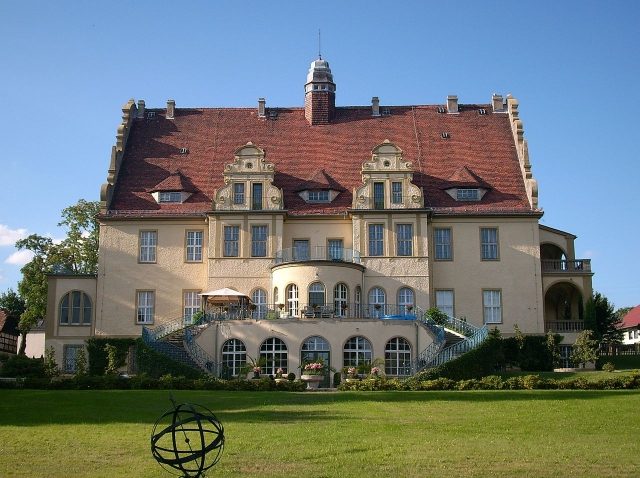
The dominant feature of the small village of Weißig, 10 kilometers north of Kamenz, is the castle located in its center. Its generous design and magnificent architecture attract the undivided attention of locals and tourists alike.
Weißig Castle was significantly influenced by the von Zehmen family. For over two centuries, the lineage, whose origins can be traced back to the 13th century, owned the estate. The ancestral home of this ancient Meissen nobility was in the village of Zehmen near Rötha in the Leipzig district.
However, many years before - since 1466 - Weißig is mentioned as a knight's seat of various noble families. The Weißig line of the noble family von Zehmen was initiated by the Royal Polish and Electoral Saxon Court, Justice, and Appeals Councillor Hanns Bastian von Zehmen when he acquired the Weißig manor from Carl von Ponickau in 1723. Hanns Bastian von Zehmen is considered the progenitor of the Upper Lusatian branch.
For many years, the owners of the Weißig manor lived in a simple, unadorned manor house covered with shingles. With increasing prosperity, however, the noble family also wanted to improve their living conditions. Thus, a stately castle was built northeast of the old manor house. The officer and estate owner Oskar Horst von Zehmen had the building constructed according to modern principles between 1907 and 1908, based on plans by the renowned architectural firm Lossow & Kühne from Dresden. At the same time, the builder did not want to forgo stately forms. Thus, stately Renaissance gables, designed after their 17th-century models, still adorn the three-story building today. The main portal bears the family crest with the initials of Otto Horst von Zehmen and the year of completion (1908=OHVZ). Two bay windows and a stepped terrace extension with a wide, sweeping grand staircase structure the main facade. Seventy rooms of various sizes and functions lie behind the arched windows. A large reception hall is included, as are dining, sleeping, study, and gentlemen's rooms. Valuable furniture, paintings, and hunting trophies were taken from the old manor house.
However, the joy over the stately possession could not last long. In 1912, the future heir Oskar Horst Ernst von Zehmen, Royal Saxon Lieutenant in the 2nd Jäger Battalion, was shot in a duel with a rival who seduced his wife. Thus, his son Georg von Zehmen took over the castle and manor after the death of his grandfather. But Georg also fell in the Second World War. His remains lie in a family crypt in the landscaped castle park. The neo-Gothic structure was built for Georg von Zehmen in 1844 and renovated in 1938. Above the entrance to the forecourt, two coats of arms commemorate Moritz Oskar von Zehmen, who died in 1899, and his second wife Thekla von Wolfersdorff.
After Georg von Zehmen's death, his wife Margot sold the castle for economic reasons to the "Reichsbund für Deutsche Jugendherbergen" (Reich Association for German Youth Hostels) in Berlin. Eventually, the castle became a military training camp for the Hitler Youth and later - in 1949 - the district children's home for orphaned children. When the home closed in 1993, the search for a new investor began. Finally, in 2005, the castle was transferred to the Dutch businessman Jan van Ede.
Take Mobile History with you
You are reading this text for free. Premium adds what matters on the road: descriptions read aloud, sites found through your camera, whole regions taken offline.
- Every description, including the ~17,700 Premium sites
- Audio guide: have descriptions read to you on location
- AR finder: see sites through your camera, with distance and bearing
- Unlimited saved sites
14 days free, then from €2.99 a month. Cancel anytime.
Source: Wikipedia · Licence: CC BY-SA 4.0 · Image: https://commons.wikimedia.org/wiki/File:Schloss_Wei%C3%9Fig_O%C3%9Fling_5.JPG
This description draws on the facts documented in the linked Wikipedia article; Wikipedia content is licensed under CC BY-SA 4.0. Wording and editing: Mobile History.
Location: 51.3510, 14.1216