To be privately owned
Wellenburg Castle

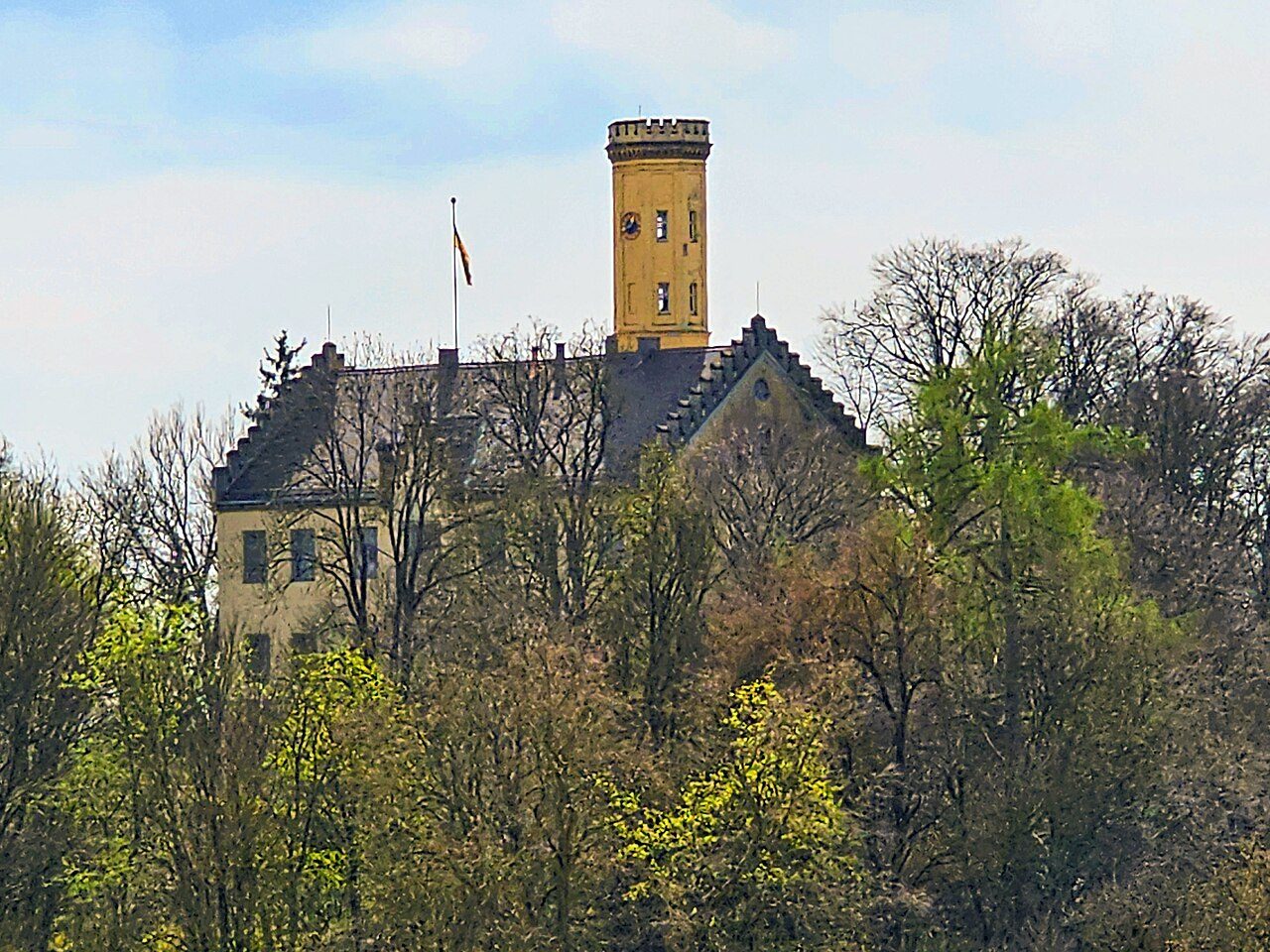
Wellenburg Castle, also known as Fugger Castle, situated on a wooded spur high above the Wertach valley, is a castle in the Augsburg-Bergheim district that has been redesigned in the Neo-Gothic style. It has been inhabited by the Fugger-Babenhausen family since 1595 and is not accessible to the public.
Wellenburg existed even before the 13th century. It was probably owned by the episcopal chamberlains of Wellenburg. St. Radegundis was once a dairymaid at the castle.
In 1507, the castle, which had been destroyed and rebuilt several times, passed through several Augsburg families – the Portner, Herwart, Langenmantel, and Onsorg – to the Augsburg patrician son and cathedral provost Matthäus Lang, who was granted the honorary title Edler von Wellenburg by Maximilian I and later, as Prince-Archbishop of Salzburg, the cardinalate by Pope Julius II. He had a pleasure palace built there by 1513, which he made available to the Emperor:
- In 1530, feasts and tournaments were held at Wellenburg in honor of Charles V. Probably on this occasion, a woodcut was created around 1536... with the earliest view of the castle, which at that time was a rectangular complex with a gabled roof, four corner towers, and a high stair tower, the substructure of which still exists today.
In 1595, Jakob Fugger III, owner of Babenhausen Castle, acquired Wellenburg Castle and the associated properties for 70,000 guilders and soon had the outer castle gate built by the Augsburg city architect Elias Holl. The castle chapel of St. George on the ground floor of the main wing and the stables were extended by the master builder Valerian Brenner, who came from the Bregenzerwald and resided in Günzburg. The esteemed Baroque master Hans Georg Mozart, great-granduncle of Wolfgang Amadeus Mozart, was also involved in later renovations.
In 1857/1858, Prince Leopold Fugger-Babenhausen had the castle rebuilt and extended in the Neo-Gothic style. Which master builder was responsible for this, Georg von Stengel or Georg Gollwitzer, has not yet been determined by research.
Historically interesting is the castle chapel of St. George, which, like the main wing of the castle, was built around 1513:
- It contains a rich number of medieval sculptures. Of particular note are a life-size figure of St. George from the end of the 15th century and a crucifix dating from the first half of the 14th century. The Neo-Gothic altar mensa shows a wooden relief from about 1520: Christ Carrying the Cross. A pair of altar wings with St. Sebastian was dated by Ernst Bucher between 1460 and 1470 and classified into the school of the 'Augsburg Master of the Ulrichs Legend'.
An approximately two-kilometer-long avenue of about 350 lime trees, laid out in 1840, leads from Göggingen to Wellenburg Castle.
Take Mobile History with you
You are reading this text for free. Premium adds what matters on the road: descriptions read aloud, sites found through your camera, whole regions taken offline.
- Every description, including the ~17,700 Premium sites
- Audio guide: have descriptions read to you on location
- AR finder: see sites through your camera, with distance and bearing
- Unlimited saved sites
14 days free, then from €2.99 a month. Cancel anytime.
Source: Wikipedia · Licence: CC BY-SA 4.0 · Image: File:Schloss Wellenburg 2.jpg: Ricardalovesmonuments derivative work: Georgfotoart / CC BY 4.0 via Wikimedia Commons
This description draws on the facts documented in the linked Wikipedia article; Wikipedia content is licensed under CC BY-SA 4.0. Wording and editing: Mobile History.
Location: 48.3329, 10.8269