CastleWendelstein

Wendelstein Castle

Wendelstein Castle

Nursing home

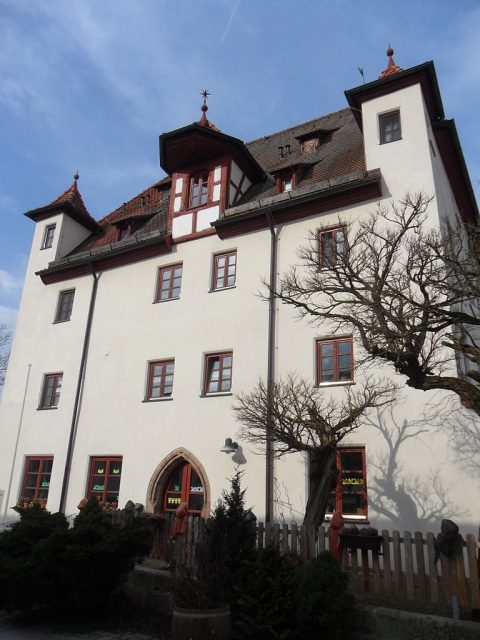
The Wendelstein Manor is commonly referred to as an estate whose representative appearance certainly corresponds to a manor house. It is said to have originated from the "free Amthof near the church in Wendelstein", which was mentioned in a 1427 feudal document by King Sigismund and went to the Nuremberg Heilig-Geist-Spital in 1467 with the sale of three-quarters of the judicial rights by Hans and Franz Ortolf. The hospital leased or bequeathed the court or buildings to individuals who were only occasionally identical with the respective Nuremberg judge.

An inscription in a window lintel is said to indicate a new construction of the judge's office building in 1545. Whether this happened on the site of the possibly partially integrated predecessor building does not seem to be clarified. However, the renewed Amthof was also given as a hereditary lease. In 1555, the Nuremberg citizen Augustin Fürnberger appears as the leaseholder. He was followed before 1562 by Dr. Melchior Ayrer, Nuremberg city and hospital doctor. The scholar, who died in 1579, became famous for an art cabinet and his astronomical and mathematical research. Further heirs from 1600 were Sebastian Müller, 1616 Caspar Plank and 1638 Franz Reuter. After the end of the 30 Years' War, the legal family Herold can be traced to the Amthof, last in 1729 Johann Michael Herold.

After the Heilig-Geist-Spital had bought back the hereditary right from the widow Herold, the building, which from then on was only used publicly, was changed around 1736 by extensive renovation. A dating on the west side commemorates this construction measure. In 1758, the court room on the first floor was converted into a gentlemen's hall for representative occasions and the court room was moved to the second floor. At that time, the official residence also housed the judge's apartment, various guest rooms and a room for the utensils of the bailiff, such as pillory equipment, foot and hand chains.

Only the Kingdom of Bavaria abolished the official residence and had the buildings privatized. Georg Andreas Ammon bought it at auction in 1809. The brewery established on the property in 1818 by Ammon's descendants, along with the main building, passed to the families Weiß and Lang, from whose ownership the brewery Lang & Maisel emerged. This was still in operation in the 1970s, with the judge's house most recently housing the brewery's offices. Then the Protestant church community acquired the former official residence and had it converted from 1987 to 1989 for a diaconal station with short-term care places. The judge's office building is a three-story, plastered solid building, characterized by the hipped roof and the two gable turrets as well as a dormer on the south side. This roof landscape gives the building the appearance of an early modern Nuremberg manor house. Whether the stucco ceilings and furnishings still present in 1970 completely survived the modernizations is doubtful.

Take Mobile History with you

You are reading this text for free. Premium adds what matters on the road: descriptions read aloud, sites found through your camera, whole regions taken offline.

  • Every description, including the ~17,700 Premium sites
  • Audio guide: have descriptions read to you on location
  • AR finder: see sites through your camera, with distance and bearing
  • Unlimited saved sites

14 days free, then from €2.99 a month. Cancel anytime.

Source: Wikipedia · Licence: CC BY-SA 4.0 · Image: http://commons.wikimedia.org/wiki/File:Schl%C3%B6sschen_Wendelstein_02.JPG

This description draws on the facts documented in the linked Wikipedia article; Wikipedia content is licensed under CC BY-SA 4.0. Wording and editing: Mobile History.

Location: 49.3558, 11.1449