CastleLehre - Wendhausen

Wendhausen Castle
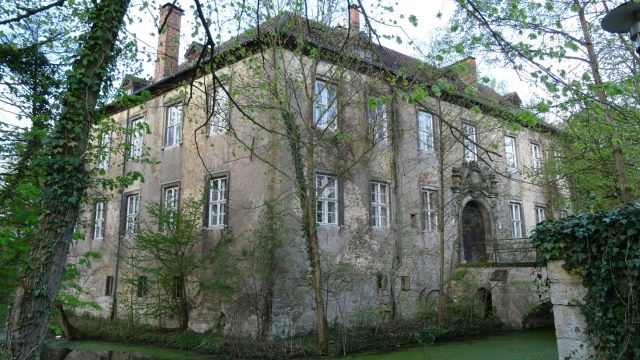
Wendhausen Castle

Offices
Apartments


Wendhausen Castle is a moated castle in the Lehrte district of Wendhausen in eastern Lower Saxony, not far from Braunschweig. The castle was built in 1688 by Philipp Ludwig Probst, Chancellor of the Duchy of Braunschweig-Wolfenbüttel, on the foundations of a 14th-century moated castle. A significant Baroque garden was added to the three-wing complex during the 18th century.

Predecessor Complex+

The predecessor of the castle complex was a castle first mentioned in 1328. Its location suggests it was a moated castle. It belonged to a chain of lowland castles along the Schunter, such as Süpplingenburg, Campen near Flechtorf, Hondelage, which used the swampy lowlands of the river for protection. Wendhausen Castle and village were located 10 km northeast of Braunschweig city center on a 400 m wide and 2 km long island in the Schunter lowlands. This was an isolated location, as the Braunschweig-Fallersleben military road (today's B 248) ran 1 km further south. Initially, Wendhausen Castle served as a pledge and feudal object to fill the ducal war chest. Over the centuries, it was destroyed several times. In 1552, the troops of the mercenary leader Vollrad von Mansfeld burned it down. Another destruction occurred in the 17th century when Duke Heinrich Julius resided there outside the city gates of Braunschweig. After disputes between him and the city of Braunschweig, his opponents burned down the castle in 1602. The current moated castle was built on its foundations between 1683 and 1688.

Architectural Description+

Building Structure

Wendhausen Moated Castle is an irregular three-wing complex, open to the west. It features two massive stone floors supported by mighty cellar vaults. The outer walls have a thickness of 1.4 m in the lower section. The building has 28 rooms with approximately 800 m² of floor space. The interior, including stucco-decorated ceilings, paneling, fireplaces, and Renaissance rooms, is now of high quality again. The rooms on the upper floor of the south wing are referred to as the Duke's Room and Duke's Hall because the Dukes of Braunschweig stayed here during their visits.

Surroundings and Access

A wide moat, fed by the nearby Schunter, runs around the castle. The castle has water rights and requires a certain water level, as it is founded on wooden piles. Access and entry to the castle are provided by a stone bridge over the current castle moat and former castle ditch. It crosses towards the north wing. Additionally, there is now a pedestrian bridge from the castle courtyard to the former castle park. The stone bridge leads to a large gate in the castle facade, adorned with a magnificent round arch portal. Through the several-meter-high archway in the north wing, one enters the approximately 500 m² castle courtyard, where the castle entrance is located. It leads into the main building, in whose round staircase there is a massive oak staircase from 1910. The staircase was originally a tall round tower, the upper part of which was demolished in 1865.

17th Century

The predecessor castle had been destroyed since 1602. The Wendhausen estate at this location was first mentioned in 1677. In 1682, Philipp Ludwig Probst (1633-1718), who served the Dukes Rudolf August and Anton Ulrich of Braunschweig, received the estate as a fiefdom in remuneration for his services. In 1683, Emperor Leopold elevated the feudal tenant to the imperial nobility, who was then allowed to call himself "von Wendhausen." As Chancellor, he was one of the most influential statesmen of the Duchy of Braunschweig-Wolfenbüttel. He was also its wealthiest private citizen, owning other knightly estates in addition to Wendhausen. From 1683, Philipp Ludwig Probst had the moated castle built on the foundations of the predecessor castle, which was completed after five years of construction. Later, he celebrated lavish parties there. In the magnificent Duke's Hall, he received, among others, the Dukes Rudolf August and Anton Ulrich of Braunschweig. Probst von Wendhausen spent his twilight years at the castle.

18th Century

After his death in 1718, his granddaughter Ilsa Louise Stisser, widowed von Imhoff, inherited the castle. In 1719, she married Konrad Detlev von Dehn, a favorite and upstart of Hereditary Prince August Wilhelm. Later, the ennobled Dehn, in his functions as privy and state councilor, was the most powerful man at the ducal court. After a short marriage, his wife died in childbed, and he inherited the castle. Dehn had major alterations made, as he was keen on representation. This included, above all, the creation of the baroque pleasure garden (see castle park below) and the construction of 2 two-story cavalier houses in half-timbered style, which were soon demolished again. He led a courtly life on the estate, although he was rarely present, as he belonged to the Duke's court society. Dehn's extravagant and costly life, as well as a change of government, abruptly ended his career in 1730. He had to leave the country and went to the Danish court. In 1751, the castle came into the possession of Duke Karl I. Thereafter, the building served as a residence for the respective tenant of the estate. As the Duchy of Braunschweig-Wolfenbüttel was heavily indebted, the castle and estate gradually fell into disrepair.

19th Century

From 1751 to 1807, the castle was the seat of the princely court. From 1807, under French foreign rule by Napoleon, the court of the canton of Wendhausen met in the castle. This organizational form was abolished again after the French occupation in 1814, and the castle came into the possession of the ducal domain chamber. From 1836, the Braunschweig publishing family Vieweg leased the estate and castle. In 1873, they acquired both. Karl Vieweg was a successful farmer and horse breeder on the estate. Eduard Vieweg had a five-winged Dutch windmill built on a hill in the village, which is now the landmark of the place. The Vieweg family built a paper factory for book production for their Vieweg Verlag in Wendhausen on the Schunter. From 1910, major changes occurred inside the castle, where the rooms were prepared as exhibition spaces. The publishing owner Helene Tepelmann, née Vieweg, exhibited the family art collection in the castle until World War II.

20th Century

After the death of the last heiress of the Vieweg family, Helene Tepelmann, in 1941, the castle was sold to the city of Braunschweig. Towards the end of the war, a makeshift hospital was set up there in 1944-45. After the war, it served as a convalescent home for patients with infectious diseases and later as a kindergarten. For years after the war, displaced persons from the German eastern territories also lived in the castle. After various other uses, it was used by the Braunschweig local group of the Subud Germany organization, an interreligious brotherhood. An agricultural business also used the castle, but from 1985 it stood empty. In 1990, the estate and castle were sold to investors Carsten Oestmann and Baron Dietrich von Dobeneck. They divided the large complex into three main areas consisting of the castle with the garden area located within the castle moat, the farm complex with barn and servants' quarters, and the adjacent lands. Numerous alterations and new buildings were erected on the farm complex, which were later marketed, resulting in the creation of residential buildings as well as a retirement and nursing home in the area of the former estate. The castle building was acquired in 1991 by the Braunschweig architect Carsten Henze and renovated between 1992 and 1995. For this, the Lower Saxony Savings Bank Foundation awarded the State Prize for Monument Preservation in 1995. Nevertheless, the castle appears unrenovated from the outside. This is because the builder deliberately left rubble masonry and plastered surfaces on the outer facade to give the old castle a lively, morbid character. Since 2003, the castle building has been used by various creative companies (architecture, advertising, software development) and as living space. Some representative rooms, such as the former Duke's Room, the Duke's Hall, and the cellar vault, as well as the outdoor facilities, can be rented for events.

Castle Park+

Already after the completion of the castle in 1688, the builder Philipp Ludwig Probst von Wendhausen had a small pleasure garden laid out west of the estate, which is no longer preserved today. When Detlef von Dehn took over his inheritance as castle owner in 1719, he had a larger Baroque garden in the French style laid out west of the castle. The rectangular complex, oriented towards the castle, was surrounded by a 1,800 m long moat. The landscape architect Le Notre was hired for the garden design. Individual elements of the park are reminiscent of the garden of Sanssouci Palace, which Le Notre had also designed. In Wendhausen, he had avenues, hedges, bosquet areas, ponds, and a central fountain created and equipped the garden with numerous statues. According to a description from 1727, the complex resembled the Baroque gardens of Salzdahlum Palace and Herrenhausen. At the beginning of the 19th century, the Baroque garden was removed, as it no longer served a representative role. It was transformed into an agricultural area with meadows, an orchard, and garden land. At the end of the 19th century, the cultivated land was partially redesigned. The eastern part of the garden, close to the castle, became a landscape park, while the western area remained cultivated land. Today, the areas appear overgrown. They consist of an open space and a forest stand with partly exotic trees, but also with old native trees, such as oaks, beeches, poplars, lindens, black locusts, and chestnuts.

Take Mobile History with you

You are reading this text for free. Premium adds what matters on the road: descriptions read aloud, sites found through your camera, whole regions taken offline.

  • Every description, including the ~17,700 Premium sites
  • Audio guide: have descriptions read to you on location
  • AR finder: see sites through your camera, with distance and bearing
  • Unlimited saved sites

14 days free, then from €2.99 a month. Cancel anytime.

Source: Wikipedia · Licence: CC BY-SA 4.0 · Image: Jörg Heldt

This description draws on the facts documented in the linked Wikipedia article; Wikipedia content is licensed under CC BY-SA 4.0. Wording and editing: Mobile History.

Location: 52.3193, 10.6329