Hotel
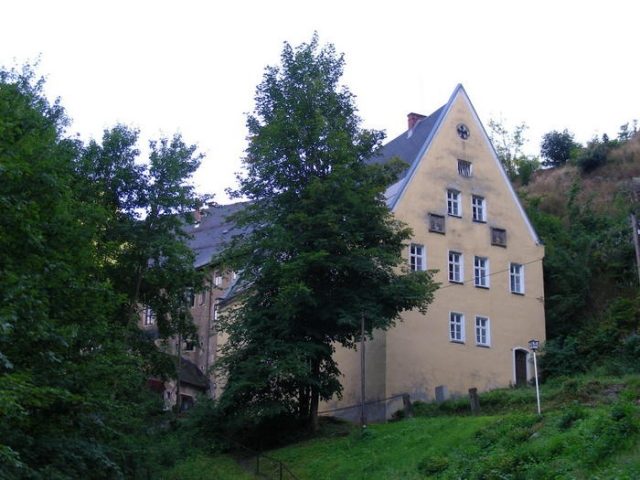
Wespenstein Castle

Wespenstein Castle is located in the town of Gräfenthal in Thuringia, directly on the border with Bavaria. It secured the pass section of a medieval military and trade route from Leipzig via Saalfeld to Nuremberg over the ridge of the Thuringian Slate Mountains and thus had strategic importance.
Built around 1250 by the Counts of Orlamünde, presumably on the site of an old Ludowingian manor house, as a toll house, it was first mentioned in a document in 1337 as Hus Greventhal. The Counts of Orlamünde first enfeoffed the Lords of Gräfendorf with it, but eventually used the castle themselves as a residence in the southern Orlagau, alongside their castle Lauenstein, as they gradually lost their ancestral lands in the Orlagau to the Wettins. Otto XI. of Weimar-Orlamünde-Gräfenthal came into possession of the castle after an inheritance division in 1414 and lived here until 1424. In 1426, he sold the castle to Duke Frederick I of Saxony, after his father Otto X. of Weimar-Orlamünde-Lauenstein had already offered it as a fief to the Wettins in 1394, along with all associated towns and rights, due to increasing economic decline, and spent the rest of his life on the Motte Lichtentanne and on the property of his deceased wife at Beichlingen Castle.
In 1438, the Imperial Hereditary Marshals of Pappenheim acquired the castle and the lordship. The first owner and founder of the Gräfenthal line was Conrad von Pappenheim. Sebastian von Pappenheim, married to Ursula von Wallenrod, extensively expanded the residence from 1517 to 1541. In the now stately castle, he received Martin Luther and the Saxon Elector Johann in 1530, and Emperor Charles V and Duke Alba in 1547. Joachim von Pappenheim died here in 1575; his tombstone is preserved in the town church of St. Marien. On December 19, 1599, the last member of the Gräfenthal hereditary line, Imperial Marshal Christoff Ullrich von Pappenheim, died here.
From 1612, Philipp von Pappenheim from the Rothenstein line, together with his nephew Maximilian, held the lordship of Gräfenthal. With Philipp's death in 1619, it fell entirely back to Maximilian von Pappenheim. He sold the lordship due to debt in 1621 for 130,000 guilders to the House of Wettin, which still held the feudal sovereignty acquired from the Orlamündes.
After 1621, the castle was the residence of the Dukes of Saxe-Altenburg and the seat of a ducal-Saxon bailiff and castellan. In 1679, it came into the possession of the Duchy of Saxe-Gotha, in 1680 of the Duchy of Saxe-Saalfeld, and from 1735, Saxe-Coburg-Saalfeld. In 1686, it largely burned down and was only partially rebuilt. From 1826, the castle served as a district court for the Duchy of Saxe-Meiningen. From 1826 to 1829, the official residence received its current appearance. In 1920, the castle became the property of the state of Thuringia.
Condition of Preservation+
Today, the castle houses a restaurant with a large beer garden and a castle guesthouse and has been privately owned since 1993. The expansion into a museum castle is planned.
Among other things, the castle chapel, where Martin Luther preached, has been preserved. It has been renovated and can be used for weddings and church services. The administrative building, the dungeon, and a cistern have been preserved, and damaged roof parts repaired. The surrounding walls in the area of the former main entrance and on the east side are largely dilapidated. In the building sections at the stair tower and around the bailiff's garden, rooms are completely buried, their location and purpose partly unknown. The remaining walls are gradually being secured, the buried rooms and vaults are being uncovered by clearing debris and documented through excavations. Wall breaches could be filled, and archways, stair landings, and lintels uncovered and rebuilt. The Pappenheim coat of arms above the former main gate (presumably 1541) is being conserved.
Take Mobile History with you
You are reading this text for free. Premium adds what matters on the road: descriptions read aloud, sites found through your camera, whole regions taken offline.
- Every description, including the ~17,700 Premium sites
- Audio guide: have descriptions read to you on location
- AR finder: see sites through your camera, with distance and bearing
- Unlimited saved sites
14 days free, then from €2.99 a month. Cancel anytime.
Source: Wikipedia · Licence: CC BY-SA 4.0 · Image: http://www.wehrbauten.de/thread.php?threadid=638
This description draws on the facts documented in the linked Wikipedia article; Wikipedia content is licensed under CC BY-SA 4.0. Wording and editing: Mobile History.
Location: 50.5265, 11.3026