Hotel
Wetzelstein Castle

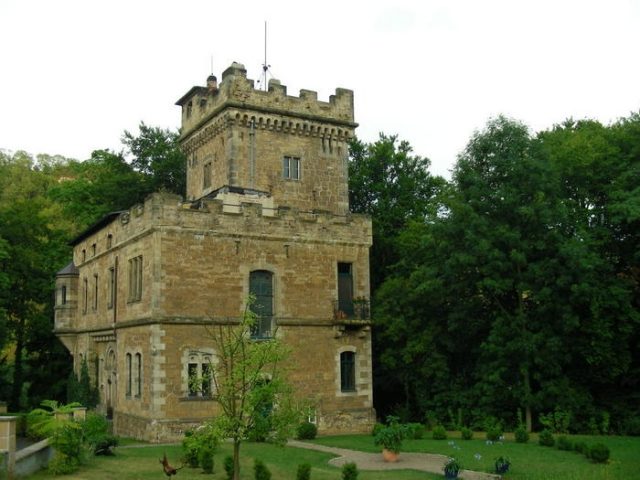
Wetzelstein is a castle-like building in Saalfeld, Thuringia.
An alum works was opened in the Saale valley as early as 1544. In 1546, an alum smelter at Wetzelstein was described by Georgius Agricola. According to Hieronymus Völker, these Fregian alum and vitriol works were in the immediate vicinity of Wetzelstein. This alum smelter changed hands several times until it was acquired in 1760 by the prominent Leipzig banker and merchant Christian Gottlob Frege, the progenitor of one of the wealthiest banking families of the time. The Frege family continued to operate the business only until 1850, because after 1850, chemical extraction methods gradually replaced alum shale as a source for alums. The mining facilities subsequently fell into disrepair. In 1874, Dr. Richard Woldemar Frege, manor owner and professor at the Faculty of Law in Leipzig and great-grandson of the progenitor Christian Gottlob Frege, acquired an older estate at Wetzelstein. Here, on the steep bank of the Saale, opposite the so-called Bohlenwand (today a nature reserve) in the Obernitz district, he had a small castle built in the Neo-Romanesque style from massive sandstone and quarry stone blocks by Constantin Lipsius between 1878 and 1880. In 1913, he bequeathed it, including the property, to his newly founded foundation, which was based in Abtnaundorf (Leipzig). The mining properties were granted to his son Dr. Arnold Woldemar von Frege-Weltzien on March 29, 1916, and sold by him to his father's foundation for 5,000 Marks on August 26, 1916. In 1919, the sale of the property was decided. It consisted of a six-story tower with a staircase. Inside were a dining room, four stately rooms with rich furnishings, five attic rooms, a wooden veranda with a galvanized floor, and other staff rooms, a toilet, kitchen, laundry room, and vaulted cellar rooms. Asphalt roofs covered the two side wings and the central building. They contained bedrooms, a library, a cloakroom, a bathroom, and a toilet. Outbuildings included: a single-story stable building made of stone half-timbering, a wooden stable building, an ice house, and a garden house. In addition, there was a heated greenhouse with an 11.5 m high chimney and a glazed front. Wetzelstein was embedded in a remarkable stock of trees and parkland and also had extensive lands, arable land, agricultural areas, meadows, woodlands, and pastures; a total of about 3.8 ha.
The Frege family used Wetzelstein Castle as a summer residence until its sale in 1921. During three years of purchase negotiations at the Lipsius House in Leipzig with a law firm staffed by Senior Justice Councilor Dr. Lohse, Justice Councilor Dr. C. Junck, and Justice Councilor Dr. O. Verges, the Bad Blankenburg real estate agent E. Macheleid was commissioned to find an interested party in Saalfeld. Macheleid was aware of the situation of the "MAUXION" chocolate factory, founded in 1855 and immediately adjacent to Wetzelstein, into which the merchant Ernst Hüther had entered in 1911 as a managing partner with considerable financial resources. Hüther had completed his commercial apprenticeship at the Berger chocolate factory in Pößneck and subsequently gained expertise as an employee of various companies in the confectionery industry. With this prior knowledge, after six years of working at MAUXION, he was able to take over the company when the former co-owners, the Mauxion brothers, retired. Other interested parties had also shown interest in purchasing Wetzelstein, including: a Baron von Helldorf, a Countess Erbach-Erbach, a Major Freiherr von Rapport, and a Baron Freiherr von der March. After sluggish negotiations, Hüther initially offered to settle for a lease and rental agreement during the transitional period until a valid purchase contract, in order to provide the Frege Foundation with urgently needed funds. However, Hüther could not agree to a rental agreement then presented by the foundation. Nevertheless, negotiations continued throughout 1920 and 1921, focusing on the purchase price and the taxes to be paid. Finally, on December 8, 1921, a purchase contract was signed.
On February 23, 1922, Ernst Hüther, as the new owner, transferred the purchase price of 600,000 Marks to the Saalfeld branch of the Bank für Thüringen. Since 1922, several families have lived in the castle after various alterations were carried out to create living space. Hüther also intended to set up apartments for civil servants and employees here; he had already set up several emergency apartments in the garden house.
In 2000, the property was acquired by a private investor and developed and furnished as a residence and upscale hotel until 2011. During these ten years, the castle was completely renovated and faithfully restored.
The small castle stands amidst a park. The grotto located within it bears witness to the former alum shale mining in Saalfeld.
Take Mobile History with you
You are reading this text for free. Premium adds what matters on the road: descriptions read aloud, sites found through your camera, whole regions taken offline.
- Every description, including the ~17,700 Premium sites
- Audio guide: have descriptions read to you on location
- AR finder: see sites through your camera, with distance and bearing
- Unlimited saved sites
14 days free, then from €2.99 a month. Cancel anytime.
Source: Wikipedia · Licence: CC BY-SA 4.0 · Image: http://www.wehrbauten.de/thread.php?threadid=638
This description draws on the facts documented in the linked Wikipedia article; Wikipedia content is licensed under CC BY-SA 4.0. Wording and editing: Mobile History.
Location: 50.6302, 11.3791