To be privately owned
Weyer Castle

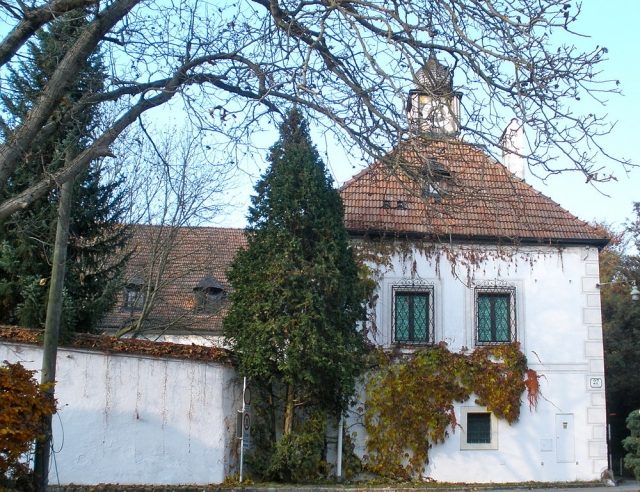
Weyer Castle is located in the district of the same name in Gmunden on Lake Traunsee in Upper Austria (Carl Josef von Frey Gasse 27).
The Weyer estate is first mentioned in 1446 as a fief of the Ort dominion. The small castle was built in 1596 by the then feoffee Abraham von Rohrbach, who had previously acquired the farm "am Weyer" from Hektor Jagenreuter. Maximilian Hackelberger von Höhenberg und Arbesbach bought the free seat in 1606 and had it administered from Mühlwang. The next owners in 1613 were the Gmunden citizen Leopold Pötsch and his wife Margaretha; the latter sold the small castle after her husband's death to Sebastian Süß. The next buyer was Hans Chrauser. In 1621, the property passed to forest master Hans Christoph Rottner. In 1624, he was able to regain the noble freedoms from Emperor Ferdinand II, which had been lost due to the sale to bourgeois owners. In 1627, Rottner had to sell his property to the Bavarian Count Adam von Herberstorff, who gave the small castle to Hans Christian Schmitzberger († 1637) as compensation "for his 20 years of loyal service". After the death of Hans Christian, who remained without descendants, his widow sold Weyer in 1651 to Dr. jur. Georg Scharl, Comes Palatinus. He already sold the entire property in 1653 to Johann Adam Spindler von Hofegg zu Waldbach († 1686). Spindler's daughter Beatrix was married to Christoph Benedikt Hayden von Dorff auf Lindach, and Weyer came to her after her father's death. Hayden married Eleonora Hegenmüller von Dubenweiler after the death of his first wife (1707) (the alliance coat of arms of both is affixed above the sacristy door of the castle chapel). In 1722, the small castle was sold to the Counts of Saalburg, in 1723 to Josef Ortner, but in 1724 repurchased by Carl Josef von Frey, son-in-law of Christoph Benedikt von Hayden. In 1738, an orphanage for boys was established here (hence the name "Woaslhaus" for Weyer), which was handed over to the chief salt office in 1755. The estate was added to Lindach.
Between 1850 and 1870, Weyer Castle was owned, among others, by John Armstrong, Esq. and his family, followed by a Knight von Cerny. Subsequently, the elementary school was housed in the small castle until the coppersmith August Hönig, son of the dialect poet Franz Hönig, acquired it. From 1981, a fundamental renovation of the small castle was initiated. The current owner is Mr. Kommerzialrat Otto Schober.
Weyer Castle Today+
The castle is a two-story, L-shaped castle complex from the 16th century, enclosed by a wall, with a freestanding baroque chapel of Our Lady. The chapel was originally (1631) dedicated to Saint Benedict; in 1710, it was re-consecrated. It has a barrel vault with lunettes; the acanthus tendril altar dates from 1696. The building consists of a longer south wing and a short east wing, and a wall that also encloses the chapel. In the courtyard there is an old well. On the east wing are sgraffiti that refer to the former owners of Weyer. In the south wing is a small hall from the 17th century with a stucco ceiling.
The castle is privately owned. The owners currently use it, among other things, as a gallery for Meissen porcelain and silverware.
Take Mobile History with you
You are reading this text for free. Premium adds what matters on the road: descriptions read aloud, sites found through your camera, whole regions taken offline.
- Every description, including the ~17,700 Premium sites
- Audio guide: have descriptions read to you on location
- AR finder: see sites through your camera, with distance and bearing
- Unlimited saved sites
14 days free, then from €2.99 a month. Cancel anytime.
Source: Wikipedia · Licence: CC BY-SA 4.0 · Image: http://commons.wikimedia.org/wiki/File:Schloss_Weyer_Gmunden.JPG
This description draws on the facts documented in the linked Wikipedia article; Wikipedia content is licensed under CC BY-SA 4.0. Wording and editing: Mobile History.
Location: 47.9144, 13.8117