CastleFrohnleiten-Rothleiten

Weyer Castle
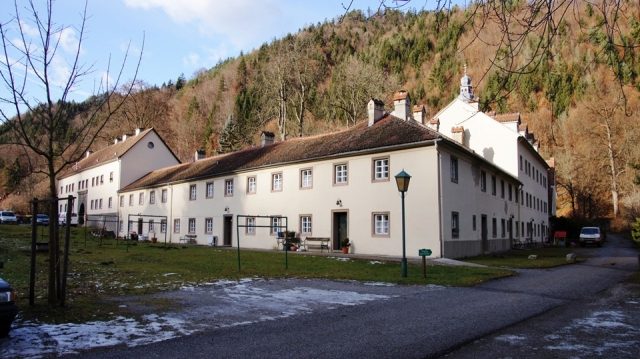
Weyer Castle

Nursing home

Weyer Castle is a castle located in Rothleiten in the municipality of Frohnleiten in Styria. Its history dates back to the 13th century. The current appearance of the castle dates from the 16th and 18th centuries. Today it serves as a retirement home.

The castle is located in the cadastral community of Rothleiten, which belongs to the municipality of Frohnleiten. It is situated near the confluence of the Gamsgraben with the Mur Valley. There, it was formerly intended to protect the road from Frohnleiten to Göss, the so-called Diebsweg (Deubsweg).

Originally owned by the Eppensteiners, the first fortress was built at the beginning of the 13th century by the Rabensteiners, a family of ministeriales of the Eppensteiners. In the middle of the 13th century, the next owners, the Counts of Pfannberg, had this fortress expanded into a moated castle. Around 1400, Weichhardt von Weyer is mentioned as a ministerialis on the estate. After the extinction of the Pfannbergers, the estate came into the possession of the Counts of Cilli and in 1373 into that of the Counts of Montfort. In 1375, the estate was granted as a fief to Gebhard von Waldstein (Weyer). The feudal possession changed several times in the following years, before the estate was divided between the Eibiswalders and the Ratmannsdorfers after 1451. Christof von Ratmannsdorf wanted to create a new family seat on the estate and therefore bought several estates in the area in 1489 and acquired the second part of the estate from Sigmund von Eibiswald in 1502. In 1560, the Protestant Wilhelm von Ratmannsdorf took over the castle and largely gave it its present appearance.

Until 1647, the estate was owned by the Ratmannsdorfers, before the widow of Georg Wilhelm von Ratmannsdorf brought it into her second marriage with Ferdinand Ernst Graf Herberstein. In 1659, Sebastian Hayd zu Haydegg bought it and transformed it into a fideicommissum. Until 1822, the castle was owned by the Haydegg family. They carried out repeated alterations and redecorated the castle chapel in 1750. In 1822, it was acquired by Prince Nikolaus Esterhazy at a forced auction. It was merged with the Pfannberg dominion. Since 1872, it has been owned by the Mayr-Melnhof family, who had the castle restored and established a retirement home for their employees.

Description+

The castle was originally a moated castle built in the 13th century. It was rebuilt several times in the 16th and 17th centuries. Parts of the moat are preserved on the north and east sides of the castle. Today, the castle is a three-story, hook-shaped building with three-story arcaded walkways on the courtyard side. The courtyard is enclosed by a narrow, baroque onion dome with a lantern. The facade of the eastern wing is flanked by two polygonal, tower-like projections and is designed in sgraffito technique. A low gatehouse leads to the castle chapel, which houses a 14th-century crucifix. The original altar was transferred to Neu-Pfannberg Castle. Inside the building is an octagonal hall from the year 1590.

Take Mobile History with you

You are reading this text for free. Premium adds what matters on the road: descriptions read aloud, sites found through your camera, whole regions taken offline.

  • Every description, including the ~17,700 Premium sites
  • Audio guide: have descriptions read to you on location
  • AR finder: see sites through your camera, with distance and bearing
  • Unlimited saved sites

14 days free, then from €2.99 a month. Cancel anytime.

Source: Wikipedia · Licence: CC BY-SA 4.0 · Image: http://www.wehrbauten.at

This description draws on the facts documented in the linked Wikipedia article; Wikipedia content is licensed under CC BY-SA 4.0. Wording and editing: Mobile History.

Location: 47.2802, 15.3026