Cultural Events
Museum
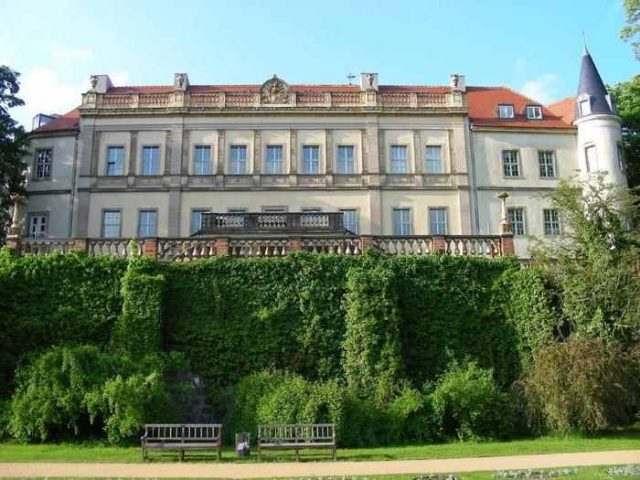
Wiesenburg Castle

Wiesenburg Castle is located south of the town center of Wiesenburg in the federal state of Brandenburg, Potsdam-Mittelmark district, on the edge of the Brandtsheide in the High Fläming Nature Park. The associated castle park extends between the castle and Wiesenburg train station.
The history of Wiesenburg Castle dates back to the 12th century. Its first documented mention as a castle ward is found in a letter from Bishop Willmar of Brandenburg to Provost Vigbert from the year 1161. After frequent changes of ownership, in 1456 Friedrich Brand von Lindau was enfeoffed with the castle and the "small town" of Wiesenburg by the Saxon Elector Friedrich II. This also included the villages of Jeserig, Reetz, Schlamau and some localities that later became desolate. Before the Thirty Years' War (1618-1648), the Saxon Elector Johann Georg I, who often stayed in Wiesenburg for hunting, intended to buy the extensive forests of the Brandtsheide from Benno Friedrich Brand von Lindau, who called himself "the Rich". Benno demanded an egg for every tree as the purchase price. This was unaffordable even for the Elector. It took many decades for the Brandtsheide and Wiesenburg to recover from the devastation of the war. In the 18th century, the royal Saxon chamberlain, appellate councilor and court judge in Wittenberg and tax collector of the Electorate, Adam Friedrich August von Watzdorf (1753-1809), was the owner of the castle. After the castle had been partially rebuilt, a thorough restoration took place in 1864. In 1945, the owners were forcibly expropriated and expelled by the communists.
After the Second World War, the castle was used as a school with a focus on Russian and an integrated boarding school ("Erich-Weinert-Oberschule"). The school closed in 1992. In 1996, a private investor acquired the castle and renovated the castle complex from the ground up in the following years. The renovation work was completed in the spring of 2003, so that today the exterior facades have been restored to their late 19th-century design. Modern apartments have been created inside the castle.
The entrance gate with the local history room and the 48-meter-high castle tower are publicly accessible, while the other areas of the castle are private property and generally not publicly accessible. The castle courtyard and the garden hall are opened for events.
Wiesenburg Castle Park Landscape Protection Area+
Wiesenburg Castle Park, with its rich stock of foreign woody plants, has been declared a landscape protection area. It was laid out around the middle of the 19th century. Until then, the area had served the count's owners mainly as a game reserve (pheasantry). Forester Gebbers was the actual creator of the park grounds. He gave it its current appearance through extensive plantings, especially of conifers from Western Europe, America, Japan, and China. The cultivation of the fast-growing Douglas fir in closed stands is particularly noteworthy. This conifer species, introduced from North America in the middle of the last century, was initially planted only as single stems, and in the rarest cases as groups, after some unsuccessful cultivation attempts in Schleswig-Holstein.
The fir is most numerous with hemlock, spear, giant, and Sitka fir. It is followed by spruce with dwarf, dwarf-tail, tiger-tail, and blue spruce. A variety of cypress and cedar species, various magnolias, and large areas of azaleas convey exotic impressions. In addition to golden and Turkey oaks, the rare Ginkgo biloba grows here. The rhododendrons have developed into a dendrological specialty. They cover large areas in the southern part of the park as undergrowth in oak and beech stands. At the edge of the tree population are giant trees over 400 years old and with a circumference of more than 5 meters. These old beeches and oaks are far surpassed in circumference and height by a black poplar and a Canadian poplar – both about 125 years old. They reveal the poplar as a fast-growing tree species.
A staircase, whose walls are overgrown with wisteria, leads over the main terrace of the castle to the altana. Beautiful figural groups and richly decorated vases by the Berlin sculptor Alexander Calandrelli (1834-1903) arouse the visitor's interest. These works are made of majolica (glazed clay with colored shards). The large silver lime tree in the eastern part of the main terrace shades an Italian pergola with three wall reliefs depicting spring, summer (grain harvest), and autumn (grape harvest). Stone mythical creatures form supports for the benches. Past the round corner tower, along the large balustrade of the main terrace, the path leads to the west side.
The castle was built on a hill that formerly sloped in steps into the park and ended in a wide, brick-lined castle moat. Since it turned out that the narrow slope did not provide enough support for the castle, especially its foundations, the moat was filled in 1864 for reinforcement, and masonry supported by strong buttresses was erected in front of the castle. The space between the masonry and the castle was filled with sand and earth. This created the current terrace. From there, one reaches a semicircular square. It is bordered by artificial groups of Nordic boulders and tufa stones, which come from the area of Bad Kösen. To the left of the semicircle are some grottoes made of fieldstones. Past the spacious flowerbeds, the path leads to the castle pond, where swans, Chinese knob-billed geese, and Turkish high-flying ducks attract the visitor's interest.
Take Mobile History with you
You are reading this text for free. Premium adds what matters on the road: descriptions read aloud, sites found through your camera, whole regions taken offline.
- Every description, including the ~17,700 Premium sites
- Audio guide: have descriptions read to you on location
- AR finder: see sites through your camera, with distance and bearing
- Unlimited saved sites
14 days free, then from €2.99 a month. Cancel anytime.
Source: Wikipedia · Licence: CC BY-SA 4.0 · Image: http://www.wehrbauten.de
This description draws on the facts documented in the linked Wikipedia article; Wikipedia content is licensed under CC BY-SA 4.0. Wording and editing: Mobile History.
Location: 52.1128, 12.4524