Gallery
Wiespach Castle

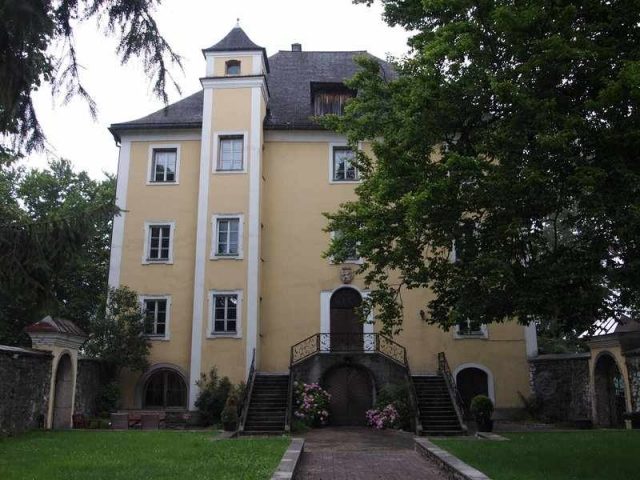
Wiespach Castle is a castle in Neualm, a district of Hallein, in the state of Salzburg.
The building is a lowland castle dating back to the High Middle Ages. The Gothic predecessor, a fortified tower, was probably built around 1300 as the seat of the Lords of Wiespach. In the 15th century, it was rebuilt or newly constructed by Georg Kölderer. After 1600, under Marx von Gils, the building received its current early Baroque facade.
The building is two-story, laid out in a square plan, with a high hipped pyramid roof, an off-center projecting turret next to the main portal with a two-winged, two-flight open staircase with half-landings, and a second turret at the rear.
Inside, there are halls with barrel vaults with lunettes, the antechamber also with groin vaults on central conglomerate pillars, and stucco ceilings on the upper floors.
On the ground floor of the main building, in a corner position, there is a castle chapel, dated to 1607, and executed as a 2-bay barrel vault with lunettes and transverse arches. The wall shows a renovation from the late 18th century, with double pilaster articulation and a single-story gallery. The altar structure is Late Baroque (1st half of the 18th century), the main panel depicts the Blood of Christ, the upper painting a St. Dionysius, by an unknown hand.
The Lords of Wiespach, Wißbach or Wispeck, a knightly family, are first documented in 1167 with a Hainricus de Wispach, and traceable until the 1370s. Initially simple ministerials, they rose to become one of the most important noble families in the Salzburg region as hereditary chamberlains of the Archdiocese of Salzburg. The family died out in the second half of the 16th century. The castle is first mentioned in a document in 1434, but is significantly older.
In 1434, the lordship – Georg von Wispeck had moved to Velberg Castle – passed as a fief to a Veit Aschacher, and in 1476 was handed over to the Pongau mine owner Georg Kölderer von Hoch. Paul Rettinger von Wiespach and Radeck, princely archbishop's personal physician, presumably from Nördlingen, took over the castle in 1555, followed by his son, Martin Herkules Rettinger von Wiespach, later Prince-Bishop of Lavant, then his daughter Benigna Rettinger. In 1570, the Salzburg city judge Stephan Frankmann von Ochsenfeld is found at the seat, in 1601 his stepson Marx von Gils, archbishop's kitchen master and administrator of Glanegg, who gave the castle its current appearance. Johann Christof Pauernfeind von Eyß bought the Wiespach estate in 1647, in 1660 it passed into the possession of the Staudacher von Wispach, namely his son-in-law Baltasar († April 18, 1684), Salzburg court chancellor 1681–1684?, and his brothers Elias and Franz Staudacher von Wispach. Paris Ignaz, a grandson of Franz, sold it in 1760 to Leopold Graf von Pranckh, who in 1768 sold it to Franz Friedrich Freiherr von Negri. In 1816, the castle was auctioned. In 1878, Daniel Graf Esterhazy acquired the property, in 1926 the Steinbacher family.
In 1958, the house became the property of the municipality of Hallein, which built a swimming pool next door and operated a youth hostel with the Youth and Family Guest Houses association until 2006. In 2010, it was taken over by the couple Gabriela and Claus Spruzina, president of the Salzburg Chamber of Notaries, with plans to establish a "House of Art" with a gallery, artist café, and studios.
Take Mobile History with you
You are reading this text for free. Premium adds what matters on the road: descriptions read aloud, sites found through your camera, whole regions taken offline.
- Every description, including the ~17,700 Premium sites
- Audio guide: have descriptions read to you on location
- AR finder: see sites through your camera, with distance and bearing
- Unlimited saved sites
14 days free, then from €2.99 a month. Cancel anytime.
Source: Wikipedia · Licence: CC BY-SA 4.0 · Image: http://www.wehrbauten.de/thread.php?threadid=1496
This description draws on the facts documented in the linked Wikipedia article; Wikipedia content is licensed under CC BY-SA 4.0. Wording and editing: Mobile History.
Location: 47.6921, 13.0959