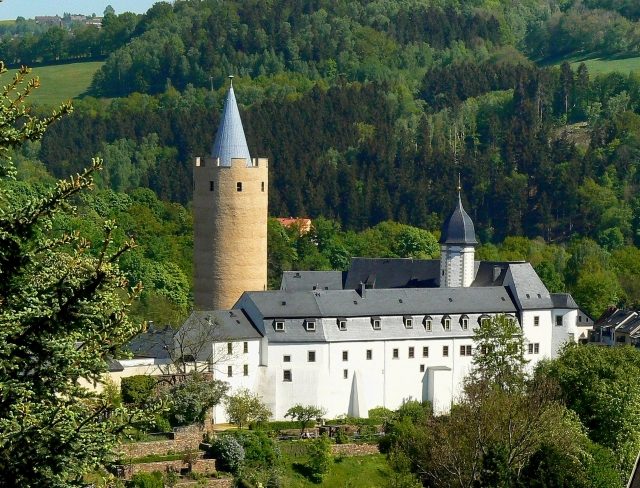
CastleZschopau

Wildeck Castle

Wildeck Castle

Museum
Public library

Wildeck Castle is a former hunting lodge in Zschopau, Saxony. It stands on a rocky spur in the immediate vicinity of the Zschopau river.

The current complex is irregularly triangular, with the narrow wings of the castle surrounding the courtyard with the keep "Dicker Heinrich" facing Zschopau, and the courtyard being enclosed by a wall towards the town. The stair tower, located at the angle of two wings, is called "Schlanke Margarete".

The origin of the castle (and thus the town of Zschopau) is a fortress that served to secure the crossing of the "Old Bohemian Steig" over the Zschopau river. The exact founding date of the castle is not known, but it is presumed to have been built during the castle construction phase from 1125 to 1180. The first documented mention of the town occurred in 1286, and the castle itself was first mentioned in 1299. The castle probably originally consisted only of a defensive tower, corresponding to today's "Dicker Heinrich", but at that time it was only 20 m high with an access at 14 meters height that could be defended by one man. Around the turn of the 13th to the 14th century, the Lords of Erdmannsdorf apparently held the Zschopau Castle.

In the 14th and 15th centuries, the castle changed its (Margravial-Meissen) feudal lord several times, with the Waldenburgers and Albrecht Burggraf von Leisnig being mentioned. Anarg von Waldenburg and Lord of Wolkenstein ceded the castle to Elector Friedrich in 1456.

Under Duke Moritz of Saxony, the castle was converted into a Renaissance hunting lodge from 1545 to 1547, during which three smaller towers were demolished and the building was raised by one storey. Of these alterations, the south wing and parts of the west wing remain today. The colorful coffered ceilings and wall paintings created in this context were only rediscovered in 1980 during construction work (Blue-White Room).

From the 17th century until 1911, the castle served as the seat of a chief forestry and game warden's office (later a chief forestry office); one of the most famous was Cornelius von Rüxleben, who was the Saxon chief forester and master huntsman in Zschopau from 1554 to 1576.

Over the years, further alterations and additions were made, some of which have since been removed. In 1754, a fire occurred in the west wing; during the reconstruction of the destroyed second floor and roof, the west wing received a Baroque mansard roof. Due to its use as a court seat (district court since 1821), a classical extension (courtroom on the east wing) was added in 1855, and a prison was established in the west wing.

Current Use+

After 1945, Wildeck Castle was used as a residential building and as the seat of various cultural institutions (library, music school, station for young technicians and natural scientists). From 1974, Wildeck Castle became a district cultural center, the keep was raised and provided with a viewing platform.

Currently, the castle houses various museums (printing museum, motorcycle museum, mint workshop), a public library, and a wedding room. A Baroque garden laid out around the castle in recent years complements the complex.

Take Mobile History with you

You are reading this text for free. Premium adds what matters on the road: descriptions read aloud, sites found through your camera, whole regions taken offline.

  • Every description, including the ~17,700 Premium sites
  • Audio guide: have descriptions read to you on location
  • AR finder: see sites through your camera, with distance and bearing
  • Unlimited saved sites

14 days free, then from €2.99 a month. Cancel anytime.

Source: Wikipedia · Licence: CC BY-SA 4.0 · Image: Thomas Eichler

This description draws on the facts documented in the linked Wikipedia article; Wikipedia content is licensed under CC BY-SA 4.0. Wording and editing: Mobile History.

Location: 50.7457, 13.0686