To be privately owned
CastleSwobnica (Wildenbruch)
Swobnica Castle (Wildenbruch Castle)
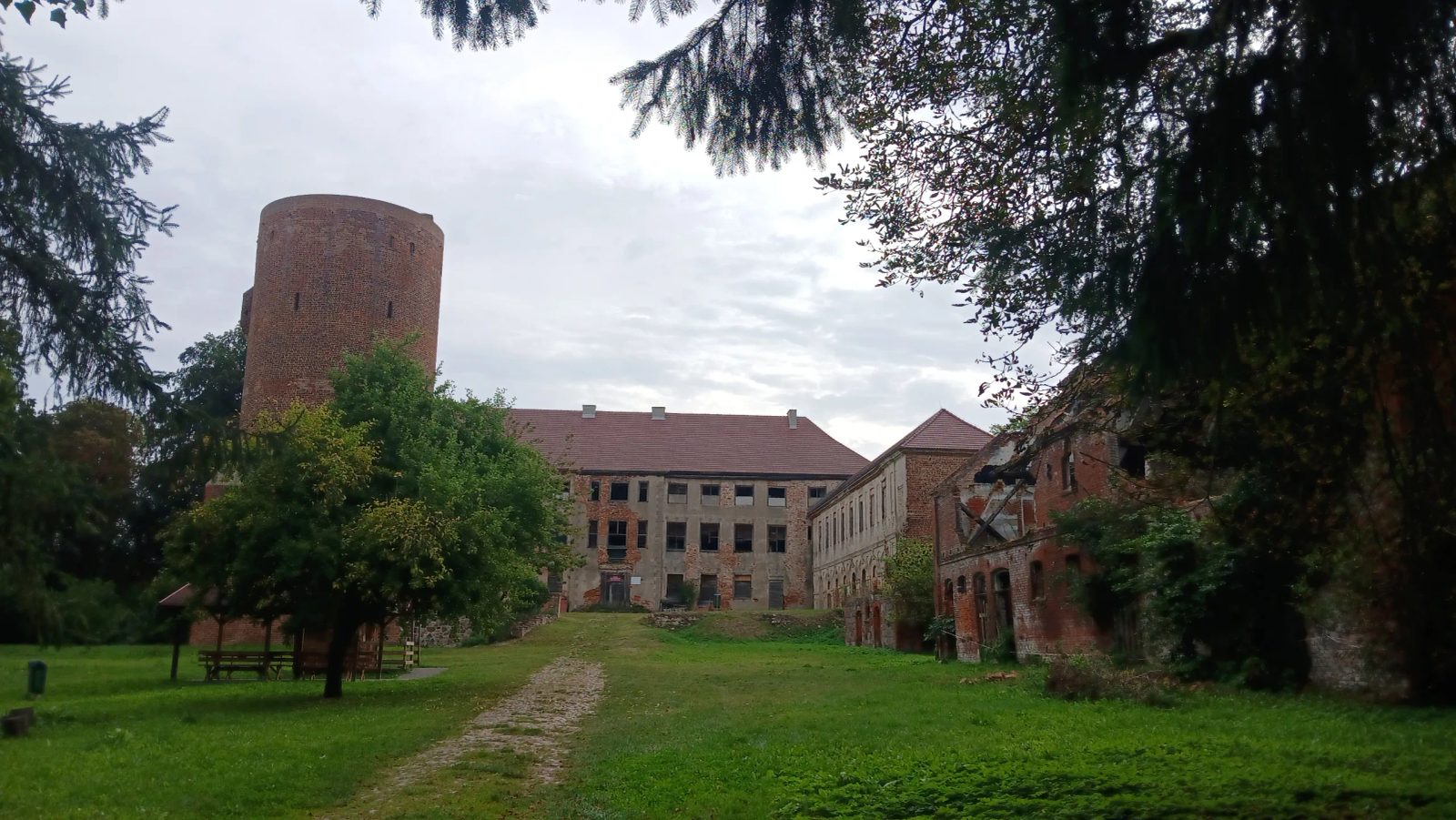
Wildenbruch Castle (Polish Zamek Swobnica) is the ruin of a castle in Swobnica (German: Wildenbruch) in the West Pomeranian Voivodeship in Poland. The castle ruin is located about 40 kilometers south of Szczecin and about 20 kilometers east of Schwedt/Oder on the bank of a silted-up lake. The castle was built in the 14th century in the Duchy of Pomerania as a Teutonic castle of the Wildenbruch Commandery of the Knights Hospitaller, later converted into a Baroque castle and again rebuilt in the 19th century.
History+
The name "Wildenbruke" first appeared in 1345 in a document concerning a dispute between the city of Bahn and the Order of St. John. The estate then belonged to the Commandery of St. John in Rörchen, which was destroyed in 1373. In 1377, the Knights Hospitaller were permitted by the Pomeranian Dukes Swantibor III and Bogislaw VII to build a new castle near Wildenbruch. The new Teutonic castle was built on an island in a lake, which was later called Schlosssee. In 1382, the seat of the commandery was moved here. In a feudal letter, Duke Bogislaw X endowed the order with numerous privileges. After the Reformation, the Wildenbruch Commandery belonged to the Brandenburg Bailiwick of the Order of St. John, which became Protestant in 1538. With the division of Pomerania in 1541, the Wildenbruch Commandery came to Pomerania-Wolgast. Wildenbruch was temporarily governed by ducal officials, as Duke Philipp I did not recognize the commander von der Marwitz. At this time, several inventories of the castle were made, which have been preserved. In 1544 and 1545, Emperor Charles V instructed Philipp I to respect the rights of the order. In 1547, an agreement was reached with the Duke, and the order then returned to Wildenbruch to protect the Pomeranian border. The order was to re-equip Wildenbruch Castle well with artillery and armor. Inventories for 1560 and 1576 are also preserved. From 1610, the seat of the commandery was in Sonnenburg. In the Thirty Years' War, Wildenbruch was occupied by imperial troops in 1629, and from 1631 by Swedish troops. After the end of the war in 1648, the Bahner Land remained with Sweden due to the Peace Treaty of Osnabrück. Wildenbruch became private property of Queen Christina of Sweden, who gave the castle to the court chancellor Johann Adler Salvius. After the Battle of Fehrbellin, all of Pomerania fell to Brandenburg, and Elector Friedrich Wilhelm transferred Wildenbruch Castle to Georg Freiherr von Derfflinger. After the Peace of St. Germain, most of Pomerania became Swedish again, but the Bahner Land remained Brandenburgian. In 1680, Electress Dorothea bought Wildenbruch Castle, incorporating it into the Wildenbruch-Schwedt dominion. In the following years, the castle was converted into a Baroque castle. After Dorothea's death, Wildenbruch fell to Philipp Wilhelm, Margrave of Brandenburg-Schwedt. Wildenbruch served as a retreat for his son Friedrich Wilhelm, the "mad Margrave". From 1788, Wildenbruch fell to the main line of the Hohenzollerns, became a crown domain in 1873, and remained private property of the Hohenzollerns until 1919. In the 19th century, the castle was rebuilt. In World War II, the castle served as an evacuation site for Szczecin museums. After the region fell to Poland in 1945 as a result of World War II, the complex was used by a state agricultural enterprise. After the end of socialism, the castle was in changing private ownership and continued to decay. After mediation by the Berlin association Wildenbruch Swobnica e. V., the castle came into the possession of the city of Banie and has been restored ever since.
Structure+
The main construction phases of the current building took place from 1377 to 1382 and from 1680 to 1690. The main house of the former Teutonic castle is evident in the current three-wing complex, whose three sides go back to the ring wall. Nothing of the former outer bailey is visible on the site. The tower of the current building also goes back to the keep of the Teutonic castle.
Take Mobile History with you
You are reading this text for free. Premium adds what matters on the road: descriptions read aloud, sites found through your camera, whole regions taken offline.
- Every description, including the ~17,700 Premium sites
- Audio guide: have descriptions read to you on location
- AR finder: see sites through your camera, with distance and bearing
- Unlimited saved sites
14 days free, then from €2.99 a month. Cancel anytime.
Source: Wikipedia · Licence: CC BY-SA 4.0 · Image: Foto: Jörg Heldt (Community)
This description is a machine translation of an excerpt from the linked Wikipedia article. The source text was written by its authors, the translation is by Mobile History; like the original it is licensed under CC BY-SA 4.0.
Location: 53.0310, 14.6234