To be privately owned
Wildenhag Castle

Wildenhag Castle is located in the eponymous district of the municipality of Straß im Attergau in the Vöcklabruck district of Upper Austria (Schlossberg 1).
Wildenhag is first mentioned in 1379. At that time, it was owned by the V(U)etzingers and was granted as a fief by Duke Albrecht IV. The Utzingers were a so-called minor knightly family from Jetzing near Leonding, first mentioned in 1271 in the retinue of the Lords of Traun. A Ulrich Utzinger was enfeoffed with Wildenhag around 1400, which was confirmed by Duke Albrecht V in 1411. Emperor Friedrich III granted Wildenhag market rights in 1449. Wildenhag then passed to the sons Veit, Valentin, and Erasmus (last mentioned in 1455) of Ulrich Utzinger. Erhard († 1497), a grandson of Erasmus, then received Wildenhag as a fief in 1497. His nephew Ulrich succeeded him as a feoffee of Wildenhag in 1523. His son Jakob, in turn, was enfeoffed with Wildenhag in 1546 after the death of his father († 1544). He is the last of the Uetzingers († 1554); his tombstone is in the parish church of St. Georgen.
After the extinction of this family with Jakob Uetzinger in 1554, King Ferdinand I granted Wildenhag as a grace fief to Erasmus von Gera. He sold it as early as 1556 to Georg Arnsteiner, a brother-in-law of the Uetzingers. The following year, he gave it to his brother Hans. Upon his death in 1561, Hans left behind his underage sons Tobias and Christoph, for whom their uncle Georg (presumably † 1565) was enfeoffed with Wildenhag. For the still minor sons, Achaz von Indersee was enfeoffed with Wildenhag. It was not until 1583 that Tobias was enfeoffed with Wildenhag for himself and his brother. They sold Wildenhag the very next year to Leonhard Hohenzeller, who died in 1593 and left behind a daughter named Susanne. For her, Siegmund Widerroiter first took the seat as a fief; then she married Ludwig von Schmelzing, who can be traced to Wildenhag in 1597, but was not enfeoffed with Wildenhag until 1603. Schmelzing sold the lordship in 1606 to Georg Hutstocker, who transferred it in 1614 to Max Hohenfelder. For his sons, Ferdinand and Wolf Ludwig, their uncle Ludwig was enfeoffed with Wildenhag in 1623.
In 1583, the Wildenhag estate was united with Walchen; at that time, both lordships belonged to Hieronymus Putz. The administrative seat was moved to Walchen, and Wildenhag was left to further decay. Owners included Leonhard von Hohenzell (1632), Nikolaus Gurland (1638), Balthasar von Starhemberg, Johann Gottlieb von Clam (1766), and Christoph Freiherr von Aretin (1786). His successor in 1802 was Josef Preuer. According to the Franciscan Cadastre, however, Christian Freiherr von Aretin was still named as owner in 1808. The associated dairy farm was then sold as a farm to the Verwangers. Rosalie Breuner was housed in the still habitable part of the castle. She sold her property to the surgeon Joseph Hamberger, who still owned the so-called castle in 1830.
Description+
As can be seen in an engraving by Georg Matthäus Vischer from 1674, Wildenhag was a three-story building with a tower featuring a clock, an onion dome, and a superimposed lantern, in an exposed position on the Schlossberg. The castle had no walls but had a defensive character due to its high-set windows. However, between 1574 or 1578 and 1581, Wildenhag had already been described as dilapidated. From the description given at the time, it can be gathered that the building had four rooms on the ground floor and first floor respectively, and a chapel on the second floor.
Before Wildenhag completely fell into disrepair, it was rebuilt. The Viennese master builder Wilhelm Lippa took on the construction. He was followed in 1921 by Freiherr von Gagern, then by the provincial school inspector Friedrich Mayr from Innsbruck (1931-1957). After that, Michael Oswald became the owner, who had the castle rebuilt in 1961.
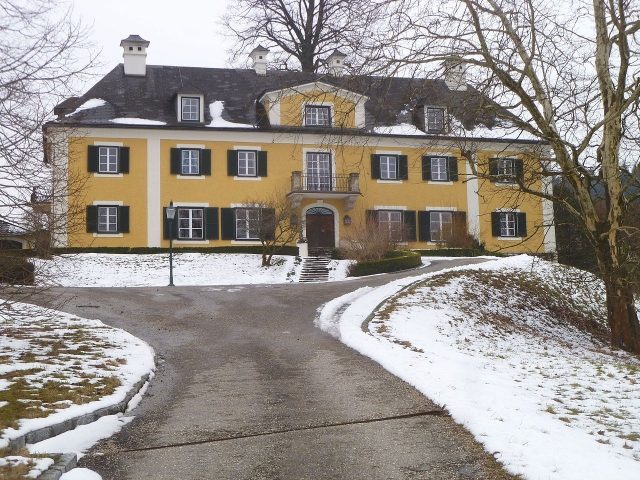
Today, on the Schlossberg, there is a new castle-like building with two stories and a converted hip roof. Above the entrance gate is a balcony, and above that is a large dormer window. In front of the castle entrance, two baroque-looking dwarf figures are placed, reminiscent of the sculptures in Salzburg's Dwarf Garden. Next to the driveway is another stone sculpture.
Not far from the castle lies the former castle farm (Schlossberg 2), which is, however, managed independently.
Take Mobile History with you
You are reading this text for free. Premium adds what matters on the road: descriptions read aloud, sites found through your camera, whole regions taken offline.
- Every description, including the ~17,700 Premium sites
- Audio guide: have descriptions read to you on location
- AR finder: see sites through your camera, with distance and bearing
- Unlimited saved sites
14 days free, then from €2.99 a month. Cancel anytime.
Source: Wikipedia · Licence: CC BY-SA 4.0 · Image: http://commons.wikimedia.org/wiki/File:Wildenhag-1.jpg
This description draws on the facts documented in the linked Wikipedia article; Wikipedia content is licensed under CC BY-SA 4.0. Wording and editing: Mobile History.
Location: 47.9074, 13.4907