To be privately owned
Wildenstein Castle
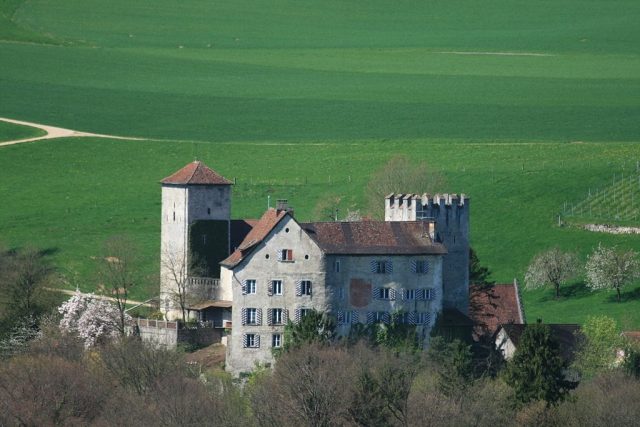
Wildenstein is a castle in the municipality of Veltheim in the Swiss canton of Aargau. It is located about 1.5 kilometers south of the village on a rocky outcrop at the foot of the Veltheimerberg, part of the Jura mountain range, not far from the western bank of the Aare river.
The origins of Wildenstein Castle are unknown. It was first mentioned in 1301 as an allod of the Schenken von Kasteln, and before 1307 it came into the possession of the Lords of Rinach. The two defensive towers were built around 1350, and the palas was built or expanded around 1400. The complex has the shape of an irregular quadrangle. The two keeps, the curtain wall, the palas, and economic buildings are grouped around the inner courtyard. In 1415, Henmann von Rinach received Wildenstein from the city of Bern as a male fief. In 1491, the brothers Hans Albrecht and Hermann von Mülinen bought Wildenstein Castle and its jurisdiction. From 1640, under Hans Thüring Effinger, the medieval castle was converted into a baroque residential castle. In 1720, Franz Friedrich Effinger sold Wildenstein to the wealthy merchant David Sprüngli (1697-1744), son-in-law of Bern's city architect Samuel Jenner. At the request of the Schenkenberg bailiff Johann Rudolf von Luternau, Sprüngli was forced to sell Wildenstein to Bern so that the bailiff of Schenkenberg could move into Wildenstein instead of the dilapidated Schenkenberg Castle. Until 1798, 15 bailiffs resided at Wildenstein Castle.
After the fall of the Republic of Bern, Wildenstein passed to the newly created Canton of Aargau, which sold the castle to private owners in 1804. In 1816, the French Lieutenant General Jean Rapp bought the castle to retire there. In 1819, the property was auctioned, and the castle building and the associated land parcels were separated. The castle went to lawyer Amsler, Ludwig Albrecht Effinger bought the Wildensteiner Schachen. Niklaus Friedrich von Mülinen was able to acquire the remaining parcels in 1831. Mülinen's brother-in-law Rudolf Emanuel Effinger managed this land and lived in the tenant's house at Wildenstein for this purpose. The Zurich painter Karl Friedrich Irminger (1813-1863) bought the castle in 1840, only to resell it to Rudolf Emanuel Effinger in the same year. From 1894, Pauline von Sinner–von Effinger (1836-1906) owned the castle. She bequeathed Wildenstein Castle as a foundation for charitable purposes, managed by her sister Julie von Effinger. Julie von Effinger soon passed on the administration of the foundation to relatives, from 1908 Anna von May (1876-?) owned the castle, and in 1927 Pastor Adolf Frey, married to Sophie von Wattenwyl, a great-niece of Pauline von Sinner, became the new owner. Frey was the head of the Deaconess House in Bern and from 1928 built a retirement home for the Deaconess House. This existed until 1972.
In 2010, Wildenstein Castle was auctioned off by the bankruptcy office. Samuel Wehrli from Suhr, the new owner, plans to make the castle accessible to the public as a museum after restoration. In March 2014, Samuel Wehrli founded the Wildenstein Castle Foundation, which will ensure the preservation, maintenance, and operation of the castle complex, which will be publicly accessible in the future.
Construction History+
Wildenstein Castle was probably expanded by the von Rinach family in the 14th century with the two towers and the surrounding wall. Between 1465 and 1483, an expansion was carried out by the then owner, the Lucerne Schultheiss Heinrich Hasfurter. Hans Thüring Effinger (1619–1667), who had become Lord of Wildenstein through his marriage to Johanna Margharetha von Mülinen, gave the residential building its current form in 1645. Franz Christoph Effinger, married to Juliana Rosina von Erlach, had the northern castle wall and the garden fitted with baroque architectural elements in 1695 and 1698. The Bernese master builder Niklaus Schiltknecht renovated four rooms in 1732, and in 1739 new windows were installed in the Schiltensaal (southeast corner) and in the audience chamber. The audience chamber also received new paneling and a large stove. Emanuel Zehender repaired dilapidated parts of the castle in 1756 and built a new cellar under the bailiwick. Further repairs were carried out in 1769 and 1785. The fiefdom house was repaired in 1756, and in 1783 an extension and a staircase were added by Carl Ahasver von Sinner. Rudolf Emanuel Effinger had the building renovated from 1840. During the time of the Deaconess House, numerous reversible interventions took place. Since 1972, Wildenstein has experienced a changeable fate. Since 2012, the castle has been comprehensively and professionally restored.
Take Mobile History with you
You are reading this text for free. Premium adds what matters on the road: descriptions read aloud, sites found through your camera, whole regions taken offline.
- Every description, including the ~17,700 Premium sites
- Audio guide: have descriptions read to you on location
- AR finder: see sites through your camera, with distance and bearing
- Unlimited saved sites
14 days free, then from €2.99 a month. Cancel anytime.
Source: Wikipedia · Licence: CC BY-SA 4.0 · Image: http://commons.wikimedia.org/wiki/File:Wildenstein_2975.JPG?uselang=de
This description draws on the facts documented in the linked Wikipedia article; Wikipedia content is licensed under CC BY-SA 4.0. Wording and editing: Mobile History.
Location: 47.4287, 8.1576