CastleSt. Pantaleon-Wildshut

Wildshut Castle
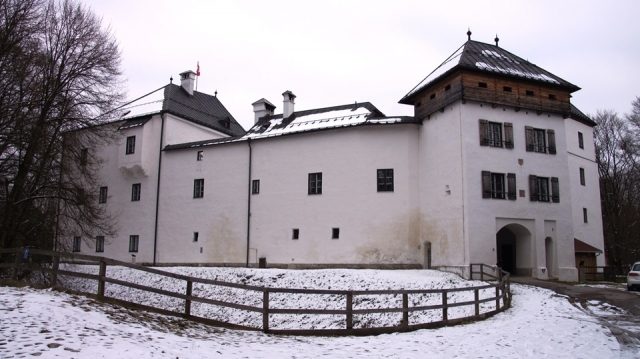
Wildshut Castle

To be privately owned

Wildshut Castle is a castle in the village of Wildshut, municipality of St. Pantaleon, Upper Austria.

The chronicle of Wildshut dates back to the year 930. A castle existing at that time was first mentioned in a document in 1115, together with the lord of the castle Albert de Hutte, as castrum Hutte. At the first documented mention of the Lords of Wylczhut in 1387, a castle already existed at the present location, which served as a hunting lodge for the Bavarian dukes and was located on the border of the Duchy of Bavaria with the Archdiocese of Salzburg. In 1402, it became the seat of the regional court in Weilhart, which was transferred as a fief to the Nußdorfer family. Around the year 1500, the castle was again taken over by the Bavarian dukes, who commissioned several renovations. Administration was carried out by caretakers. The first mentioned was Hans Offenheimer between 1500 and 1521, followed by David Aigl until 1548. In the 17th century, living conditions were so poor that the caretakers were allowed to carry out their duties from their own castles. Wilhelm Krausmann is mentioned as the first Austrian caretaker in 1729. The owner at that time was Hans Pokorny, judge and German novelist.

After the Innviertel was handed over to Austria in 1779, an independent district court of Wildshut was housed in the castle. From 1810 to 1816, it was subordinate to the Salzburg regional court of Laufen and then became independent again.

Description+

Despite its great age, the old building fabric on the exterior is still almost perfectly preserved in its original style. The complex stands on a river terrace with a steep drop to the Salzach, which, along with a ring wall that probably existed at the time of the first documented mention, provided sufficient protection. The current appearance of a fortified castle essentially originated in the 16th century. A chapel was added to the defensive wall. The two construction phases are still recognizable inside the castle. The altarpiece "Maria Hilf" dates from the mid-19th century. In the castle courtyard, there is a 150 m deep brick-lined draw well.

Since the castle was used as a district court for many years and was restored and renovated several times, little of the original interior has been preserved. A tiled stove from 1683, which was long housed in the Upper Austrian State Museum in Linz, can now be seen again in the castle's concert hall.

After the dissolution of the Wildshut District Court in 2002, the castle was sold to Georg Florens Traugott, who had it exemplarily and comprehensively renovated. For example, the floors on the first story could be fitted with shell limestone slabs that had previously been used in Linz train station. A sundial in the inner courtyard shows the years of important castle renovations. The draw well in the castle courtyard was made functional again, and further art objects could be installed. Today, the castle serves residential purposes and as an event venue.

Take Mobile History with you

You are reading this text for free. Premium adds what matters on the road: descriptions read aloud, sites found through your camera, whole regions taken offline.

  • Every description, including the ~17,700 Premium sites
  • Audio guide: have descriptions read to you on location
  • AR finder: see sites through your camera, with distance and bearing
  • Unlimited saved sites

14 days free, then from €2.99 a month. Cancel anytime.

Source: Wikipedia · Licence: CC BY-SA 4.0 · Image: http://www.wehrbauten.at

This description draws on the facts documented in the linked Wikipedia article; Wikipedia content is licensed under CC BY-SA 4.0. Wording and editing: Mobile History.

Location: 48.0073, 12.8660