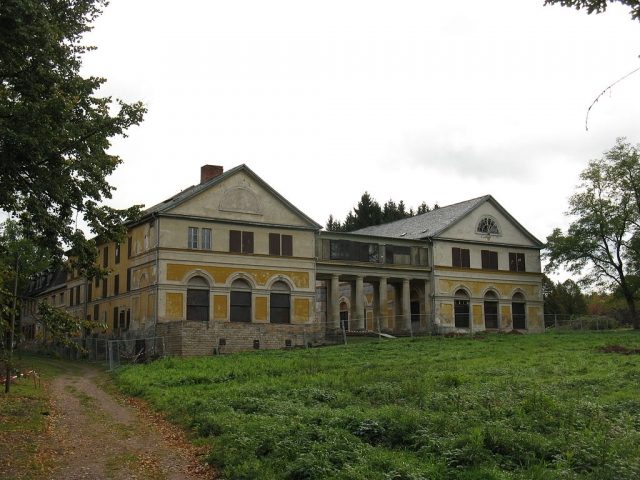
Uninhabited
Wilhelmsthal Castle
Wilhelmsthal Palace is a palace and garden complex in the Eckardtshausen district of the municipality of Marksuhl in the Wartburg district in Thuringia. The former residential and hunting lodge is located about seven kilometers south of Eisenach in the Elte valley. Wilhelmsthal Palace is considered the last preserved secular premiere venue of the composer Georg Philipp Telemann.
The original place was first mentioned in a document in 1349 as "Wintershusen". The game-rich forests and meadows along the Elte were a popular hunting ground for the high nobility. Starting from the Eisenach castles and the Marksuhl hunting lodge, comfortable hunting accommodations and stables were built. They were built on the Rennsteig (Hohe Sonne hunting lodge) and on the Glöckner near Ruhla. The "Jagdhaus Prunftau" was built in the Eltetal, where Duke Johann Georg I died on September 19, 1686, during the hunting season.
Since the constant activity and noise of the village population of Wintershusen scared away the game, the few forest farmers who had returned after the Thirty Years' War had to resettle in neighboring villages; only the inn and the forester's lodge remained tolerated. Since 1699, the place has borne the name Wilhelmsthal in honor of Duke Johann Wilhelm. Between 1709 and 1715, the master builder Johann Mützel converted the complex into a summer residence with animal enclosures and terraced gardens. From 1698 to 1719, 16 multi-story pavilions in the Baroque style were built along an axis of paths, as well as an oval festival and concert hall, inaugurated in 1714, now known as the Telemann Hall. The concert hall is considered one of the oldest freestanding concert halls in Europe. The water of the Elte was dammed to form a lake, and a direct road connection from Eisenach via the Hohe Sonne was created for better accessibility, which still follows the course of Federal Highway 19 today.
The buildings, kept in a simple Baroque style, were fundamentally redesigned in the 1740s by order of Duke Ernst August by his court architect Gottfried Heinrich Krohne. Several of the pavilions had to make way for new buildings in the Rococo style; a stable was built at one end of the path axis, and an orangery at the other.
The landscape garden, laid out around 1800, was transformed into a nature park between 1852 and 1855 according to the ideas of Duke Carl Alexander and Prince Hermann von Pückler-Muskau, with the participation of garden designers Hermann Jäger and Eduard Petzold. However, Pückler's plans to extend the park over the Thuringian Forest to Eisenach were not implemented. The stable was also affected by further reconstruction measures, being extended by another wing and a coach house. The ensemble also included the "Swiss House" and farm buildings.
Until 1941, the complex was in ducal possession before it was sold to the Thuringian Ministry of Finance. The German Wehrmacht confiscated the area in 1942 and used it as a military hospital until 1945.
After the end of World War II, the palace was used as an orphanage until 1993. During this time, the complex was redesigned to suit its use, particularly through extensions and the construction of new buildings. The Telemann Hall served as a dining hall. Next to the orphanage, not far from the palace complex, the bungalow village was opened in the summer holidays of 1964 as a holiday camp for the Young Pioneers.
With the abandonment of its use in 1993, the now vacant palace complex increasingly fell into disrepair. The area of the holiday camp now houses a vocational training center, which was also a short-term tenant of the palace. The lake serves as a boating pond for recreational purposes.
Since 2001, the listed palace complex has been unsuccessfully offered for sale by the State of Thuringia. In June 2009, the property was taken over by the Thuringian Palaces and Gardens Foundation, which initiated steps to secure and renovate the monument. In 2011, a fundamental restoration of a part of the landscape park between the Corps de Logis and the "Flower Island" was carried out with funds from the Economic Stimulus Package II. Despite the renovation efforts, parts of the palace, especially the historic stucco ceiling in the Telemann Hall, are considered to be at acute risk of collapse.
Famous Guests+
Numerous prominent guests stayed at the palace. These included the composer Franz Liszt and Tsar Alexander I. Maria Pavlovna spent the summer months here and organized literary afternoons.
Between 1716 and 1725, works by Georg Philipp Telemann were premiered in the palace's concert hall. Wilhelmsthal Palace is considered the last preserved secular premiere venue of the composer.
Johann Wolfgang Goethe was also a guest at Wilhelmsthal Palace several times. According to an anecdote, during a stay in the 1770s during his Weimar period, he is said to have knocked over stone figures in the palace park that he disliked. Later, his work Elective Affinities was created here.
Take Mobile History with you
You are reading this text for free. Premium adds what matters on the road: descriptions read aloud, sites found through your camera, whole regions taken offline.
- Every description, including the ~17,700 Premium sites
- Audio guide: have descriptions read to you on location
- AR finder: see sites through your camera, with distance and bearing
- Unlimited saved sites
14 days free, then from €2.99 a month. Cancel anytime.
Source: Wikipedia · Licence: CC BY-SA 4.0
This description draws on the facts documented in the linked Wikipedia article; Wikipedia content is licensed under CC BY-SA 4.0. Wording and editing: Mobile History.
Location: 50.9185, 10.3038