To be privately owned
Wilkendorf Castle

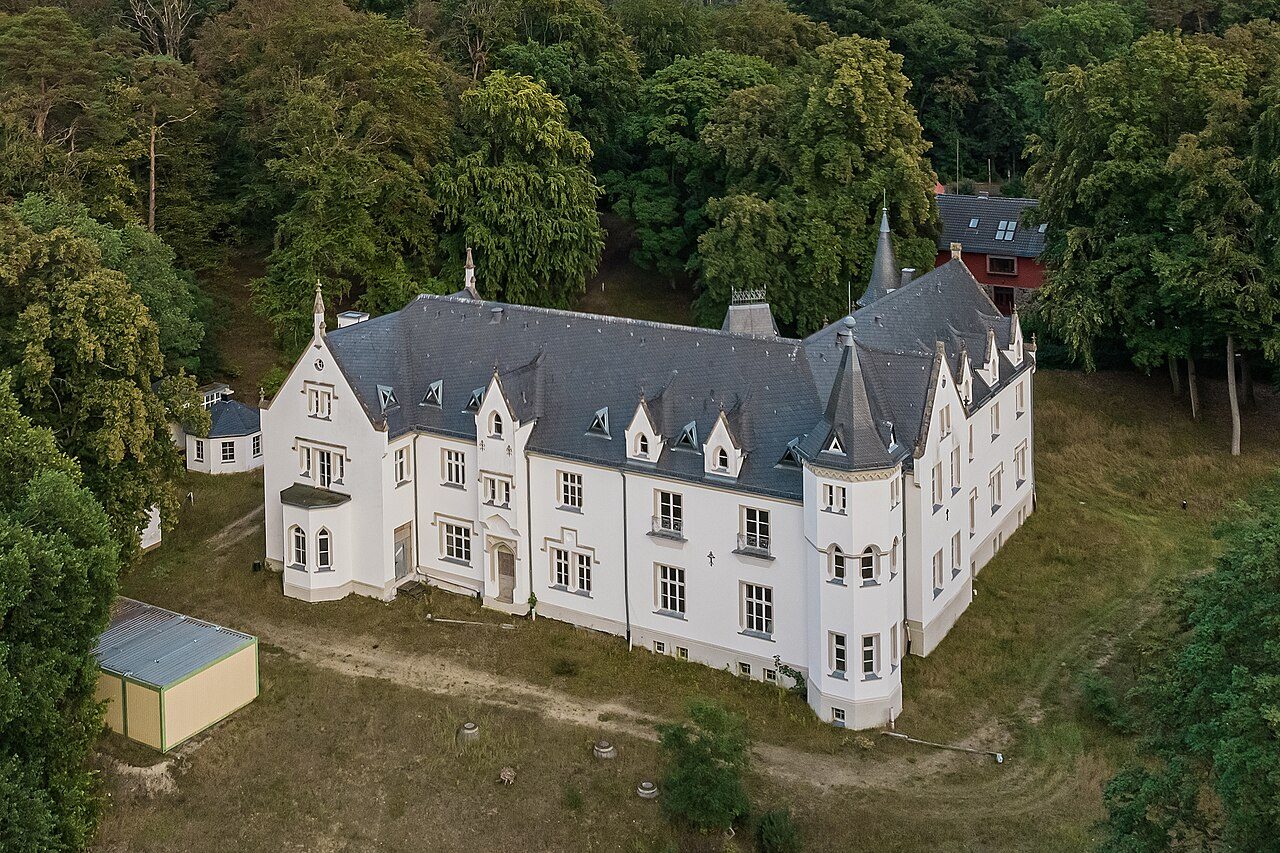
Wilkendorf Castle is a listed noble residence in the village of Wilkendorf in Altlandsberg, north of Strausberg, which served as a guesthouse for the Ministry of Defense during GDR times.
Since 1536, the estate belonged to members of the ancient noble Marchian family of Pfuel (Pfuel line of Wilkendorf). Until 1855, there was no so-called "manorial building" in Wilkendorf. Only from 1856 did Gustav Felix Bertram von Pfuhl, as the fifth child of the Pfuhls, have the castle built. It was initially only a modest castle complex. In this architectural epoch of Historicism (1840 - 1900), which reinterprets and combines many preceding styles such as Romanesque, Gothic, Renaissance, Baroque, and Rococo, the architectural style of the castle is predominantly characterized by Neo-Gothic and Neo-Renaissance.
At Wilkendorf Castle, Theodor Fontane developed the idea for his novel Effi Briest when he viewed (now vanished) ancestral portraits from the possession of District Administrator von Briest of Nennhausen. In memory of his last daughter, he gave the title character of his novel the name "Effi Briest".
In 1891, two-thirds of the castle burned down. Nothing is known about the cause of the fire. In 1892/93, the castle was partially rebuilt.
Around 1900, the castle, along with the over 1000-hectare manor, was owned by the industrial magnate Georg von Caro (1849-1913). The building underwent extensive structural changes and enlargement in 1909 under von Caro. Thus, the castle was repeatedly restored and partially reconstructed. The new lord of the manor and castle had the coat of arms of the von Pfuhl family, located above the main entrance, removed and replaced it with the coat of arms of the von Caro family. After the death of Dr. von Caro, the entire village of Wilkendorf/Gielsdorf and the castle passed into the possession of Mrs. Carolina Wolff and her husband in 1914. They subsequently took over the management. From 1920, the estates were leased, and Wolff retained the castle, the lake, and the forests. During the Third Reich, a Mr. von Dippe then took over the castle and the estate.
In the last years of the war, due to the constant heavy air raids on Berlin, the Spanish ambassador was quartered in Wilkendorf Castle.
After 1945, Wilkendorf Castle became a guesthouse of the GDR Ministry of Defense. There, on August 9, 1961, the "operative group" of the "Ministry for National Defense" (its official name) met to finalize the detailed plans for the deployment of the National People's Army of the GDR in connection with the construction of the Berlin Wall starting August 13, 1961.
Since 1990, the castle stood empty.
In 2005, the buildings were sold to Russian investors who are having the dilapidated building extensively renovated and converted into a luxury residence. The "Schloss Wilkendorf Liegenschaften GmbH", founded at the end of 2005, has taken on these tasks. Currently, the castle is not accessible to the public as extensive renovation and conversion work is taking place.
Golf Club+
The "Schloss Wilkendorf Golf Club" (220 hectares), founded in 1991 and located north of the village, has two 18-hole courses: The Sandy Lyle Course was voted the 6th most beautiful golf course in Germany in 2010 (out of a total of 700 facilities), and the Westside Course is Berlin's first and only handicap-free 18-hole course.
Take Mobile History with you
You are reading this text for free. Premium adds what matters on the road: descriptions read aloud, sites found through your camera, whole regions taken offline.
- Every description, including the ~17,700 Premium sites
- Audio guide: have descriptions read to you on location
- AR finder: see sites through your camera, with distance and bearing
- Unlimited saved sites
14 days free, then from €2.99 a month. Cancel anytime.
Source: Wikipedia · Licence: CC BY-SA 4.0 · Image: A.Savin / FAL via Wikimedia Commons
This description draws on the facts documented in the linked Wikipedia article; Wikipedia content is licensed under CC BY-SA 4.0. Wording and editing: Mobile History.
Location: 52.6092, 13.9019