Museum
Winsen Castle
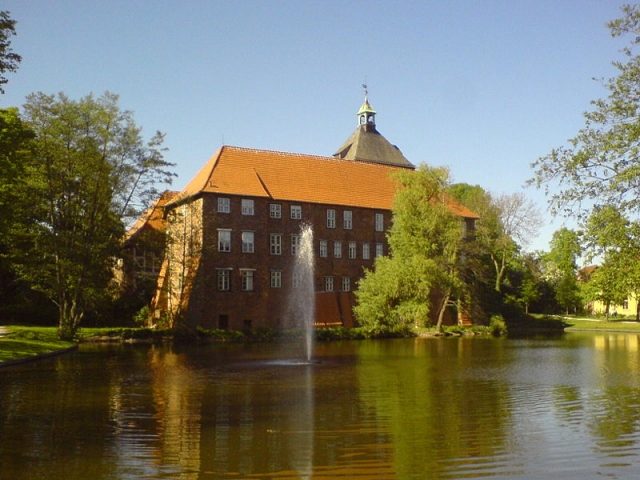
Winsen (Luhe) Castle in northern Lower Saxony is the most significant secular building in the city. The building, parts of which are over 700 years old, now houses the district court.
The castle originated from a fortress at a crossing of the Luhe and was first mentioned in a document in 1315. However, another document from 1277 suggests that the castle probably already existed at that time. At the beginning of the Lüneburg War of Succession in 1371, Duke Magnus II was forced to relocate the Grand Bailiwick of Lüneburg to Winsen. Winsen Castle subsequently served as the Grand Bailiwick of Winsen and administered the Welf estates in the northern part of the Principality of Lüneburg, which was a sub-principality of the Duchy of Brunswick-Lüneburg. In the 14th and 15th centuries, the castle and its associated lands were pledged several times by the dukes. Thus, from 1374 to 1389, it belonged to the Council of the City of Lüneburg, in 1396 it went to Hamburg and Lübeck, from 1434 with interruptions it was again in the possession of Lüneburg, and from 1493 to 1523 it even went to the Electors of Saxony. At the beginning of the 17th century, the castle was the scene of several witch trials.
From 1593 to 1617, the building was inhabited by Dorothea of Brunswick-Lüneburg, the widow of William the Younger, as her retirement residence. She had the castle chapel in the only remaining tower of the castle rebuilt. In the course of the Thirty Years' War, the castle's fortifications were strengthened, and in 1628 it briefly served as headquarters for Tilly and his staff. After the Thirty Years' War, the castle was only used as the seat of the bailiffs of the Winsen district. In 1852, the district court moved into the premises, and from 1885, the castle also housed the district administration of the Winsen district until the district reform in 1932, when the Winsen district merged into the Harburg district and the seat of the district administration moved to the independent city of Harburg. Due to the war-related destruction of the district administration office in Harburg, the district administration was relocated back to Winsen Castle and to four barracks in the castle park in 1944. The district administration remained there until it moved into a new building in the immediate vicinity of the castle in 1961. For some time, the land registry office remained in the castle until it moved into its own building in the 1990s. Today, the Winsen District Court is the sole user of the castle.
Architecture+
The castle, although stripped of its fortifications, has retained its defensive character to this day. The existing building components largely date from the Renaissance. The brick building with half-timbered elements stands within a dammed pond on the Luhe and consists of an irregular, three-winged structure with an open courtyard. The courtyard was once enclosed by a fourth wing, but this was demolished around the 18th century. The castle's facade facing the town is emphasized by the chapel tower and the gate, while the other exterior facades are relatively unadorned.
The long-standing construction activity at the castle can still be traced in many architectural details today. In the basement, a Gothic star vault from around 1500 has been preserved. In the Renaissance, the castle was adapted to the taste of the time, a gallery was added to the courtyard, and various embellishments were made. Since the castle served as an official residence for a long time, there were fewer courtly reception rooms and more administrative rooms in the building. Only under Dorothea was court held at the castle for a longer period, as evidenced, among other things, by the furnishings of the castle chapel.
Current Use+
The owner of the castle today is the State of Lower Saxony. It is the seat of the Winsen District Court. From 1995 to 2006, the castle underwent extensive renovation, and since 2008, a small museum has been set up in the castle tower. Due to the castle's use as a court building, the rooms are generally not open to visitors, with exceptions occurring, for example, on Heritage Day. There are also occasional guided tours on other action days, which can be inquired about at the neighboring museum in the Marstall. Various cultural events such as concerts take place in the castle chapel, and it can also be rented for weddings.
Cannon in the Courtyard+
The cannon in the courtyard never served to defend the castle. It was manufactured in Liège, Belgium, in 1863 and was placed as a decoration by the then district administrator Friedrich Ecker in 1917.
Surroundings+
The castle park and courtyard are freely accessible to visitors. The former fortifications were transformed into a landscaped park after their demolition. The castle garden was included in the Winsen State Garden Show in 2006. Within sight of the castle is the large half-timbered building of the Marstall. This now houses the city library, the tourist information office, and a museum.
Take Mobile History with you
You are reading this text for free. Premium adds what matters on the road: descriptions read aloud, sites found through your camera, whole regions taken offline.
- Every description, including the ~17,700 Premium sites
- Audio guide: have descriptions read to you on location
- AR finder: see sites through your camera, with distance and bearing
- Unlimited saved sites
14 days free, then from €2.99 a month. Cancel anytime.
Location: 53.3631, 10.2043