To be privately owned
Wintergrün Castle

Wintergrün Castle is located in the municipality of Ramingstein in the Tamsweg district in the federal state of Salzburg (Schloßgasse 58).
In 1188, Otto von Machland handed over his possessions in Lungau to the Salzburg Cathedral Chapter; this remained the feudal lord of the Ramingstein dominion until the land was relieved of its burdens. Wintergrün, along with Finstergrün Castle, formed the essential border fortification on the Mur against Styria. In 1459, Archbishop Sigismund declared the mining area a free district. The mining judge was authorized to rule on all disputes, except those that entailed the death penalty. For these, the regional judge in Moosham was responsible. The administrative center of this free district became Wintergrün Castle.
It became the seat of the Mooshamer family, who called themselves von Mosshaimb zu Ramingstein. The son of Wilhelm von Moosham, who died in 1556, and Anna von Haunsperg, Seyfried von Moosham, built a chapel in his castle in honor of Saint Helena and the Finding of the Cross. He and his wife Helena Freiin von Teuffenbach endowed two weekly masses and on the day of the Finding of the Cross (May 3rd each year). The priests reading the mass were to be accommodated in the castle. Seyfried's sisters Elisabeth and Ursula were married to the brothers Christoph and Hans Weitmoser zu Winkl, Ramseiden and Grueb. After Hans Weitmoser died without descendants in 1603, the daughters of Christoph Weitmoser, who died in the same year, inherited the dominion. Regina, married to Hans Friedrich Fuchs von Fuxberg, received the old Ramingstein Castle in the division of the inheritance with her sister. Her husband transferred the mass endowment to the church of St. Margareten, and this in turn transferred it to Nonnberg Abbey in 1664.
In 1647, the siblings Wilhelm Carl, Ursula, and Eva Jocher followed in possession; in 1658, the dominion passed to Andree Salzleitner and in 1661 to his son Franz and other co-heirs. In 1662, the property was sold to Balthasar Plockh von Arnholz auf Niederaich, administrator of Mauterndorf. He had acquired the castle only so that the well-built chapel, named St. Helena, and furnished with the necessary vestments, would not fall into other hands or be ruined. In 1667, he sold the property to the Ramingstein mining company. In 1684, it was considered to accommodate the vicar and the sacristan in the small castle in Ramingstein, where the mining judge and the Ranttner now live, and where, according to rumor, there are special chapels, because large rooms were available for all ecclesiastical tasks. However, since the distance to St. Achaz parish church was too great, this project was not carried out. In 1750, the bailiff was assigned an apartment there until a separate house was built. No repairs were necessary until then, only the hut writer had to remove her chickens from the rooms. In 1759, the building was completely renovated, and the chapel was re-consecrated to St. Helena by Archbishop Sigmund von Schrattenbach on September 16 of the same year. He donated various relics (of St. Urban, Benedict, Creszenzius, Deodat, Chrysostom, and Daria) and granted a forty-year indulgence. At the request of the miners, the masses, which had not been held since 1699, were reintroduced. The castle chapel was given the rank of an archiepiscopal court chapel. But already in the next year, the portable altar was handed over to the mining administrator in Gastein for safekeeping.
In 1778, mining operations ceased. A detailed inventory of the furnishings of the St. Helena Chapel was made in 1781. In 1806, mining operations were reopened. In 1825, the Imperial and Royal Mining Treasury sold the property to Prince Schwarzenberg, and the Imperial and Royal Salt Works Directorate Salzburg handed over the entire complex to the Schwarzenberg'sche Oberverweseramt Murau in 1827. Since the castle was no longer needed for mining operations, the Schwarzenberg commissioner handed over the keys to the chapel to the Imperial and Royal District Forester Mathias Klettner. The archiepiscopal consistory in Salzburg objected to this, and a legal dispute arose, which only ended with the fire of Ramingstein.
Schloss Wintergrün today+
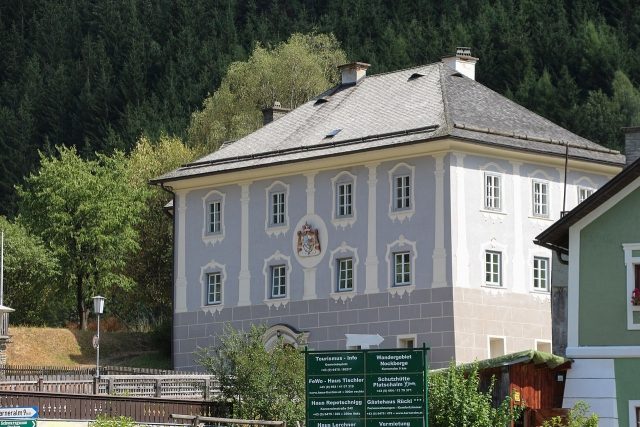
On July 26, 1841, a devastating forest fire ravaged Ramingstein, also affecting the castle. Miraculously, the altar of the chapel was spared. In 1892, the south wing of the castle was demolished and the chapel tower was removed. Of the originally Gothic building, only the Rococo-influenced north wing, the so-called Verweserhaus (administrator's house), remained.
Since 1827, the castle has been owned by the Schwarzenberg family. The owners include: Josef Schwarzenberg, Johann Adolf (1840), Adolf Josef (1900), Johann (1920), Dr. Adolf (1940), Dr. Heinrich (1951) and Dr. Karl Johannes (1967). From 1970 to 1973, the building was restored and renovated. Today, the Schwarzenberg forestry administration and apartments for employees are housed in the building. Nothing remains to remind one of its former use as the administrative center of the Ramingstein and Lungau mining industry.
The castle building has three stories and a hip roof. The main facade is equipped with blind pilasters. The windows are highlighted by projecting lesenes.
Take Mobile History with you
You are reading this text for free. Premium adds what matters on the road: descriptions read aloud, sites found through your camera, whole regions taken offline.
- Every description, including the ~17,700 Premium sites
- Audio guide: have descriptions read to you on location
- AR finder: see sites through your camera, with distance and bearing
- Unlimited saved sites
14 days free, then from €2.99 a month. Cancel anytime.
Source: Wikipedia · Licence: CC BY-SA 4.0 · Image: http://commons.wikimedia.org/wiki/File:AT-24389_Ramingstein_Schloss_Wintergr%C3%BCn_01.jpg
This description draws on the facts documented in the linked Wikipedia article; Wikipedia content is licensed under CC BY-SA 4.0. Wording and editing: Mobile History.
Location: 47.0750, 13.8377