CastleBad Laasphe

Wittgenstein Castle (Bad Laasphe)
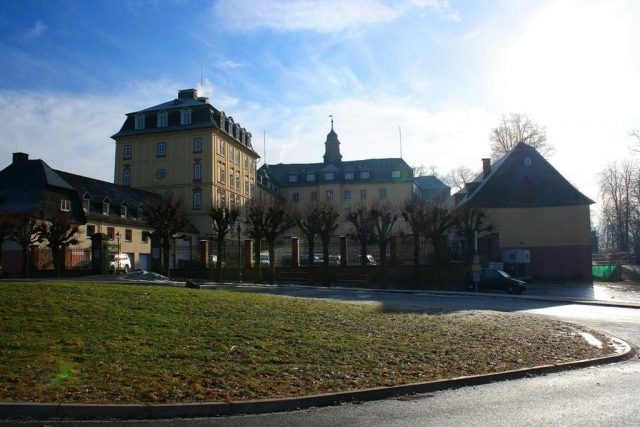
Wittgenstein Castle (Bad Laasphe)

School

College

Wittgenstein Castle is located between the Lahn and Laasphebach rivers above the town of Bad Laasphe in North Rhine-Westphalia on a 470 m high mountain.

Historical Overview+

A castle was first mentioned in a document in 1187 as "Widenkindigstein". With the construction of this castle, the House of Battenberg secured its influence in the Wittgenstein region on the upper Lahn. In 1190, Count Werner I of Battenberg and Wittgenstein concluded a contract with the Archbishop of Mainz, Konrad I of Wittelsbach, according to which he promised to transfer Wittgenstein Castle to the archdiocese in exchange for a payment, and was to receive it back as a fief. However, the archbishop remained indebted for part of the payment, so the contract did not come into force, and Werner was able to free himself from the associated dependence on Mainz after only a few years. It was only in a contract with Werner's sons Werner II, Widekind I, and Hermann on September 2, 1223, that the new Archbishop Siegfried II succeeded in obtaining the transfer of Wittgenstein Castle to the archdiocese and granting it to them as a fief.

In 1238, the House of Battenberg was divided into a Battenberg and a Wittgenstein line by the sons of Widekind I. Wittgenstein Castle and the town of Laasphe went to Siegfried I, who now called himself Count of Wittgenstein. With the extinction of the Counts of Wittgenstein in the male line in 1359, the castle fell to the House of Sayn-Wittgenstein. During the Thirty Years' War, the castle was occupied and severely damaged in 1634, but was subsequently repaired. Until 1950, it served as the residence of the Princes of Sayn-Wittgenstein-Hohenstein.

After the princes moved to Schwarzenau Castle, the dormitory of a boarding school was housed in the castle. During the 1960s, this was transformed into the Gymnasium Schloss Wittgenstein. Meanwhile, many rooms have been converted into classrooms and regular school lessons take place. To provide for full-day students, the existing boarding school kitchen and dining hall were renovated in 2009. In March 2010, part of the film "Dschungelkind" was shot at the castle.

Architectural Description+

The irregular three-wing complex of the castle extends over a length of approximately 125 meters. The complex was built in several construction phases and does not have a uniform architectural style. The building is predominantly attributable to the Renaissance and Baroque periods.

The north wing (or central building) of the castle dates from the end of the 16th century. In its western part, the foundations of a square tower have been excavated, and it is assumed that this can be attributed to the original castle from the 12th century.

On both sides of the north wing are the west wing (or kitchen wing) and the east wing (chamber wing). These were originally independent buildings but were connected to the north wing at the beginning of the 18th century. The striking four-story pavilion on the east wing was built in 1783.

The castle's stable dates from 1736; the other outbuildings are of more recent date.

It is little known that the castle is built on a rock that is significant for the naming of the Wittgenstein region. The "Widukind" rock still protrudes untreated and raw into one of the glass corridors that enclose the inner "Rose Garden". Until recently, the princely archive, which preserves historical documents from past centuries, especially from the 17th century onwards, was located within the castle. After the change of ownership, this archive was moved to a building of the Rentkammer below the castle. According to unproven rumors, there is an escape tunnel between the castle and the town church, which has not yet been found.

Take Mobile History with you

You are reading this text for free. Premium adds what matters on the road: descriptions read aloud, sites found through your camera, whole regions taken offline.

  • Every description, including the ~17,700 Premium sites
  • Audio guide: have descriptions read to you on location
  • AR finder: see sites through your camera, with distance and bearing
  • Unlimited saved sites

14 days free, then from €2.99 a month. Cancel anytime.

Source: Wikipedia · Licence: CC BY-SA 4.0

This description draws on the facts documented in the linked Wikipedia article; Wikipedia content is licensed under CC BY-SA 4.0. Wording and editing: Mobile History.

Location: 50.9300, 8.3978