To be privately owned
Wörth Castle

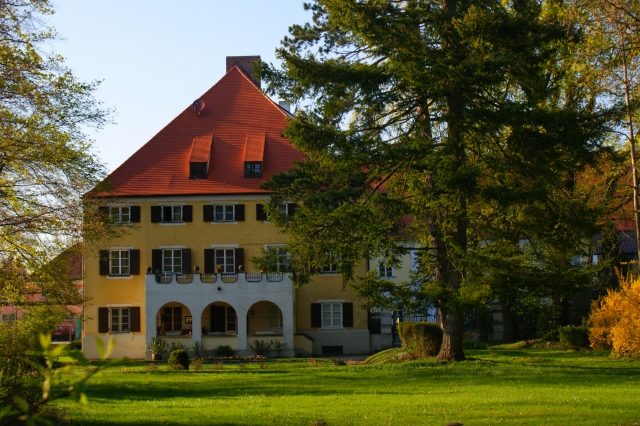
For more than 200 years, the history of Wörth/Isar has been closely linked to the development of Wörth Castle. Elector Max III. Josef bought the complex, which at the time consisted of a tavern - first mentioned in a document in 1486 - a brewery, a forge, and plots of land, in order to rebuild it under the direction of the Electoral Court Chamber in Munich between 1769 and 1771.
The importance of the brewery for the community is also expressed in the coat of arms, which depicts a silver brewing vat with a golden scoop and a golden malt shovel, as well as a silver abbess's staff.
According to an expert opinion from the Monument Protection Office, the brewery building in Wörth "as one of the few electoral white breweries and as the seat of an electoral Hofmark court from 1796 to 1803 represents a significant architectural monument."
Since 1929, the property has been owned by the Kell family. The castle brewery and malthouse were operated by Georg Kell until 1973 and 1980 respectively, for which extensive modernization work was already necessary at that time.
With the founding of the company "Grundstücksverwaltung Schloss Wörth" (Property Management Wörth Castle) in 1986, the next generation of the Adam, Dandorfer, Hoepner, and Kell families, with the support of their mother Therese Kell, is striving to preserve the historically significant buildings and put them to contemporary use.
The newly designed building complex in the center of Wörth is located in the immediate vicinity of the town hall. The completed construction measures will certainly enhance the town center not only in terms of architecture but also make the community even more attractive through the new and expanded businesses and offer an interesting alternative to history-less new buildings on greenfield sites.
The Castle Owners
The entire district was originally electoral property. The Bavarian Elector Max Emanuel was also the one who began building the present castle and brewery at the beginning of the seventeenth century. However, at that time he had no intention of building a castle or a brewery; instead, the present castle was to become a monastery and the brewery a church.
Many may have wondered about the church windows in our brewery. The turmoil of the Thirty Years' War thwarted this plan. Later, the castle and the brewery were made from it, and it was then the first wheat beer brewery in Lower Bavaria.
For two hundred years, the place was then owned by the Egger family, and even today, in the oldest part of our church, there is a tombstone of Thomas Egger, who was buried there in 1727. His and his family's remains are still under this stone today. In 1823, the property passed to a Mr. von Heffels. He was also the one who built the first school in Wörth. Until then, the children of Wörth had gone to school in Postau.
Mr. von Heffels was a bachelor all his life because, as he is said to have stated, he could not support a wife. Most likely, he was also the one who carried out the enormous construction of the ice and beer cellar, still fully used by the brewery today, which, built deep into the earth, covered with earth and planted with trees, is recognizable as a wooded hill only by its entrance from the outside. Previously, a cellar located on the other side of the Isar was used for beer storage. The foundations can still be seen today.
Until 50 years ago, there was a beer tap here, where people enjoyed refreshing themselves with a fresh liter of beer in the cool mountain shade after a walk along the Isar in summer. Incidentally, 100 years ago, a hunter's house stood on the mountain above this cellar, where the hunters lived who managed the extensive forests belonging to Wörth. No trace of it can be found today.
In 1885, the estate came into the possession of a cavalry captain Schüler, from whom Baron Nagel bought it in 1893 and resold it in 1929 to the father of the current owner - Kell. In 1895, the current school building was built, which, of course, no longer meets today's requirements.
During this time, when the large estate had changed hands several times, it had been greatly reduced and fragmented through various sales, which then led to the creation of today's farms. The 500-acre Kröninger Forest, which stretches from Oberaichbach to Reichelkofen and formerly belonged to the castle estate, also passed into the possession of Crown Prince Ruprecht at that time, who still owns it today.
Apart from the Old Castle Tavern, before the turn of the century, the only other businesses were probably the old village forge. However, at that time it was located in the residential building of today's master blacksmith Zeiller. It has preserved the old romance of a village forge with bellows and open fire to this day. Here, draft animals were shod, glowing iron was worked with a hand hammer, and - something very rare today - wrought-iron handicrafts were still made by the young master blacksmith, such as the iron grilles with black iron roses entwining them, found on some Wörth house doors.
Mainly after the First World War, Wörth began to grow rapidly. Only then did today's large businesses emerge here, such as the sawmill, the dairy - it was located in part of today's agricultural warehouse, the warehouse itself was built as early as 1912 (although it was very small then; the modern large-scale operation as it stands today was only created by the current owner) - the first bakery, the first barber shop, the butcher shop, and the car repair shops.
Even the stone houses have only adorned our Lower Bavarian village since this time. It would also be worth mentioning the water pipeline, which many years ago was laid in wooden pipes exclusively for the use of the brewery and the stately castle household from the Isar mountains across the river, and which certainly contributed to the good reputation of the castle brewery beer - it has long since been converted to barley beer - with its pure spring water. Unfortunately, it fell victim to the senseless bridge demolitions shortly before the Americans moved in. From the castle park, the strange trees are worth mentioning, which a traveler from foreign lands must have once transplanted here and which seem to feel surprisingly comfortable in the somewhat harsh climate of the Isar valley. Among them are some whose seeds ripen in autumn in pods that are longer and larger than our most beautiful pole beans.
Take Mobile History with you
You are reading this text for free. Premium adds what matters on the road: descriptions read aloud, sites found through your camera, whole regions taken offline.
- Every description, including the ~17,700 Premium sites
- Audio guide: have descriptions read to you on location
- AR finder: see sites through your camera, with distance and bearing
- Unlimited saved sites
14 days free, then from €2.99 a month. Cancel anytime.
Source: Wikipedia · Licence: CC BY-SA 4.0
This description draws on the facts documented in the linked Wikipedia article; Wikipedia content is licensed under CC BY-SA 4.0. Wording and editing: Mobile History.
Location: 48.6229, 12.3382