To be privately owned
Wörth Castle

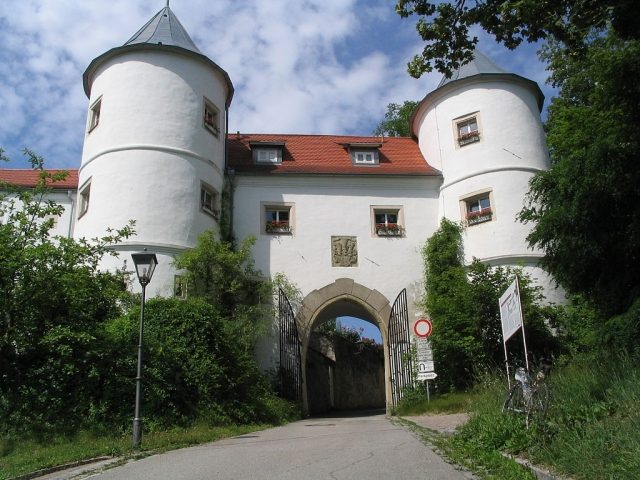
Wörth Castle is a castle in Wörth an der Donau in the Upper Palatinate district of Regensburg. The castle is located next to the A 3 motorway on a hill in the middle of the town.
The manorial lordship was among the oldest possessions of the Prince-Bishopric of Regensburg. The castle located here was first mentioned in a document in 1264. From 1345, it was pledged by the Bishops of Regensburg to local noble families such as the Auers and the Chamerauers. In 1433, Bishop Konrad was able to redeem the castle in exchange for concessions to the Bavarian dukes. Thanks to the associated large forest, the lordship became an immediate imperial possession of the bishops.
From 1522, the castle was transformed into a Renaissance-style palace in the 16th and 17th centuries. Most of the new construction took place under Administrator Palatine Johann (1507–1538). Around 1570, work was still underway on the residential wings. In 1616, Bishop Albert von Toerring-Stein added the chapel and the north wing. The castle was administered by stewards and served as a summer residence for the bishops; at times, they moved their seat entirely here. In 1803, the area fell to the new Principality of Regensburg.
On July 26, 1806, Prince-Bishop Karl Theodor von Dalberg, the last spiritual Prince of the Holy Roman Empire, signed the Confederation of the Rhine Act in the King's Room. In 1810, Wörth became part of the Kingdom of Bavaria. In 1812, it was ceded to the Thurn und Taxis family as compensation for the abolished postal rights of the then Imperial Postmaster Karl Alexander von Thurn und Taxis. Until the reorganization in 1848, Wörth housed a patrimonial court of the Thurn und Taxis. Afterwards, an older district court was located here, later an Amtsgericht (local court) until 1939. In 1899, the House of Thurn und Taxis was granted the title Duke of Wörth and Donaustauf.
From 1949 to 1976, the Deutsche Bundesbahn (German Federal Railway) maintained a training school here. In 1978, Johannes Prince von Thurn und Taxis sold the castle, and in 1984, a community of castle owners acquired it, of which the Regensburg district is the most significant member. In 1988, it was leased by a senior citizens' foundation, which has since operated a senior citizens' residence with a nursing department in the castle.
Description+
The extensive rectangular building, equipped with round towers, has the external character of a fortress. Approaching from the east, one encounters a gatehouse with the date 1605. This is followed by the two-story main gate from 1525, flanked by two battery towers.
Inside, to the left is the gatekeeper's apartment, to the right the service building. The rectangular, six-story residential tower made of quarry stone dates from the Middle Ages. On the inside, there is a later added stair tower, one of the upper floors has a niche with a late medieval rib vault. The roofing was renewed in the early 17th century.
Opposite these buildings to the west lies the three-winged Fürstenbau (Princely Building), which was built in the early 16th and early 17th centuries. The former bedroom in the central building has a wooden ceiling from 1616. The Rondellzimmer (Roundel Room) in the following tower features stucco work from 1673 and a vault painting from 1676, depicting the story of Procris and Cephalus. The rooms of the north wing, serving as servants' quarters, are relatively simple. In the south wing is the elongated former ballroom with a barrel vault with lunettes on pilasters.
The western end is formed by the single-nave castle chapel of St. Martin from 1616. Its furnishings date from the late 17th century. The altarpiece of the high altar by Jakob Heybel, Regensburg, from 1671 depicts the Death of Mary, the painting on the left side altar, also by Heybel and from 1675, depicts the Last Judgment, the painting on the right side altar shows Saint Martin sharing his soldier's cloak with the beggar.
The courtyards are freely accessible during the day, but not the interior of the buildings. Guided tours are conducted for their viewing. Annual castle festivals take place.
Take Mobile History with you
You are reading this text for free. Premium adds what matters on the road: descriptions read aloud, sites found through your camera, whole regions taken offline.
- Every description, including the ~17,700 Premium sites
- Audio guide: have descriptions read to you on location
- AR finder: see sites through your camera, with distance and bearing
- Unlimited saved sites
14 days free, then from €2.99 a month. Cancel anytime.
Source: Wikipedia · Licence: CC BY-SA 4.0
This description draws on the facts documented in the linked Wikipedia article; Wikipedia content is licensed under CC BY-SA 4.0. Wording and editing: Mobile History.
Location: 49.0002, 12.4025