Museum
School
Wolfenbüttel Castle

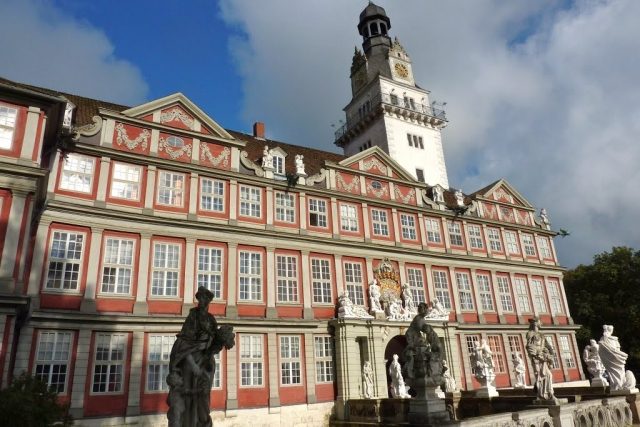
Wolfenbüttel Castle in Wolfenbüttel is the second-largest preserved castle in Lower Saxony. The extensive four-wing complex of the original moated castle served the Dukes of Brunswick-Lüneburg as their Wolfenbüttel residence between the years 1283 and 1754. The castle was destroyed several times by attacks and sieges. The appearance of the castle also changed several times after numerous alterations and additions. Today, the castle is used by a grammar school, the Federal Academy for Cultural Education, and a museum.
Originally, today's castle was a moated castle, first documented in 1074 and built by Widekind von Wolfenbüttel at a ford over the Oker. In the marshy Oker floodplains, the small settlement of Wulferisbuttle already existed. It was located on a trade route from the Rhine to the Elbe, which merchants and pilgrim monks used to travel between the bishoprics of Halberstadt and Hildesheim.
When Gunzelin von Wolfenbüttel refused to pledge allegiance to Duke Albrecht I in 1255, the latter marched against the castle and destroyed it. Duke Henry the Wondrous had the ducal moated castle rebuilt in 1283. From this period, the castle's floor plan, the moat, and the lower parts of the castle tower with the castle dungeon are still preserved today. Around 1350, the castle became the residence of the Welfs from Brunswick. Another destruction occurred in 1542 when the princes of the Schmalkaldic League conquered the castle complex. Reconstruction only began in 1553. During this time, Duke Henry the Younger had a new residential palace built. The former residential tower was then converted into a castle chapel. From 1575 onwards, arcades were installed in the castle courtyard, following Italian models.
The castle formerly had several towers, of which some foundation walls still exist today. The Hausmannsturm, as the highest tower, was built in 1613 by the ducal master builder Paul Francke in Renaissance style. This tower still stands today. In 1642, Duke August moved into the castle, which had been damaged by the Thirty Years' War. Later, he had a library set up there. Between 1690 and 1697, major renovation work took place in the castle building. During this, ballrooms were converted into princely living quarters. In the Baroque period, the castle received a new half-timbered facade between 1714-1716 under the master builder Hermann Korb. The stone entrance portal and the sculptures on the bridge and along the castle moat also date from this period. The sculptures are by the Austrian sculptor Franz Finck and are intended to embody the virtues and duties of the dukes.
Known Residents and Guests+
The Protestant composer Michael Praetorius initially entered the service of Duke Heinrich Julius of Brunswick-Wolfenbüttel as chamber secretary in 1595. As court organist, he also worked on the Gröningen castle organ, completed in 1596. In 1604, Praetorius received the title of Kapellmeister. Praetorius created the popular lyrical version of the second stanza as well as the most famous setting of the popular Christmas carol Es ist ein Ros entsprungen in 1609.
Between 1641 and 1643, the engraver Conrad Buno was assigned his own room at Wolfenbüttel Castle by Duke August I; during this period, he created several portraits of the prince.
After the ducal court moved from Wolfenbüttel to Brunswick in 1753, the castle stood empty. When Gotthold Ephraim Lessing accepted a position as librarian at the Bibliotheca Augusta in 1770, the Duke provided him with several rooms on the second floor of the empty castle as his residence. Lessing spent over five years in the representative and ducally furnished rooms. After marrying Eva König in 1776, the couple moved into the Meißnerhaus (Wolfenbüttel) in the immediate vicinity of the castle, and in 1777 into the Schäffersche Haus, later called Lessinghaus. During this time, works such as Emilia Galotti (1772) and Nathan der Weise (1779) were created.
Usage+
The ducal residential castle of the Welfs was one of the most important political and cultural centers of Northern Germany for more than three centuries (1432-1754).
Wolfenbüttel has a theatrical tradition over 400 years old. In the 16th century, Duke Heinrich-Julius founded Germany's first permanent theater in the castle rooms. At that time, there were no permanent theaters in Germany. The regularly performing theater group with English professional actors earned Heinrich-Julius and the city of Wolfenbüttel the reputation of being the founders of German theater.
School in the Castle
In 1866, the Anna-Vorwerk-Schule was founded as an all-girls' school. Since 1969, the Gymnasium im Schloss (GiS) has been a co-educational school, which at times was among the ten largest grammar schools in Lower Saxony.
Museum
The representative rooms designed between 1690 and 1740 form the heart of the Museum in Wolfenbüttel Castle. In addition to the state rooms with their authentic examples of princely living and dining culture from the age of absolutism, the museum offers a wealth of objects from bourgeois life of the last three hundred years. Since the school's language laboratory next to the Hausmannsturm fell victim to flames, the restored rooms there have been used to expand the museum.
Federal Academy for Cultural Education Wolfenbüttel e. V.
Since 1991, the north wing of the castle has also housed event and administrative rooms of the Federal Academy for Cultural Education Wolfenbüttel.
Culture
The amateur theater "kleine bühne Wolfenbüttel e.V." performs various plays in the castle courtyard during the summer season and in the theater hall year-round. From the Hausmannsturm, music by Michael Praetorius or other composers, performed by the Wolfenbüttel trombone choir, resounds on Saturdays during the summer months.
Four times a year, the changing of the guard of the Ducal Castle Guard takes place in the castle courtyard. This changing of the guard is performed by the association Die Wolfenbüttler e.V. in costumes that are modeled after the guard soldier's uniform from the Baroque period.
Miscellaneous
The only high Baroque state apartments in Lower Saxony can be found in the castle. The Renaissance Hall on the ground floor can be used for events. The building was one of the filming locations for the movie Der ganz große Traum, released in 2011.
Castle Surroundings+
In the immediate vicinity of the castle are the Herzog August Library, the Lessinghaus, the Zeughaus, and the Kleine Schloss.
Take Mobile History with you
You are reading this text for free. Premium adds what matters on the road: descriptions read aloud, sites found through your camera, whole regions taken offline.
- Every description, including the ~17,700 Premium sites
- Audio guide: have descriptions read to you on location
- AR finder: see sites through your camera, with distance and bearing
- Unlimited saved sites
14 days free, then from €2.99 a month. Cancel anytime.
Source: Wikipedia · Licence: CC BY-SA 4.0 · Image: Joachim Schneeleopard
This description draws on the facts documented in the linked Wikipedia article; Wikipedia content is licensed under CC BY-SA 4.0. Wording and editing: Mobile History.
Location: 52.1627, 10.5299