Apartments
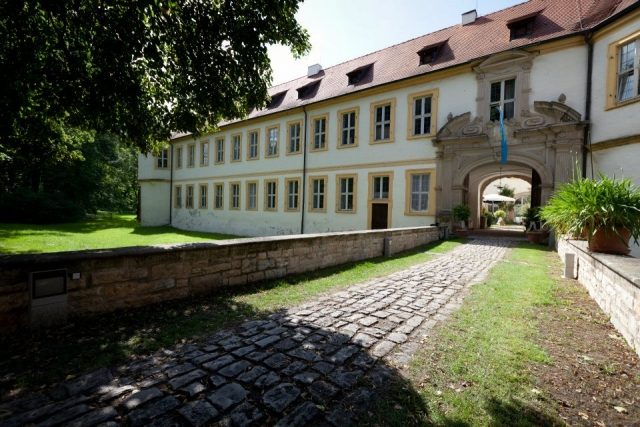
Wonfurt Castle

According to documents and traditions, the moated castle Wonfurt was originally a court of justice, which, after the settlement of the Main region by the Franks under Charlemagne, functioned as a central office -Centuris-, i.e., as a main seat for justice and administration of the surrounding settlements. Wonfurt Castle maintained this function as a patrimonial court until 1851.
According to tradition, between 801-850, a woman named v. Unfordi was the owner, whose husband had fallen in a campaign against the pagan Thuringians. As she was without heirs, she bequeathed all her land to the Burgrave of Obertheres, Count Babenberg, with the stipulation, however, that if the Count or his descendants wished to sell the court, it could only be passed on to an ecclesiastical or religious corporation. Uonfordi or Uonifurt had gained importance early on thanks to its location not far from the opposite castle of the Babenbergs at the ford crossing the Main.
Wonfurt is first mentioned in a document in 903 as part of the possessions of Count Adelhard of Babenberg. He rebelled against the East Frankish King Louis IV (the Child) and was defeated in battle. It was a struggle for supremacy in Francia, for in 911, with Louis IV, the Carolingian dynasty died out. In this struggle for supremacy, the Babenbergs were defeated by the Conradine noble family. This family then provided the next German king, Conrad I, from 911 - 918, who, however, was not fully recognized. Before his death, Conrad I designated his opponent, Henry of Saxony, as his successor, bypassing his brother Eberhard. The last Babenberg, however, was beheaded in his castle Theres in 908 for breach of the peace. Wonfurt consequently came into monastic possession (Fulda, Hersfeld, Bamberg, Würzburg, Mariaburghausen). Obertheres fell to the king. On July 1, 1010, Emperor Henry (the Saint) handed this over to the Diocese of Bamberg, which established a Benedictine monastery. In 1047, it received a papal letter of protection. The first Bamberg Cathedral was built on the site of the Babenbergs' ancestral castle, Bamberg, and was consecrated in 1012. However, it burned down in 1081 and again in 1185, after which the current Staufer Cathedral was built in the early 13th century.
In 1303, the brothers Wemhaus and Guno v. Wunfurth are mentioned as vassals of the Mariaburghausen monastery. In 1330, Dietrich v. Fuchs is attested in Wonfurt, who founded the line of the Fuchs of Wonfurt. They then built a chapel in Wonfurt. Pope Urban V granted a 40-day indulgence in 1363 to all who participated in the construction of the chapel. In 1397, Cuntz Fuchs v. Wonfurt participated in a feud between the cities and the sovereign, the Prince-Bishop of Würzburg. In 1400, the eleven cities were defeated in the Battle of Bergtheim. Knight Fuchs was punished for treason or high treason and had to pay damages. In 1525, Georg Fuchs v. Wonfurt hid in his own forest during the Peasants' War from the Haßfurt mob encamped nearby, where he was discovered, however, when the Haßfurt mob returned from the destruction of Zabelstein Castle.
He was imprisoned in his own prison. Thus, Wonfurt Castle escaped destruction in the Peasants' War. In 1580, Wilhelm Karl Fuchs v. Wonfurt, the only son of the last Fuchs in Wonfurt, died. His relief in the form of a child in a shroud can still be seen well preserved in the Wonfurt cemetery. The epitaph of the last Fuchs, Georg Siegmund, who died in 1593, has been classified as particularly valuable in art history. The fief reverted to the sovereign, the Prince-Bishop of Würzburg.
In 1650, Wonfurt, as an imperial knightly fief directly subordinate to the emperor, came under the rule of the Barons von der Beeck, who originated from Holland. The first owner was Philipp, who, as a high-ranking officer with fortune, played an important role in Wallenstein's army. Wallenstein personally initiated him into his plans for a separate peace, which he, however, strictly rejected. Soon thereafter, Wallenstein was murdered.
His son Philipp, Lord of Wunfurte, fell as a colonel in the Battle of St. Gotthard against the Turks. His younger brother, Melchior Leopold, now Lord of Wunfurt, as a colonel, contributed decisively to the successful defense of Vienna during the second Turkish siege. A few years later, he liberated Ofen (Budapest after 145 years of Turkish rule). Thereafter, he became commander of the strategically important fortress of Ofen and also governor of Ofen. Melchior Leopold's daughter married a Mr. von Sommerau, who descended from a Hessian Landgrave. Their son and daughter sold Wonfurt Castle and lordship in 1764 to the Brandenburg-Kulmbach minister Wilhelm Friedrich v. Seckendorff from the Aberdar line. His son and next lord of Wonfurt, Albrecht Christoph, became Prussian Minister of Finance and was also a co-founder of the Bavarian State Bank. After his death, the castle passed jointly to two of his three sons, Friedrich Maximilian and Ludwig Carl. The eldest son, who did not take up his Wonfurt inheritance, was the renowned writer and journalist Leo Frhr. v. Seckendorff, born in Wonfurt in 1776. He was employed as a government assessor in the government of Saxony-Weimar in Weimar and was good friends with Goethe, Schiller, and Wieland. Later, in Vienna, he published the literary journal "Prometheus," while continuing to write his own literary works. He fell in 1809 as a captain of the Vienna Landwehr in the Napoleonic Wars. The later descendants of his two brothers divided the castle among themselves in the last century and lived in it together. Unfortunately, they rarely agreed. The consequence was ultimately the total loss of agricultural and forestry assets and the increasing neglect of the maintenance of the castle building. Nevertheless, numerous refugee families were housed in this building again in 1945.
In 1972, a fire destroyed the northwest wing. Due to the loss of the roof, it had been exposed to the elements without protection ever since. Shortly before the death of the last co-owner, Adalbert v. Seckendorff-Aberdar, Friedrich v. Bismarck was able to acquire the castle from him and the municipality of Wonfurt in 1978, thus saving this building, which with its Romanesque parts is one of the oldest in the region, from demolition. Since then, it has been owned by Friedrich and Maren v. Bismarck, who, with the support of the Bavarian State Government, especially the Bavarian State Ministry for Education, Science and Art, as well as the Haßberge district and the municipality of Wonfurt, have restored the monument in several construction phases and thus preserved it for posterity.
In a three-and-a-half-year full renovation phase, eleven comfortable apartments were furnished by 1996. The renovation was carried out exclusively with historically compatible materials. The structural changes made can be reversed at any time without substantial loss.
Take Mobile History with you
You are reading this text for free. Premium adds what matters on the road: descriptions read aloud, sites found through your camera, whole regions taken offline.
- Every description, including the ~17,700 Premium sites
- Audio guide: have descriptions read to you on location
- AR finder: see sites through your camera, with distance and bearing
- Unlimited saved sites
14 days free, then from €2.99 a month. Cancel anytime.
Source: Wikipedia · Licence: CC BY-SA 4.0
This description draws on the facts documented in the linked Wikipedia article; Wikipedia content is licensed under CC BY-SA 4.0. Wording and editing: Mobile History.
Location: 50.0114, 10.4647