To be privately owned
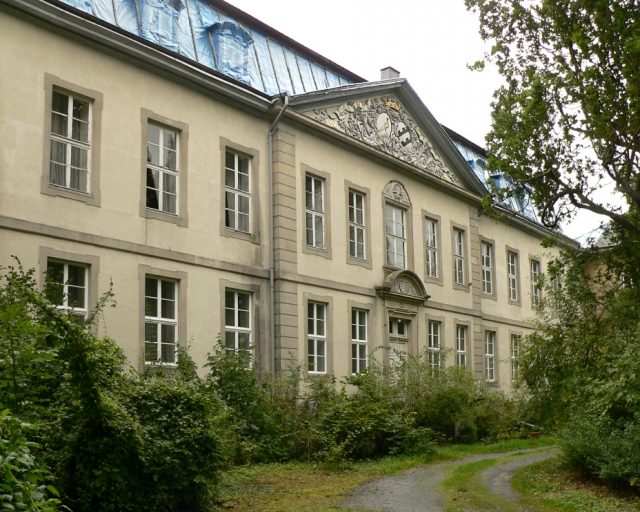
Wrisbergholzen Castle

Wrisbergholzen was first mentioned in a document in 1019 as Thiderikes Holzhusen. Bishop Godehard of Hildesheim valued the place and visited it frequently, even shortly before his death in 1038.
According to a first local plan from 1589, Wrisbergholzen had a medieval castle complex, whose origins can be assumed to date back to the first documented mention of the Lords of Wrisberg around 1350. The map depicts the building with a gate tower in front and surrounding, water-filled moats. It is a stone building with Renaissance forms, featuring two stories and two wings. This was a predecessor complex at the site of Wrisbergholzen Castle, completed in 1745.
In the lower village is the Wrisbergholzen Faience Manufactory, built in 1736, which is the oldest manufactory building for faience products in Northern Germany still preserved in its original design. With the establishment of the manufactory and the construction of the castle from 1740, more craftsmen settled in the village and new houses were built. The manufactory, which produced for almost 100 years, contributed to the economic prosperity of the place. In 1809, there were around 470 inhabitants, in 1925 about 410. About 40 percent of the local residents, including many day laborers, worked on the estate. In 1870, the municipal district of Wrisbergholzen split into two communities due to disputes over municipal burdens. The estate community and the village community were reunited in 1928.
Manor and Castle
The development of the place is closely linked to the existence of the knight's estate, which was in the hands of the Wrisberg family. The lineage is first documented with Hermann Wristberg on June 5, 1355. They were initially barons, who were elevated to the rank of count in 1817. To distinguish the place name from many other "Holthusen" and "Holzen", the noble name Wrisberg became the first part of the place name in the early modern period. In 1920, the estate owned about 1,500 hectares of land, of which it had to provide about 150 hectares for settlement purposes under the Imperial Settlement Law as part of internal colonization.
The current estate complex with Wrisbergholzen Castle was built between 1740 and 1745. The builder was Count Johann Rudolf von Wrisberg (1677-1764), then President of the Higher Court of Appeal in Celle. The castle and castle park are still impressive today, but have been in need of renovation for decades. The castle park is a nature reserve. Inside the castle is the Tile Room, a room tiled with blue and white emblem tiles. The tiles come from the Wrisbergholzen Faience Manufactory, established in 1736.
20th Century
In 1901, Werner Graf Görtz-Wrisberg had a new brickworks built on the outskirts of the village, replacing an old hand brickworks. 22 employees produced up to one million bricks, roof tiles, and pipes annually. In 1903, the village, coming from Alfeld, received its first telephone connection, which led to the manor and the brickworks. On the Kirchkamp above the village, the Marienstift was built in 1903 by the comital family of Wrisberg, where sick and infirm estate workers were accommodated. From 1904, the Count had the estate illuminated with gaslight. For this purpose, a gas plant for the production of aerogen gas was built. In 1911, the village and estate received electricity, supplied by the Gronau power plant. In 1911, a new school building was erected in the village.
About one kilometer southwest of the village, on the elevation of Wernershöhe (329 m), lies a building constructed in 1670 as a hunting lodge, which was long owned by Count Görtz-Wrisberg. In 1906, it was destroyed by an arson attack and then rebuilt as a residential building for the local outwork. Subsequently, an excursion restaurant with a coffee garden was also established there. After the seizure of power, the National Socialist Motor Corps set up a school in the building in 1938. Since November 1997, the event center Kulturherberge Wernershöhe has been located on the premises. In the vicinity of Wernershöhe, a military airfield was established in 1941. The castle served the military as a photo station for aerial images, while the castle owners were relocated.
Towards the end of World War II, on April 7, 1945, American troops shelled the village with artillery and machine guns, as they suspected German troops were there. The air unit from Wernershöhe had previously already withdrawn to Hildesheim. As a result of the attack, a cow shed of the estate burned down. In October 1945, British troops quartered themselves in the castle. Upon their departure in January 1946, they took furnishings and other inventory with them. After the war, numerous noble families who had fled or been expelled from their homeland in the east of the Greater German Reich chose Wrisbergholzen as their new residence. They were initially accommodated in the castle.
Take Mobile History with you
You are reading this text for free. Premium adds what matters on the road: descriptions read aloud, sites found through your camera, whole regions taken offline.
- Every description, including the ~17,700 Premium sites
- Audio guide: have descriptions read to you on location
- AR finder: see sites through your camera, with distance and bearing
- Unlimited saved sites
14 days free, then from €2.99 a month. Cancel anytime.
Location: 52.0292, 9.9144