Home for the elderly
School
Wurzach Castle

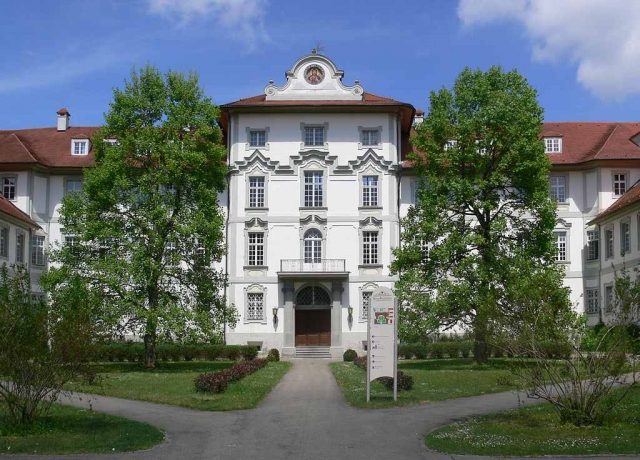
Bad Wurzach Castle, also known as Wurzach Castle or Wurzacher Schloss, is a cultural monument and landmark of the town of Bad Wurzach in the Upper Swabian district of Ravensburg in Baden-Württemberg. The Baroque staircase from 1728 is particularly noteworthy.
The castle was built between 1723 and 1728 by Count Ernst Jakob Truchsess von Waldburg-Zeil-Wurzach. For two centuries, it served as the residence of the Wurzach line of the noble family and developed into a center of courtly music and painting. In 1922, the Salvatorians purchased Wurzach Castle and established a Latin school with a boys' boarding school there. Operations began in 1924, and the new school grew very quickly.
On November 28, 1937, due to Nazi education policy, the Salvatorkolleg was prohibited from admitting further students. Soon it had to cease its school operations, and the large building stood practically empty. In September 1940, the Biberach Army Garrison Administration rented the castle for use as a prisoner-of-war camp. From 1940 to 1945, Wurzach Castle, as the site of three camps, was part of the Nazi camp system. A so-called "Wehrertüchtigungslager" (military fitness camp) was also located in the castle park. The prisoners in Wurzach were relatively safe. They were liberated by the French army on April 28, 1945.
Wurzach was the site of three Wehrmacht officer camps (Oflag):
- Oflag V-C, from September 1940 to May 1942, subordinate to the Commander of Prisoners of War in Military District V
- Oflag V-D, from December 1942, subordinate to the Commander of Prisoners of War in Military District V
- Oflag 55, from May 1942 to April 1, 1944
Prisoner-of-War Camp
After its forced closure in 1940, it initially served as a prisoner-of-war camp (Oflag V C) for French officers. Between early 1941 and mid-1942, 500 to 600 prisoners of war were housed in the castle and in five barracks in the castle garden. After the camp was dissolved in autumn 1942, the prisoners were transferred to other camps. The camp reached its maximum occupancy in March 1941 with 804 French prisoners of war and 210 guards. In November 1942, the Army Garrison Administration terminated the contract for renting the castle, although at that time the castle was already being used for another purpose.
Internment Camp
At the end of the Western Campaign, the British Channel Islands were occupied by the German Luftwaffe on June 30, 1940. A German civil administration took over the archipelago, established a civil administration there, and the islands were fortified into impregnable fortresses. In September 1941, the British authorities had requested the Persian government to extradite German citizens who were working against the Allies. As a countermeasure, Adolf Hitler ordered all British-born residents of the Channel Islands to be taken hostage and deported. The deportation took place in September 1942; they were brought to Oflag VI Dorsten, southwest of Münster in Westphalia, and finally to various camps in Southern Germany. Because the Lindele camp in Biberach was overcrowded, on October 31, 1942, 186 men and 411 women and children were transferred to the Wurzach sub-camp, Ilag VC. The first transport from Jersey had arrived there on September 16, 1942. On October 31, 1942, the citizens from Jersey were transferred to Wurzach by special train, unusually in 2nd class. At this time, the old building was dirty, the beds were damp, plaster was falling from the walls and ceilings.
A tangle of responsibilities for the internment camp in the castle arose between Reich authorities and local institutions. After a few weeks under Wehrmacht guard, the administration of the camp was handed over to the Württemberg Ministry of Interior on December 1, 1942. The Wehrmacht guard units were withdrawn and replaced by police forces from the Ravensburg Schutzpolizei guard battalion. The camp commandant became Master and later Lieutenant of the Schutzpolizei, Martin Riedesser. No SS guards were ever deployed, even though the central decision-making authority over the internment camp lay with the Reich Leader SS and Chief of the German Police in the Reich Ministry of the Interior. Central instructions therefore came from the Reich Security Main Office in Berlin. However, employees of the legal department of the Foreign Office, who had found an alternative quarter in Liebenau, and an employee of the Württemberg Ministry of the Interior generally took care of the internees' concerns.
It became clear that, unlike many other harassed groups, the British were indeed privileged prisoners. The Geneva Convention for the Protection of Prisoners was observed by the local camp management and also by the superior authorities as far as possible. The camp was monitored by international organizations until the end of the war, including the International Committee of the Red Cross (ICRC), the YMCA War Prisoners' Aid, and observers from the protecting power Switzerland. Packages regularly arrived from the ICRC. There were also friendly contacts with the local population. The more than 600 civilian internees were granted camp self-administration. Although they were poorly fed, they received a monthly pocket money of 10 Reichsmark, were allowed to receive food parcels, had medical care, and worked in the supply and maintenance of order in the camp. A cultural life and care for children and young people also developed. There were twelve deaths and five births until 1945. Individual internees were allowed to return from Wurzach to Jersey as "hardship cases."
According to Rothenhäusler's research, the correct local camp leader could not regain a foothold after the war; his superior in the SS Reich Security Main Office made a veritable career in Adenauer's Germany.
Jewish Prisoners from Bergen-Belsen
In the winter of 1944/45, the castle finally served as a transit station for 72 Jewish prisoners from the Bergen-Belsen concentration camp. Those transferred from Bergen-Belsen to Wurzach in November 1944 were Jews from Holland who had foreign nationality, meaning they also held British or American citizenship or at least papers from South and Central American states, and who were considered "exchangeable" in negotiations concerning German citizens in Allied custody. They had been brought in two transports in autumn and winter from this concentration camp northeast of Hanover to Southern Germany to be exchanged via Switzerland for German citizens in Allied hands. However, part of the group had to leave the train in Ravensburg without stating reasons. Fortunately, they were not transported back to Bergen-Belsen but were distributed among the Württemberg internment camps in Liebenau, Biberach, and Wurzach. According to reports from the internees from Jersey, the so-called "exchange Jews" were in a deplorable state upon their arrival, completely starved and frightened. However, due to better nutrition and additional Red Cross packages, they recovered relatively quickly and, with one exception, experienced their liberation in Wurzach.
Castle Complex+
The center of the middle wing is formed by the staircase of an unknown architect, which is considered a highlight of Upper Swabian Baroque architecture. Elegantly curved, the sandstone staircase leads upwards around a trefoil core. It is built in a stage-set architectural technique with painted wooden parts that simulate lower steps and stone (marble, alabaster) towards the top, creating a wide and imposing perspective from the entrance. The ceiling fresco depicts the Olympian pantheon. The staircase served as a meeting point for the British internees during World War II and was nicknamed "Marble Arch" by them.
The castle chapel is located in the right wing of the castle.
Current Use+
The west wing houses senior-friendly apartments connected to the neighboring Stift zum Heiligen Geist nursing home. The upper school of the Salvatorkolleg grammar school is also located in the castle, as is a special program for promoting particularly gifted young people. The Institute for Social Professions (IfsB) trains students for curative education and geriatric care in the east wing. The Salvatorian order is also still based in the castle. In 2006, a banquet area was opened in the castle, enabling events and conferences to be held there. The Baroque staircase is the official registry office of the town of Bad Wurzach.
Foundation Cultural Monument Bad Wurzach Castle+
In 2004, the Foundation Cultural Monument Bad Wurzach Castle was established, which has owned the castle ever since. The foundation has made it its mission to permanently preserve the listed castle and open it to the public.
Take Mobile History with you
You are reading this text for free. Premium adds what matters on the road: descriptions read aloud, sites found through your camera, whole regions taken offline.
- Every description, including the ~17,700 Premium sites
- Audio guide: have descriptions read to you on location
- AR finder: see sites through your camera, with distance and bearing
- Unlimited saved sites
14 days free, then from €2.99 a month. Cancel anytime.
Source: Wikipedia · Licence: CC BY-SA 4.0 · Image: http://de.wikipedia.org/wiki/Datei:Bad_Wurzach_Schloss_Hauptfassade.jpg
This description draws on the facts documented in the linked Wikipedia article; Wikipedia content is licensed under CC BY-SA 4.0. Wording and editing: Mobile History.
Location: 47.9093, 9.8963