Uninhabited
CastleZerbst
Zerbst Castle
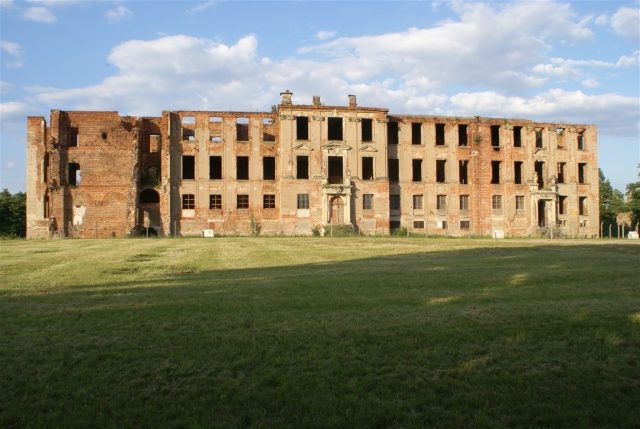
In Zerbst, Saxony-Anhalt, stands the ruin of Zerbst Castle, once the residence of the Princes of Anhalt-Zerbst. Although severely damaged during World War II and largely demolished thereafter, the preserved east wing still shows its former Baroque splendor and a history that dates back to a Slavic water castle.
History+
The origins of Zerbst Castle lie in a Slavic water castle from the 12th century, first documented in 1196. This complex, consisting of a bailey and a main castle, was surrounded by a moat and a fortress wall. By the 16th century, the castle evolved into a Ganerbenburg with several houses for different family branches. After a period of decay in the early 17th century and the Thirty Years' War, the complex was largely uninhabitable in the second half of the 17th century. Prince Karl Wilhelm then commissioned the Dutchman Cornelis Ryckwaert in 1681 to construct a new Baroque building. The foundation stone was laid on May 31, 1681. The three-winged castle in Dutch Baroque style was built in stages: the shell of the Corps de Logis was completed in 1689, and its inauguration took place in 1696. Under Ryckwaert's successor Giovanni Simonetti, the west wing was built from 1703 to 1706, and from 1721, the central risalit was expanded into a castle tower.
Source: Wikipedia · Licence: CC BY-SA 4.0 · Image: Roland Neubert, Halle (Saale)
This description draws on the facts documented in the linked Wikipedia article; Wikipedia content is licensed under CC BY-SA 4.0. Wording and editing: Mobile History.
Location: 51.9639, 12.0819