CastleZinnitz

Zinnitz Castle

Zinnitz Castle

Apartments

Offices

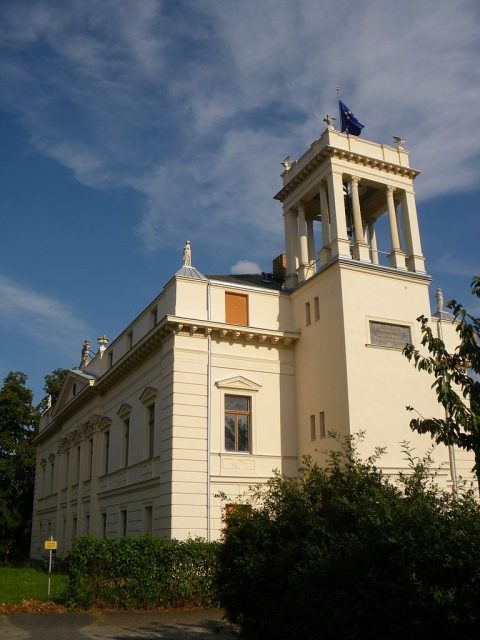
Zinnitz Castle (current appearance from 1860–1864) is a Neoclassical building in Zinnitz, a district of the town of Calau south of the Spreewald. It is one of the listed buildings in Calau and is currently used, among other things, as an architectural office and residential building.

Legends and Origins

According to Heinrich Berghaus, Zinnitz "is one of those localities in Lower Lusatia that are mentioned earliest in history, already at the beginning of the 11th century in the Chronicle of Bishop Dithmar of Merseburg as one of the fortified castles of the land". The village with its manor "Ciani, Zizani or Sciciani" was thus temporarily the residence of the Polish Duke Bolesław I and is also said to have been the starting point of a fruitless attack on the German army marching into Poland in 1014. However, more recent research seems to refute Berghaus' statements or to relativize them to the effect that today's Zinnitz was probably not the location of those events.

Around 1255, the v. Cynnitz family appears in Lower Lusatia with a Gebhard. This letter from Doberlugk Monastery is considered the earliest documented written mention of the place. On August 3, 1301, Margrave Dietrich the Younger sold the March of Lusatia to Archbishop Burchard of Magdeburg, including the "curia Zcinnitz" among the associated estates.

The Era of Bocksdorf

After that, the manor came into private ownership. The family of Buckinsdorff, Buckenstorf de Czymricz or Bocksdorf,

Buxdorf owned it for about 300 years. Among them, Dietrich III von Bocksdorf deserves special mention: Around 1425, he was enrolled at the University of Leipzig "to study law there". After a stay in Italy, where he earned a doctorate in both laws in Perugia, he rose to become a full professor in Leipzig in 1439, head of the Faculty of Law, and was elected Rector of the University for the summer semester of 1439. Dietrich von Bocksdorf was considered at that time "one of the highest authorities of Saxon law". Among his most prominent cases is certainly the legal dispute between the Saxon Elector Frederick II and Kunz von Kauffungen, which preceded the Altenburg Prince Abduction of 1455. Bocksdorf, who had advised the Leipzig aldermen, had single-handedly ensured that the Elector he represented was vindicated. His high income made him a rich man, who in 1459 endowed a scholarship for a family member suitable for study. However, the Bocksdorf family made little use of it and repeatedly refrained from allowing family members to study under the favorable conditions Dietrich had created. While Dietrich von Bocksdorf rose to become Bishop of Naumburg before his death in 1466, the Buxdorf family sank into insignificance in the following centuries. The decline of the Bucksdorf family is documented by a judgment against Heinrich Apollo von Buxdorf from 1670 for a homicide offense.

Changing Owners

In the following 100 years, the Zinnitz manor changed hands several times, sometimes in individual shares of inheritance. Among these, the Royal Prussian Major Friedrich Gottlob von Schladen should be mentioned as an example, who bought it in 1784 and kept it only until 1786. In this short time, however, he is said to have built "a new, very modest manor house, which stood until 1851 and was last used as a servant's house".

Upswing through des Granges

From him, in 1786, Zinnitz with Berlinchen was bought by the former Royal Prussian Captain, then Colonel and finally Major General Philipp Ludwig Sigismund Bouton des Granges, who since 1778 was also the first head of the Feldjäger Regiment newly established under Frederick II. He came from a family that had emigrated from Switzerland.
In 1795, he sold it to his son Ludwig Philipp Karl des Granges. His daughter Pauline, born in 1801, later Countess Nostitz-Rieneck, was married in her first marriage to the naturalist Johann Wilhelm Helfer, with whom she undertook research trips, among others, through the Near East along the Euphrates and to India. Her travel descriptions were also published by her. In her childhood memories, she reports, among other things, that her father never allowed heating in the castle before November 1st and about encounters with French troops during the Napoleonic Wars. Thus, "to drive away the cold with cold," she went swimming in the nearby castle pond in winter. During the des Granges era, a more stately new manor house was built – probably around 1818/19. His heirs sold it in 1837 to Sofie Henriette Isabella Countess zu Lynar, who resold it as early as 1842.

Country Estate of the Prussian Finance Minister

In 1842, the estate finally came into the possession of the Royal Prussian Privy Senior Finance Councillor, later Finance Minister and President of the Province of Brandenburg, Erasmus Robert Freiherr von Patow. He had extensive construction work carried out, transforming the existing manor house into a late-classical castle complex with spacious parklands and water features. The landscape gardener Johann Gottlieb Handschick skillfully integrated the vaulted fragment of a previous building as a "rose hill" with a pavilion into the overall complex.

Patow outlived his children and died in 1890. The estate fell to his nephew Egon von Patow, who finally sold it in 1917/18 to Ilse Bergbau AG. From 1929, the Deutsche Reichsbahn-Gesellschaft was named as the owner.

The Times of National Socialism and the GDR

On June 27, 1933, the "Reichsautobahn", a subsidiary of the Deutsche Reichsbahn-Gesellschaft, was founded. The construction of the Berlin-Dresden motorway began and touched the castle at a distance of only 3 km as the crow flies.

From 1939 to 1944, it served as a National Socialist labor camp for young women, and after the turmoil of the end of the war, from 1945, the castle was under the legal responsibility of the municipality of Zinnitz. During the GDR era, it was then used first as a school ("Maxim-Gorki-OS"), then as the municipal council, headquarters and canteen of an agricultural production cooperative, and for residential purposes. In individual renovation phases, damage to the facades was repaired, but all historical windows were also replaced, as was the wooden main staircase by a precast concrete staircase. The installation of a large kitchen led to further structural damage. The rose hill was already leveled during its use as a school.

The surrounding area was severely affected by nearby lignite open-cast mines until 1990; the groundwater level dropped dramatically, and trees in the remaining part of the park died.

Recent Development

In 1993, the architect Robert Viktor Scholz bought the castle from the municipality and began the careful restoration and reconstruction of the severely damaged facades in several stages. The aim of his design efforts is to restore the appearance of the castle during Patow's time.

Building+

Predecessor Buildings No Longer Extant

Unfortunately, no pictorial representations of the buildings before 1860 are known. Apart from some cadastral maps (which, however, only exist after the Buxdorf dynasty), which show the entire locality of Zinnitz at different time intervals, there are no more precise details about the location and size of buildings in the castle area.

The first, at least written, descriptions appear during the time of Gottlob von Schladen, about whose new construction of a "modest manor house" Berghaus states "that the front was adorned in the manner of the Propylaea in Athens by a wooden colonnade".

However, since this was supposed to have been a "very modest manor house", "which stood until 1851" and "was last used as a servant's house"², it probably did not stand on the site of the present castle, especially since the later owner Ludwig Philipp Karl des Granges is said to have built a more stately new manor house around 1818/19 (cf. above).

The latter was finally reshaped by Robert von Patow – and not replaced in substance by a new building, as came to light during the facade renovation: Under the classical plaster of the building from 1860/64, bricked-up window openings vaulted with round arches appeared, referring to the predecessor building.

Current Late-Classical Appearance

The current late-classical appearance of the castle shows the significant alterations and additions that Robert von Patow had carried out between 1860 and 1864. He followed the ideals of Classicism and the Italian Renaissance. Alexander Duncker recorded this in his contemporary work around 1869. Patow had a whole series of contemporary models at his disposal:

Models

Between 1858 and 1862, Patow was Finance Minister and had his official residence in Berlin in the Palais am Festungsgraben right next to the Singakademie built by Karl-Friedrich Schinkel, which in the summer of 1848 was the venue for the Constituent Prussian National Assembly – and thus very familiar to the politician Patow. In 1863 and 1864, the building of the Prussian Ministry of Finance was rebuilt according to plans by Georg Heinrich Bürde and Hermann von der Hude.

Exactly at the same time – namely from 1860 to 1864 – Patow also had Zinnitz Castle extensively rebuilt and gave it its characteristic classical facades that still define it today. It is probable that he sought the collaboration of the aforementioned architects for this and that he – if one compares the central risalit of Zinnitz Castle with the facade of the Singakademie – was also inspired by the latter (as he constantly had it in view from his workplace).

In addition, Patow had a Belvedere tower added to the west side. This, in turn, could have been inspired by another construction project of those years: the Belvedere on Pfingstberg. The double-tower complex, modeled on Italian Renaissance examples, underwent two construction phases, the second of which, after a longer interruption, took place from 1860 to 1863. According to design drawings by King Friedrich Wilhelm IV, the architects Ludwig Persius, Friedrich August Stüler, and Ludwig Ferdinand Hesse were commissioned to carry out the construction. Similar Belvedere towers can also be found on numerous other buildings and villas of that period in Potsdam and Berlin.

Changes during the GDR Era

As already described in the "History" chapter, there were gradual changes between 1945 and 1990, which, while giving the castle a use, all reversed the classical original state.

While by 1945 the colonnades in front of the south facade and the pavilion on the rose hill (cf. Duncker view) as well as some sculptures on the roof had already disappeared or were severely damaged, further new facts were created after the end of the war:

Removal of the rose hill, excavation of part of the castle park for lignite mining (accompanied by groundwater lowering and destruction of surface waters), demolition of the wooden internal staircase, partial destruction of internal doors, parquet floors and historical wall and ceiling paintings, complete replacement of the historical windows (around 1969), removal of stucco friezes and consoles on the Belvedere tower and much more.

In addition, the fragmentation of the land into small parcels in the course of the GDR land reform led to the destruction of the original outdoor facilities.

Reconstructions since 1993

After purchasing the castle, the architect Robert Viktor Scholz has since supplemented or extensively renewed the lost classical decorative elements of the facades all around by 2002. Contemporary witnesses from earlier decades – including descendants and members of the des Granges and von Patow families – were able to provide valuable information for this.

In 2003, the LMBV restored parts of the castle park with a new concept, creating a new path system and planting trees. This was preceded by extensive dismantling of surface facilities from lignite mining.

However, a restoration of destroyed surface waters has not taken place.

Take Mobile History with you

You are reading this text for free. Premium adds what matters on the road: descriptions read aloud, sites found through your camera, whole regions taken offline.

  • Every description, including the ~17,700 Premium sites
  • Audio guide: have descriptions read to you on location
  • AR finder: see sites through your camera, with distance and bearing
  • Unlimited saved sites

14 days free, then from €2.99 a month. Cancel anytime.

Source: Wikipedia · Licence: CC BY-SA 4.0

This description draws on the facts documented in the linked Wikipedia article; Wikipedia content is licensed under CC BY-SA 4.0. Wording and editing: Mobile History.

Location: 51.7913, 13.8496