Local government
Zwingen Castle

Between Basel and Delémont lies Zwingen Castle in the middle of the Birs River – where wood was floated – and on the former path through the Laufen Valley. Zwingen Castle can be reached on foot from Zwingen train station in five minutes.
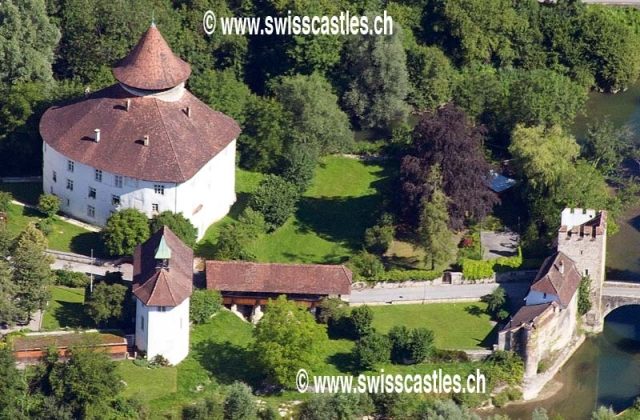
The entire complex was built on islands in the Birs River. However, the arms of the Birs that still flowed between the islands in the Middle Ages have since dried up or been drained. Nevertheless, the entire complex is still surrounded by the Birs. The overall concept represents a compromise between a castle and a town foundation: on the one hand, characteristic castle features such as a keep are present, but on the other hand, the size of the walled area is designed for the establishment of a settlement.
The eastern outer bailey is dominated by the gate tower with its battlements. This Ramsteiner Tower protected the access from the path towards Basel. The original drawbridge over this arm of the Birs was replaced by a stone bridge. Significant parts of the curtain wall still stand, and a shell tower reinforces the southeastern corner of the wall. A covered wooden bridge connects the outer bailey with the main part of the complex. This historic wooden bridge is one of the few that still largely consists of its original timber. The arm of the Birs that formerly flowed under the bridge has since dried up, but is still clearly visible.
The main castle is dominated by the approximately oval core castle. This originally stood on its own small island, which is no longer recognizable as such today. The round keep, which today protrudes from the top of the core castle, represents the first significant construction phase. Later, various buildings were directly attached to it. Today, these annexes have all merged with the keep and form the core castle. On the north side of the core castle, several latrine bay windows were formerly installed, which used the Birs as a natural flush.
The two gates of the main castle have disappeared, but significant sections of its curtain wall are still present on the central islands. In the southeast corner of the main castle is the Oswald Chapel. The space within the curtain wall was never completely built over, which is considered an indication of the failure of the town foundation. The Zwingen municipal administration is housed in a building that has probably been altered over time but still contains considerable medieval building fabric.
The moat between the central islands and the western island was artificially leveled. This western island was probably never included in the complex. Due to the strong commercial-industrial use, few traces would have remained anyway. However, it can certainly be stated that the paper mill, as the owner of Zwingen Castle, has made a significant contribution to the current good condition of the complex.
No documents regarding the construction period have been preserved. The oldest parts are dated after the middle of the 13th century. The Barons of Ramstein are documented as owners of the complex in 1312, which was a fief of the Bishop of Basel. The Ramsteiners had gained power and influence as episcopal ministeriales. They will have pushed for the expansion into a small town in order to compete with the episcopal town foundation in Laufen and to further advance their own power development. This even went so far that, as partisans of the Habsburgs, they pressured the bishop. The successful enforcement of the interests of the Bishop of Basel is likely to be cited as a significant cause for the failure of the town foundation – including the halt of the construction of further buildings inside the complex. When the Ramsteiners died out with Rudolf von Ramstein, who had no legitimate sons, the bishop confiscated the fief in the 15th century and had it administered by a bailiff. Significant alterations were made in the 16th and 17th centuries, for example, the Oswald Chapel was rebuilt between 1571 and 1575. In 1795, as a result of the revolutionary turmoil, the complex was sold to private owners and then acquired by the Zwingen paper mill in 1913. Since 1993, it has been owned by the municipality of Zwingen.
Take Mobile History with you
You are reading this text for free. Premium adds what matters on the road: descriptions read aloud, sites found through your camera, whole regions taken offline.
- Every description, including the ~17,700 Premium sites
- Audio guide: have descriptions read to you on location
- AR finder: see sites through your camera, with distance and bearing
- Unlimited saved sites
14 days free, then from €2.99 a month. Cancel anytime.
Source: Wikipedia · Licence: CC BY-SA 4.0
This description draws on the facts documented in the linked Wikipedia article; Wikipedia content is licensed under CC BY-SA 4.0. Wording and editing: Mobile History.
Location: 47.4377, 7.5270