To be privately owned
Schlossbauerngut Castle

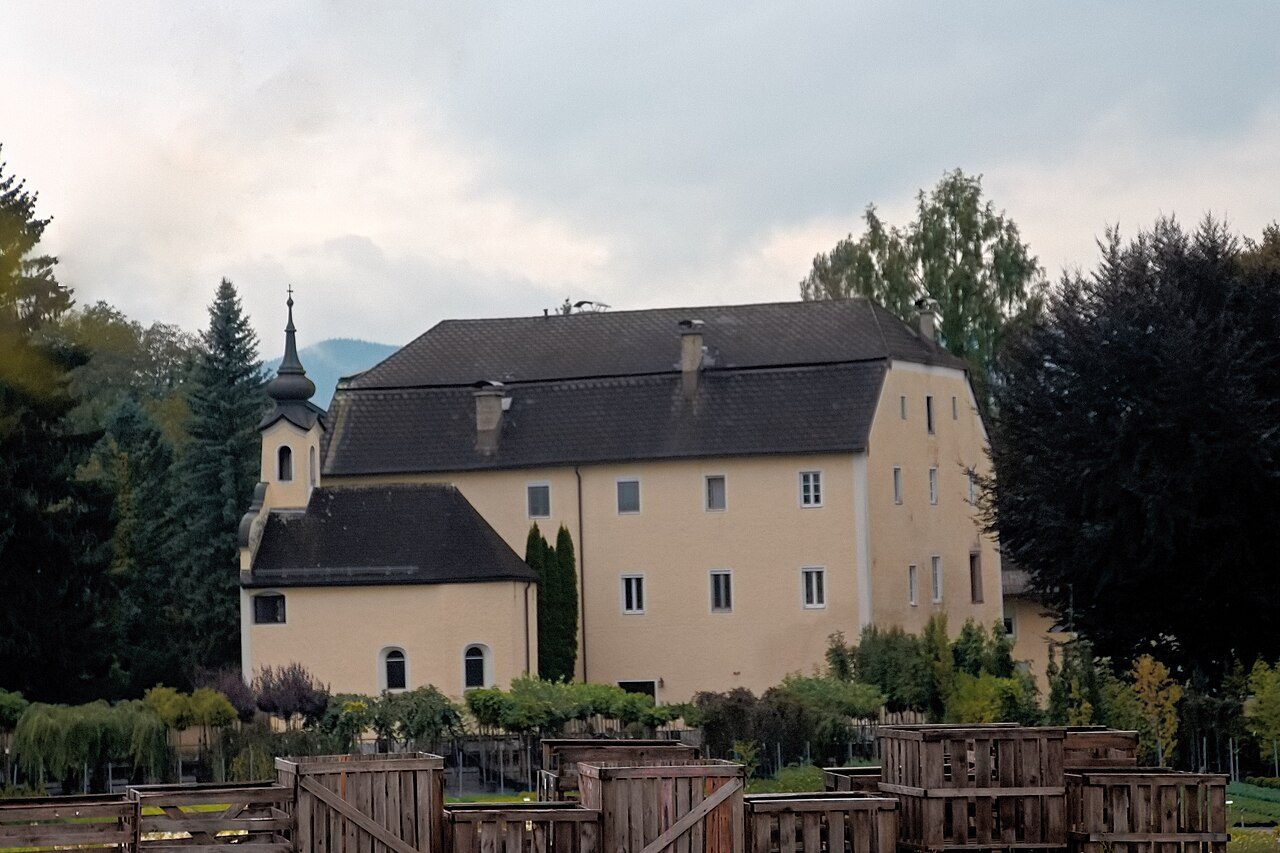
The Schlossbauerngut with the Anna Chapel is a manor from the 15th century in Liefering (Lieferinger Hauptstraße 86), today a district of Salzburg.
In 1463, the Salzburg physician Leonhard Kurz is documented as the owner of the estate in Liefering. Since his will mentions the "estate in Lifring, which he inherited there," a house must have existed earlier. After his death, the property passed in 1495 to his wife Ursula Lyfringin (derived from her husband's nickname, the "Lifriger"), then to their daughter Margareta (1502), who was married to Sebastian Klaner, the Urbarrichter (land registrar) of St. Peter's Monastery. They were followed by Sebastian Höflinger, Chancellor and Hofurbarrichter. From him, it passed in 1576 to his widow and son Sebastian. By this time, a walled farmstead must have existed, which was tax-exempt. Subsequently, the husbands - Hans Jakob Teufl von Pichl and Christoph Georg Schweickhardtsreiter zu Sweykhartsrieth - of Sebastian Höflinger's two sisters took over the property and sold it in 1592 to the noble and steadfast Captain Leonhard Ehrgott. In 1596, he became Colonel Captain of His Royal Majesty of Spain, Salzburg War Councillor, and around 1600 was elevated to the Imperial Nobility by Emperor Rudolf II. He rebuilt the 'house' in Liefering, which had by then become a castle, and essentially gave it its present form; a west wing as a barracks, a ring wall around the farmstead (castle?), and a drawbridge, which no longer exists today, were added. Leonhard Ehrgott remained childless despite multiple marriages. Therefore, the property passed, via his nieces and nephews, through sale to a Georg Ludwig Grimming. This was followed by other nobles such as Ludwig von Grimming zu Neudegg und Liefering, Dorothea Countess von Schernberg, and Thomas Perger von Emslieb.
From 1685, the "Adeliche Süß Lifering" seems to have come into the possession of Franz Georg Grembs, city and court physician of Salzburg and related to the Grimmings. After his death in 1706, his daughter Anna Ursula and his son Stephan Adam sold the estate in the same year to their curator Adam Franz Gutrater (hence also the name Gutratshof). In 1741, he sold the castle to his son Carl Adam. After his death, his six children inherited the property. In 1758, Joseph Claudi von Altguetrat, his sister Maria Franziska Theresia, and their mother Maria Elisabeth sold the entire property to Johann Marian Lürzer von Zehendthal. He was the last noble owner of the castle estate. He was followed in quick succession by the brewer Lorenz Hierl (1763), then his wife Kunigund Böstin (1793), Franz Hörl or Hierl (1803), Anna Waldherr (1824), and finally Jakob Helminger by auction (1833). Katharina Helminger married Hans Unger in 1949. Their descendants still live on the manor today.
The Castle and the Chapel of Saint Anna+
The castle was probably built in its present form at the beginning of the 17th century. It is a three-story, cubic building with a mighty hipped roof, connected on the east by a connecting wing to the Anna Chapel.
In 1606, under Leonhard Ehrgott, the Anna Chapel was built and consecrated in honor of the Feast of the Assumption of Mary. Its east side borders the manor. It is a tall, two-bay, north-south oriented hall building with a polygonal apse (3/8-closure) in the north. The entrance facade in the south is crowned by a curved volute gable and a roof turret with an onion dome.
The interior of the chapel has a barrel vault with lunettes and a pilaster structure with Ionic capitals. In the vault stucco from the 3rd quarter of the 18th century, reliefs of the four Evangelists can be seen. In 1975, the renovation of the chapel began. During this, old fresco remnants with depictions of apostles were uncovered. Remnants of Baroque wall painting (17th century) as door and window frames, apostle crosses, and half-figures have been heavily restored.
The original Renaissance altar with the altarpiece of the Assumption of Mary - the original patronage for the Feast of the Assumption of Mary - was sold to an unknown location in the interwar period. A painting shows Mary as the Queen of the Rosary and the founder of the chapel. A Renaissance painting of Anna Selbdritt by Arsenio Mascagni went to Crown Prince Ludwig of Bavaria in 1824. The current altar with a cross dates from the third quarter of the 18th century.
In 1976, the chapel was re-consecrated by Prelate Ferdinand Grell.
Schlossbauerngut Today+
In 1929, a great storm tore off the shingle roof of the castle. The roof was restored in a slightly altered form. In the following years, the castle was gradually renovated. In 1949, the Schlossbauerngut was placed under monument protection.
Take Mobile History with you
You are reading this text for free. Premium adds what matters on the road: descriptions read aloud, sites found through your camera, whole regions taken offline.
- Every description, including the ~17,700 Premium sites
- Audio guide: have descriptions read to you on location
- AR finder: see sites through your camera, with distance and bearing
- Unlimited saved sites
14 days free, then from €2.99 a month. Cancel anytime.
Source: Wikipedia · Licence: CC BY-SA 4.0 · Image: Eweht / CC BY-SA 4.0 via Wikimedia Commons
This description draws on the facts documented in the linked Wikipedia article; Wikipedia content is licensed under CC BY-SA 4.0. Wording and editing: Mobile History.
Location: 47.8227, 13.0109