CastleGera - Untermhaus

Osterstein Castle
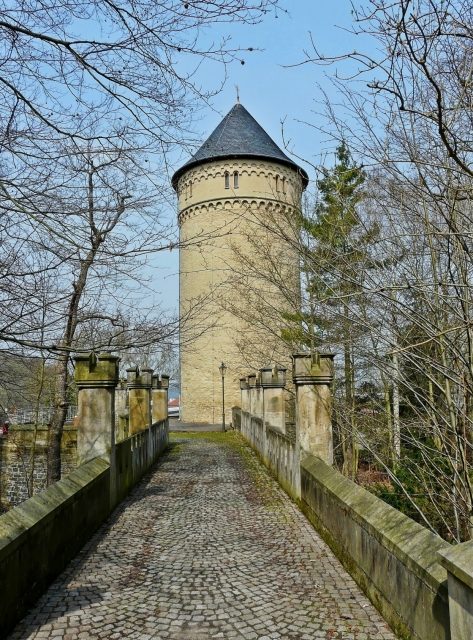
Osterstein Castle

The remains of the Castle can be visited

Osterstein Castle on the Hainberg hill above the Gera district of Untermhaus was the princely residential castle of Reuss Younger Line.

The castle was destroyed in World War II, and the ruins were blown up in 1962. Today, only the former keep from the 12th century, as well as remains of outbuildings and the castle courtyard, are preserved from the original building fabric.

On the site of a Bronze Age rampart and a later Slavic castle, only proven since 1997, on the Hainberg, a castle complex was built by the Lords of Weida in the 12th century. From this period dates the keep, one of the few remaining parts of the castle. However, the complex remained insignificant for a long time compared to the Vogt's castle in the city of Gera, as Osterstein was located to the left of the Elster and thus did not belong to the Quedlinburg collegiate territory like Gera, but was subject to the Landgraves of Thuringia. Only when the Gera city castle was destroyed in 1450 during the Saxon Fratricidal War did the Lords of Gera move their seat back here.

In 1550, the line of the Lords of Gera died out, and the territory fell to the related line of Reuss of Plauen zu Greiz. In the 16th and 17th centuries – starting with Heinrich the Younger, the father of Heinrich Posthumus Reuss, in the 1560s – the castle was converted into a stately Renaissance castle. In 1581, the name Osterstein was first mentioned by Petrus Albinus. Until its extinction in 1802, the castle was the seat of the Reuss-Gera line.

Since 1863, Osterstein was the residence of the Principality of Reuss Younger Line. On March 1, 1908, the marriage between the Bulgarian Tsar Ferdinand I and Eleonore Reuss zu Köstritz was solemnized at the castle. This was a Protestant ceremony, after the couple had already been married Catholic two days earlier in Coburg. On April 24, 1917, the last princely wedding took place at Osterstein Castle, in which Feodora Reuss Younger Line married Duke Adolf Friedrich zu Mecklenburg.

After the end of the monarchies in the German Empire in 1918, the princely family Reuss continued to use the castle as their residence for a long time. During the heaviest bombing raid on Gera on April 6, 1945, the castle was destroyed and completely burned out. The ruins were largely left to decay; only the keep received its current conical spire. As part of a NAW project, the dilapidated ruins were blown up on December 9, 1962. On the plateau of the former main castle, a restaurant for excursions, the Terrassencafé Osterstein, was built, which also includes a small open-air stage and a children's playground. Together with the keep, now used as an observation tower, the café is a popular excursion destination today.

Take Mobile History with you

You are reading this text for free. Premium adds what matters on the road: descriptions read aloud, sites found through your camera, whole regions taken offline.

  • Every description, including the ~17,700 Premium sites
  • Audio guide: have descriptions read to you on location
  • AR finder: see sites through your camera, with distance and bearing
  • Unlimited saved sites

14 days free, then from €2.99 a month. Cancel anytime.

Source: Wikipedia · Licence: CC BY-SA 4.0 · Image: Thomas Eichler

This description draws on the facts documented in the linked Wikipedia article; Wikipedia content is licensed under CC BY-SA 4.0. Wording and editing: Mobile History.

Location: 50.8807, 12.0630