Cultural Events
To be privately owned
Alt-Wartenburg Castle

The Wartenburg dominion was located in today's Oberthalheim, a village in the municipality of Timelkam on the municipal border with Vöcklabruck. It was first mentioned in a document with Arnold von Wartenburg in 1128 in the foundation charter of the Benedictine monastery of Gleink.
Owners or Feoffees+
The dominion was in the possession of the Lords of Pollheim (Polheim-Wartenburg line) for over 300 years. Ortolf von Pollheim was mentioned as the owner of the property in a document in 1319. One of the most significant owners was Wolfgang von Polheim (1458–1512), who founded the first Paulaner monastery in the German-speaking world in nearby Oberthalheim. His son Cyriak von Polheim (1495–1533) and his descendants joined the Reformation. In the course of the Counter-Reformation, around 1640, the Protestant Ludwig von Pollheim sold the dominion to the Catholic Tobias Nütz von Goisernburg. He succeeded in converting the fief into free property. Around 1729, Johann Albert Graf Saint-Julien-Wallsee bought the dominion from Nütz's bankruptcy estate. Subsequently, there were several changes of ownership (Johann Ignaz von Ghelen, Baron Johann Georg Grechtler, Baron von Reischach, Ludwig von Ratzesberg) and in 1869 it came back into the possession of the Counts Saint-Julien-Wallsee. In 1973, the Alt- and Neu-Wartenburg estate was acquired by the Counts Strachwitz.
Seats of Power+
Neu-Wartenburg Castle
On the right bank of the Vöckla, below Wartenburg Castle, is Neu-Wartenburg Castle. The castle was built on behalf of Johann Albert Graf Saint-Julien-Wallsee (1673–1766) by the Viennese architect Anton Erhard Martinelli between 1730 and 1732.
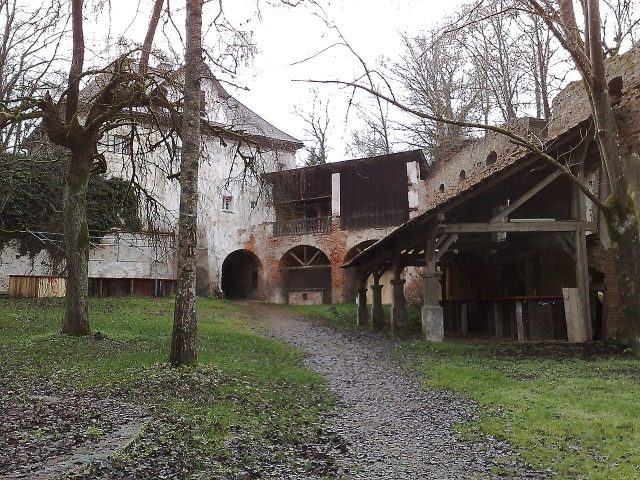
Alt-Wartenburg Castle
Tobias Nütz, who bought the dominion from Ludwig von Polheim in 1639, built a castle on a hilltop adjacent to the old castle. The new seat of power was partly built with demolition material from the old castle. In 1678, the castle burned down but was rebuilt in 1689/90. After the construction of Neu-Wartenburg Castle in 1732, Alt-Wartenburg Castle served only a subordinate purpose, and after the Second World War, the castle largely fell into ruin. Currently (as of 2009), the area is used for occasional open-air events.
Wartenburg Castle
On a hill on the left bank of the Vöckla was Wartenburg Castle, which was partially demolished in the 18th century. Currently, only the round keep remains.
Take Mobile History with you
You are reading this text for free. Premium adds what matters on the road: descriptions read aloud, sites found through your camera, whole regions taken offline.
- Every description, including the ~17,700 Premium sites
- Audio guide: have descriptions read to you on location
- AR finder: see sites through your camera, with distance and bearing
- Unlimited saved sites
14 days free, then from €2.99 a month. Cancel anytime.
Source: Wikipedia · Licence: CC BY-SA 4.0 · Image: http://commons.wikimedia.org/wiki/File:Schloss_Alt-Wartenburg.jpg
This description draws on the facts documented in the linked Wikipedia article; Wikipedia content is licensed under CC BY-SA 4.0. Wording and editing: Mobile History.
Location: 48.0155, 13.6233