Museum
Dölitz Castle
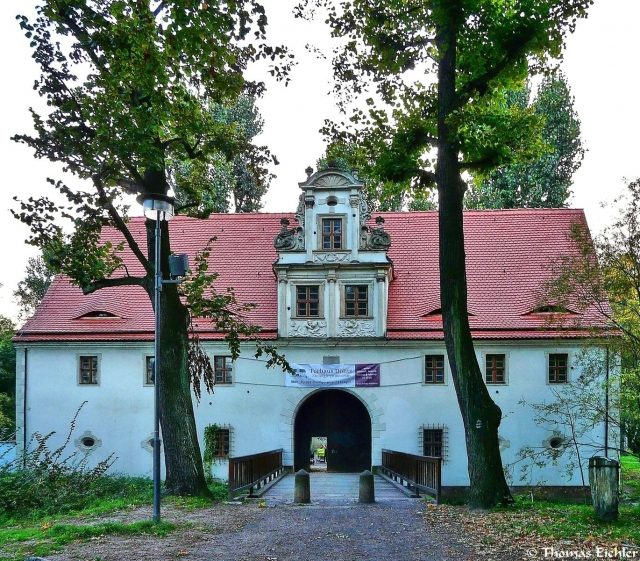
The Dölitz Gatehouse is the structural remnant of a noble residence in the village of Dölitz, which is now part of Leipzig. Large parts of Dölitz Castle and with it the gatehouse were built in the last third of the 17th century.
The Dölitz manor was owned by the Leipzig merchant family von Winckler for almost 300 years.
The castle was acquired, renovated, and rebuilt in 1636 by Georg Winckler (1582–1654), a merchant in Leipzig and the progenitor of the family. He was ennobled in 1650 by Emperor Ferdinand III. The family had extensive possessions in the area, including villages and manors. Later, through Johann Benedict Winckler, they are said to have been elevated to the rank of Barons von Schwendendorf.
The castle's gatehouse was built between 1670 and 1672 by Andreas von Winckler, a son of Georg Winckler. Architecturally, it marks the transition from Saxon Late Renaissance to Saxon Early Baroque. The castle itself was a three-story, four-wing complex with an inner courtyard, topped by an octagonal roof turret with a Baroque cupola. The gatehouse was located on an island formed by two arms of the Pleißemühlgraben. Today, only the eastern moat remains. The entrance is reached from the east via a wooden bridge.
During the Battle of Leipzig, the gatehouse was fiercely contested. Austrian troops repeatedly tried to storm the complex but were repelled by the French until they retreated unhindered on the night of October 18-19, 1813. The gatehouse is the last remaining building that played an important role in the Battle of Leipzig.
The Dölitz manor was acquired by the city of Leipzig in 1929. In World War II, the castle was severely damaged in an air raid in 1944. Therefore, the main building was blown up and demolished in 1947. The still-preserved manor barn fell victim to a fire in 1953. It was located directly next to the gatehouse, which could be saved from the fire. In the 1950s, the building was still inhabited but increasingly fell into disrepair. In 1959, the Institute for Monument Preservation of the GDR began restoring the building. Traces of the Battle of Leipzig, such as cannonballs, disappeared under the newly applied exterior plaster. However, a part has been visible again since a renewed renovation in the 1990s.
The Tin Figure Exhibition in the Dölitz Gatehouse+
In 1958, a specialist group of the Kulturbund of the GDR established a cultural-historical exhibition in the rooms of the gatehouse building. In February 1960, the exhibition of cultural-historical tin figures was opened and has since been managed by the Kulturbund. After reunification, the association Zinnfigurenfreunde Leipzig e.V. was founded from the specialist group of the Kulturbund. Until 1998, the association was able to lease the grounds of the former Dölitz manor from the city of Leipzig. In 1998, the working group "Befreiungskrieg 1813" Finsterwalde e.V. took over the lease and since then also the maintenance of the grounds and the listed buildings. The association Zinnfigurenfreunde Leipzig e.V. has since been entrusted with the care of the very well-known tin figure exhibition, with a focus on the Battle of Leipzig. The historical diorama of the Battle of Leipzig, which was inaugurated in 1913 on the occasion of the 100th anniversary of the battle, was acquired by the association from the Leipzig City History Museum in 2000. Subsequently, the diorama with approx. 12,000 figures was revised and has since been part of the exhibition in the Dölitz Gatehouse.
Present Day+
Today, the gatehouse, located in Goethepark, belongs to the AGRA grounds and directly borders the exhibition and trade fair grounds of the former agricultural exhibition. Thus, the gatehouse, surrounded by forest and park, is part of the Markkleeberg recreation area. Due to its significance in the Battle of Leipzig, the area is often used as a venue for military camps and battle reenactments. Annually at Pentecost, the tents of the pagan village, the large medieval market of the Wave-Gotik-Treffen, are pitched on the gatehouse grounds. This is also accessible to non-festival visitors for an entrance fee.
Take Mobile History with you
You are reading this text for free. Premium adds what matters on the road: descriptions read aloud, sites found through your camera, whole regions taken offline.
- Every description, including the ~17,700 Premium sites
- Audio guide: have descriptions read to you on location
- AR finder: see sites through your camera, with distance and bearing
- Unlimited saved sites
14 days free, then from €2.99 a month. Cancel anytime.
Source: Wikipedia · Licence: CC BY-SA 4.0 · Image: Thomas Eichler
This description draws on the facts documented in the linked Wikipedia article; Wikipedia content is licensed under CC BY-SA 4.0. Wording and editing: Mobile History.
Location: 51.2875, 12.3878