CastleFaulenrost

Faulenrost Castle

Faulenrost Castle

The remains of the Castle can be visited

Faulenrost was first mentioned in 1275, when the knight Henning von Rostock was enfeoffed with the Faulenrost estate by Prince Nikolaus von Werle-Güstrow. The knight seems to have given the village he acquired his name: "Villa Rostock" (1288). However, the place name could also originate from the Slavic word rastokŭ (place where two waters separate or unite).

Over time, popular usage transformed it into Vůlen Rozstock (1385), then Vulen Rostke (1494), and finally Faulenrost (1683).

During a division among the sons of Colonel Levin Ludwig Hahn, Faulenrost fell to Knight Claus Ludwig Hahn in 1746. In 1760, he began construction of the castle and the courtyard with the intention of making Faulenrost his summer residence. Before its completion, the builder "sank into melancholic despondency," so that only his successor, Friedrich II von Hahn, known for his contributions to astronomy, completed the construction and laid out extensive gardens with greenhouses.

In 1933, Count Septimus von Hahn, who had fallen into financial difficulties, sold the castle and its associated estate to a Berlin settlement company, which settled the estate lands with new farmers from Württemberg. The castle was sold to the political municipality shortly thereafter. It served as a camp for the female labor service and accommodation for local Nazi organizations. The large ballroom was used as a church for the Faulenrost community until its confiscation by the Reich Governor (1938).

With the outbreak of World War II, Polish prisoners of war were also interned in the castle complex, and after the war, refugees were housed there. In 1954, a kindergarten was established (until 1964), and most recently it served as a school. In the following years, the castle visibly deteriorated. On January 13, 1969, it burned down, but the outbuildings and parts of the park are preserved.

From 1842 to 1845, the Low German poet Fritz Reuter lived in Demzin, a neighboring village of Faulenrost that is now incorporated. During this time, he met his future wife Lowising, who worked as a governess in Rittermannshagen - also incorporated today. Faulenrost is mentioned in Reuter's work "Die Urgeschicht von Meckelnborg."

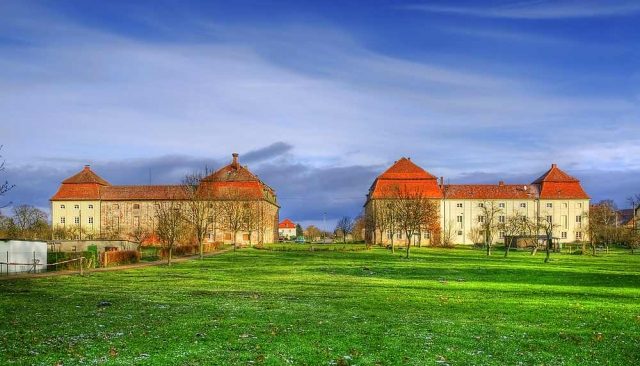
Of the baroque castle complex, gatehouses, cavalier houses, and outbuildings are preserved. The cavalier houses are two-and-a-half-story plastered buildings with mansard roofs, to which square corner pavilions are attached via connecting structures. The two-story gatehouses are also designed as plastered buildings with mansard roofs. Among the outbuildings is a barn from 1744, which was built before the baroque redesign of the castle. The landscape park is still partially recognizable. A flower bed marks the footprint of the main building that burned down in 1968.

Take Mobile History with you

You are reading this text for free. Premium adds what matters on the road: descriptions read aloud, sites found through your camera, whole regions taken offline.

  • Every description, including the ~17,700 Premium sites
  • Audio guide: have descriptions read to you on location
  • AR finder: see sites through your camera, with distance and bearing
  • Unlimited saved sites

14 days free, then from €2.99 a month. Cancel anytime.

Source: Wikipedia · Licence: CC BY-SA 4.0 · Image: http://www.werner-conrad.de/schloss-faulenrost.html

This description draws on the facts documented in the linked Wikipedia article; Wikipedia content is licensed under CC BY-SA 4.0. Wording and editing: Mobile History.

Location: 53.6370, 12.7854