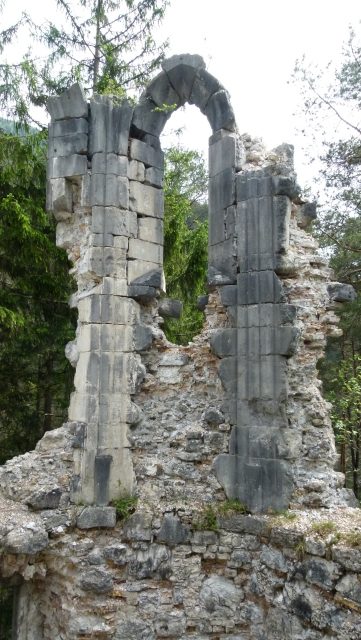
The remains of the Castle can be visited
Sigmundsburg Castle

The castle ruin Sigmundsburg stands – completely hidden by forest – on an island in Fernsteinsee. The area belongs to the municipality of Nassereith in the district of Imst in Tyrol.
Sigmundsburg Castle was built by Duke Sigmund the Rich in Coins. It was a "homage" (Arnold-Öttl) to his first wife, the Scottish king's daughter Eleonore, whom he married in 1449. After the completion of the castle in 1463, Eleonore took up residence in the castle, which she preferred to the "Hofburg teeming with guests" in Innsbruck. The Duke probably used it for hunting parties in the game-rich area. Pleasure was also found in fishing on the trout-rich lake, for which there were four boats. The secluded castle also occasionally served as a refuge, in 1463/65 from a rampant epidemic and in 1478 from the Turks.
Building accounts prove that work was repeatedly carried out on the castle during Sigmund's lifetime, but it was never fully completed. Of the chapel, which even received an indulgence in 1471, it was said in 1574 that "the little church was completely empty and never completed."
After Sigmund had to hand over government affairs to King Maximilian I in 1490 due to massive pressure from the Tyrolean estates, he probably chose Sigmundsburg as a frequent residence until his death. Maximilian also still appreciated the convenient lodging during his hunts in Außerfern. After that, the castle lost its function and faced its decay. In 1703 it was said to be "now desolate" and in 1775, "the collapsed Sigmundsburg Castle is much more to be considered a pile of stones than a dwelling."
In the 19th century, King Maximilian II of Bavaria showed interest in the castle ruin. But the plans for a reconstruction or conversion were not carried out. His son Ludwig II also came here and had a red and blue room set up in Fernstein in 1872 as a secret quarter.
Construction+
Sigmundsburg never had a special military function; the fortified complex and Fernstein hermitage on the medieval road over the Fernpass served that purpose instead. Therefore, the characteristic features of a castle are missing. The castle on the island hill consisted of an approximately square building with towers at each corner and a two-story chapel in the east. The interior is divided by a central wall, on which a steep hipped roof rested. Stonemason's marks on the ashlar stones of the chapel and the windows are attributed to the workshop of Master Heinrich from Imst. In 1952, stabilization work began in the chapel but was not continued. An illustration in the Tyrolean Castle Book from 1986 still shows the arches of two Gothic windows. In 2012, there was only one left.
Sigmundsburg Castle is a "special case" (Arnold-Öttl) in Tyrol. The conception of the building may have been influenced by the Loire castles. Sigmund's first wife Eleonore lived there before her marriage, and Sigmund also saw these castles.
Take Mobile History with you
You are reading this text for free. Premium adds what matters on the road: descriptions read aloud, sites found through your camera, whole regions taken offline.
- Every description, including the ~17,700 Premium sites
- Audio guide: have descriptions read to you on location
- AR finder: see sites through your camera, with distance and bearing
- Unlimited saved sites
14 days free, then from €2.99 a month. Cancel anytime.
Source: Wikipedia · Licence: CC BY-SA 4.0 · Image: http://commons.wikimedia.org/wiki/File:Fernsteinsee_Sigmundsburg-Kapelle.jpg
This description draws on the facts documented in the linked Wikipedia article; Wikipedia content is licensed under CC BY-SA 4.0. Wording and editing: Mobile History.
Location: 47.3451, 10.8238