The castle ruin can only be viewed from the outside.
CastleSeinsheim - Wässerndorf
Wässerndorf Castle
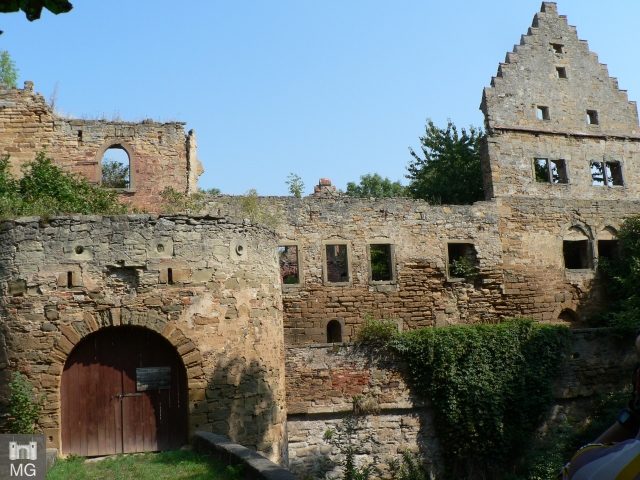
Wässerndorf Castle is a former aristocratic residence in the Seinsheim district of Wässerndorf in the Kitzingen district. The castle was inhabited until the end of World War II, before it was destroyed by wartime actions. The ruins have been preserved to this day. The castle is located in the center of the village.
The history of the castle is closely linked to the history of the von Seinsheim family. In the 12th century, a ministerialis named "de Sovensheim" was first mentioned, and from 1263, the family had its ancestral seat in Wässerndorf. In this period, the second half of the 13th and the first half of the 14th century, the predecessor building of the castle was also erected on the same site. Initially, a moated castle was built. In 1502, Baron Johann von Schwarzenberg acquired two quarters of the property in the village. The Peasants' War of 1525 destroyed some parts of the complex, but most of it remained intact. In 1529, Wässerndorf and its castle fell to the Erlacher line of the Lords of Seinsheim. Another quarter came to Johann von Schwarzenberg in 1538. His son Friedrich completed the acquisitions in 1550, so that all of Wässerndorf was in the hands of the Schwarzenberg family. Baron Friedrich von Schwarzenberg began the construction of the present castle in 1555. In the 18th century, some alterations were made to the building, such as the replacement of the drawbridge with a stone bridge. From 1910, the von Pölnitz family inhabited the former aristocratic residence. The castle was expropriated by the National Socialists in 1936, but the former owners were still allowed to inhabit the complex. In the last days of World War II, after the Americans had already taken the village, the castle was destroyed by fire. The reasons for the act are unclear; it was probably an act of revenge because an American officer had been shot in the village. The fire destroyed not only the castle but also several thousand boxes of stored archives and art objects from Würzburg and Munich. Refugees housed in the castle, including the composer Armin Knab, were able to escape. In the post-war period, the ruin came into the possession of the Bavarian state. This sold the complex to private individuals.
Source: Wikipedia · Licence: CC BY-SA 4.0 · Image: Mobile Geschichte
This description is a machine translation of an excerpt from the linked Wikipedia article. The source text was written by its authors, the translation is by Mobile History; like the original it is licensed under CC BY-SA 4.0.
Location: 49.6398, 10.2036