Library
Cultural facilitie
Schoeler Castle

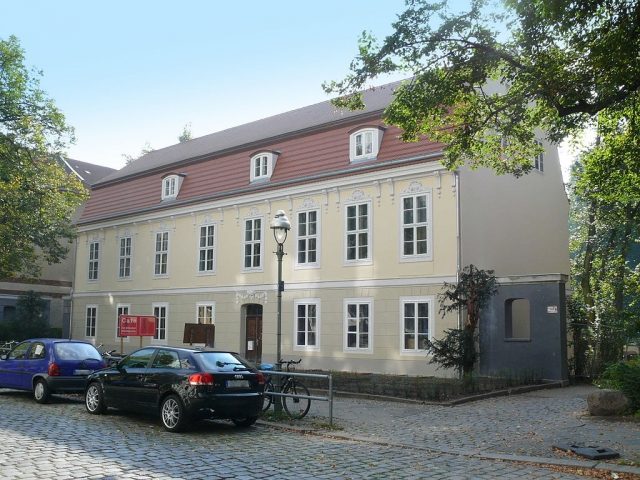
The Schoeler-Schlösschen (Schoeler Manor) is the oldest surviving building in the Berlin district of Wilmersdorf, with its origins dating back to 1752/1753. It is located at Wilhelmsaue 126.
The then Wilmersdorf pastor Samuel Gottlieb Fuhrmann received a "desolate" farm – unused since the end of the Thirty Years' War – with the condition that he build a single-story cottager's house there as a simple half-timbered structure and plant mulberry trees for silkworm breeding. The house and property subsequently changed hands several times. In 1765/1766, it was converted into a stately baroque country house, an additional floor was added, outbuildings were erected, and a large garden was laid out towards Wilmersdorfer See. In 1893, the house passed to the well-known Berlin ophthalmologist Heinrich Schoeler, who lived there until his death in 1918 and became the namesake of the property. In 1929, a housing association acquired part of the property and built large apartment blocks there; the house and part of the park came into municipal ownership and were used by the district youth welfare office for various purposes. In 1935, the building was extended by a second story – adapted in style to the lower floors – and used by the Hitler Youth as well as a local history museum. From 1946 to 2003, the house was used as a daycare center; since a fire in February 2003, the building stood empty.
The Charlottenburg-Wilmersdorf district office intends to restore the listed building in cooperation with the private Stiftung Denkmalschutz Berlin (Berlin Monument Protection Foundation). The latter insisted, as a condition for its involvement, that the building had to be restored to its baroque original state by demolishing the second story. After initially opposing it, the Supreme Monument Protection Authority of Berlin approved the demolition of the top story in February 2007 under political pressure. The Schoeler-Schlösschen is later intended to house, among other things, the book collection of former Federal President Johannes Rau, comprising approximately 8000 volumes, and to present artists.
On January 29, 2010, the topping-out ceremony for the reconstructed roof truss took place with the participation of the board of the Stiftung Denkmalschutz Berlin and numerous representatives from municipal cultural policy, art history, and the trades involved in the project. Construction work on the building is in full swing.
On January 17, 2011, the Stiftung Denkmalschutz Berlin received a check for 100,000 Euros from the Essen-based Evonik Group for the construction of the library.
The ground floor was used by Lebenswege gGmbH for exhibition purposes, lectures, and performances (Kultursalon) as well as a "construction site café." The Kultursalon, including the café, closed on August 30, 2011.
Take Mobile History with you
You are reading this text for free. Premium adds what matters on the road: descriptions read aloud, sites found through your camera, whole regions taken offline.
- Every description, including the ~17,700 Premium sites
- Audio guide: have descriptions read to you on location
- AR finder: see sites through your camera, with distance and bearing
- Unlimited saved sites
14 days free, then from €2.99 a month. Cancel anytime.
Source: Wikipedia · Licence: CC BY-SA 4.0 · Image: http://commons.wikimedia.org/wiki/File:Wilmersdorf_Schoeler-Schl%C3%B6sschen.jpg
This description draws on the facts documented in the linked Wikipedia article; Wikipedia content is licensed under CC BY-SA 4.0. Wording and editing: Mobile History.
Location: 52.4850, 13.3268