The sacred building can be visited
ChurchWürzburg
Schönborn Chapel
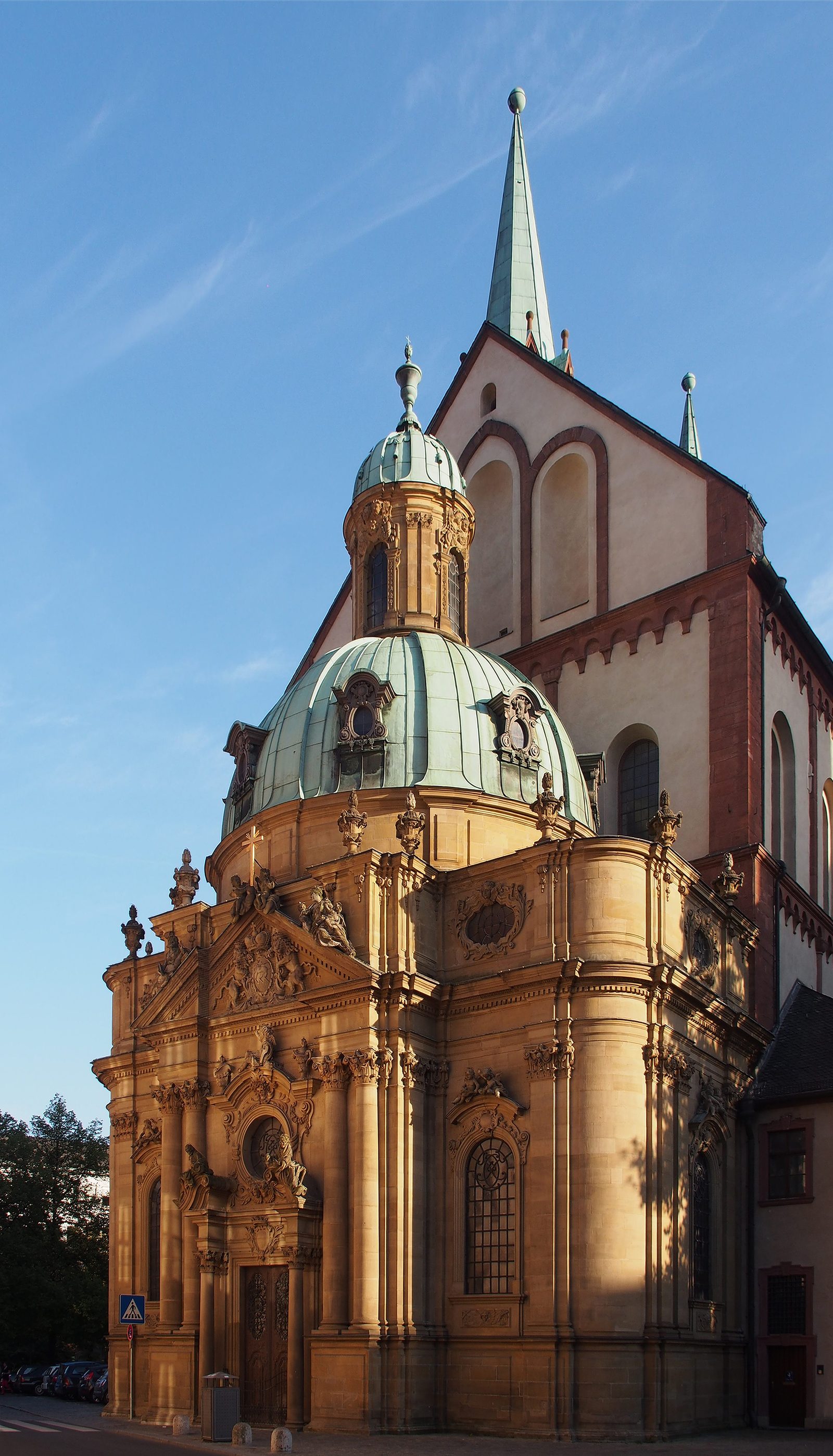
The so-called Schönborn Chapel on the northern transept of Würzburg Cathedral was built starting in 1721, primarily by Balthasar Neumann, commissioned by Johann Philipp Franz von Schönborn until 1724 (shell construction), and from 1731 to 1736 by Friedrich Carl von Schönborn, as a burial place for the Schönborn family.
The Schönborn Chapel, consisting of a round central building (rotunda) with two annexes, is attached to the northern transept of the Romanesque Kiliansdom, where it replaced an older chapel. The patron was Johann Philipp Franz von Schönborn, and Maximilian von Welsch drew up the plans. Construction began in 1721, the plans were revised by Balthasar Neumann in 1723, and the shell construction was completed in 1724. Johann Lukas von Hildebrandt was also likely involved in the modifications. The consecration took place in 1736. The Schönborn Chapel is considered one of the most beautiful Baroque interior creations in Germany. The interior decoration was carried out from 1733 to 1738 by court artists. Antonio Giuseppe Bossi created the marble stucco work in 1734. He also created a significant stucco statue of the Immaculata, which inspired the so-called House Madonnas of Würzburg, from the episcopal private altar on the gallery above the main altar. The frescoes were created (partly with Johann Thalhofer and Anton Joseph Högler) by court painter Johann Rudolf Byss.
Source: Wikipedia · Licence: CC BY-SA 4.0 · Image: Hajotthu · Wikimedia Commons · CC BY 3.0
This description is a machine translation of an excerpt from the linked Wikipedia article. The source text was written by its authors, the translation is by Mobile History; like the original it is licensed under CC BY-SA 4.0.
Location: 49.7937, 9.9326