Cultural Events
CastleSosnowiec (Sosnowitz)
Sielecki Castle
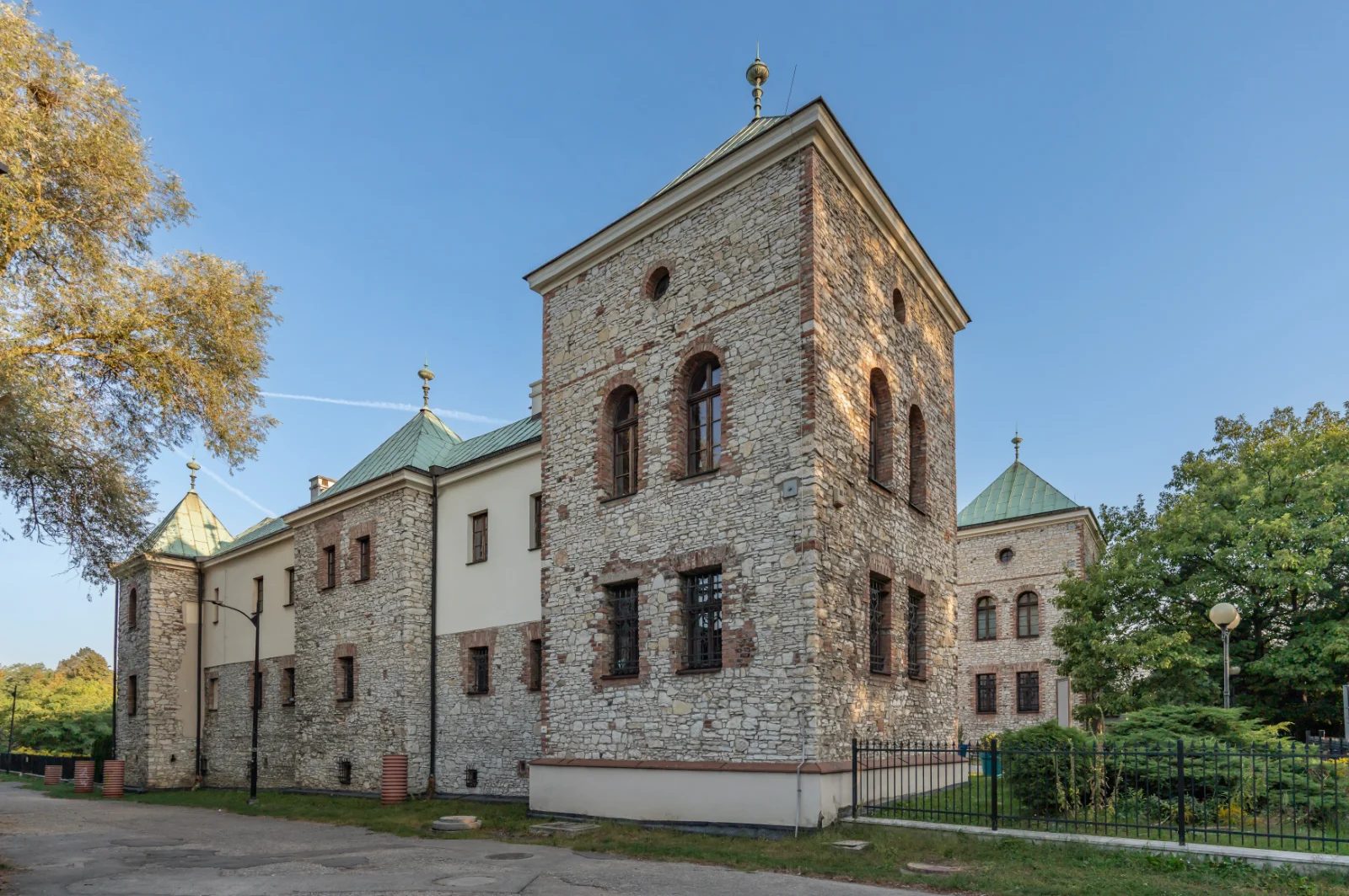
Sielecki Castle is a listed castle in Sosnowiec in the Silesian Voivodeship in Poland. The building of a historic fortress is located on the left bank of the Czarna Przemsza in the Sielec district. It is the oldest building in the city, whose history dates back to the late Middle Ages.
Architecture+
The medieval fortification was expanded in 1620 into a four-winged castle complex with corner towers, presumably using older buildings. The castle was built of broken limestone and bricks. The building has two stories and a basement. After the fire of 1824, the castle was rebuilt in 1832, but the east wing with the entrance gate was removed and the moats were filled in. Despite the changes, the design of the building's shape indicates its original defensive character: it has four corner towers and risalits in the extension of the side wings. Today it is a three-winged building with a horseshoe-shaped floor plan and an open inner courtyard. In the north wing, on the first floor, is the former chapel, which is covered by a barrel vault with lunettes and geometric stucco decoration. The roofs of the building are gable roofs and are covered with sheet metal, and the spires of the towers are tent-shaped. The roof of the chapel is a hip roof and is crowned by an onion-shaped turret with an octagonal lantern.
History+
The history of the castle's construction is not fully clarified. The assumption that it was built in 1620 has been dated back to the 15th century by archaeological findings and archival research. In 1620, Sebastian Minor (Półkozic coat of arms) completed the construction of a new building on a square plan with a central courtyard. A plaque preserved in the chapel to this day commemorates this. The appearance of the castle from this period is depicted in inventories from 1665 and 1719. After the Minors, the Modrzewscy and the Tęgoborscy were the lords of Sielec. At the time of the reign of King Stanislaus II August Poniatowski, the castle belonged to Colonel Michał Żuliński and then to the chamberlain of the royal court Jordan Stojewski, who sold the castle in 1802 to the Prussian General Christian Ludwig Schimmelpfennig von der Oye. After his death on July 21, 1812, his widow Johanna Elisabeth, together with her 25-year-old son Ludwik, a Prussian officer, sold the castle in 1814 to the Prince of Pless Ludwik Anhalt-Coethen von Pless. In 1824, the castle burned down. Subsequently, the Prince commissioned its reconstruction according to plans by Józef Heintz. Based on these, the east wing was removed and the moats were filled in, creating an open inner courtyard. In 1841, the reconstruction of the castle was continued by the next owner of Sielec, Countess Charlotta von Stolberg-Wernigerode zum Hochberg. In 1856, Count Andrzej Renard from Strzelce Opolskie bought the property for his son Jan Renard, who worked as a Prussian consul in Vienna. After his death in 1874, the building came into the hands of his heirs and the associated company Gwarectwo „Hrabia Renard“ (Q115973126), with whom the castle remained until World War II and served as an office building. After 1945, the administration of the Sosnowiec coal mine and temporarily the Muzeum Górnictwa were housed there, and from 1980, the new owner, Zjednoczone Huty Szkła Gospodarczego i Technicznego „Vitropol“, after a general renovation, set up the Centralną Wzorcownię Szkła Współczesnego in the building. In 1982, the exhibits of the Wzorcownia were made accessible to the newly opened Muzeum Szkła Współczesnego. After 1990, the castle was adapted as a wedding hall for the Sosnowiec registry office, as a restaurant and as a conference complex. In 1995, due to the very poor condition of the building, all activities in the castle were stopped and the property was closed. In 1999, the Sosnowiec City Council decided to renovate the monument in conjunction with archaeological investigations. The work was completed in 2002. In the same year, the municipal institution Sosnowieckie Centrum Sztuki-Zamek Sielecki was founded, which is responsible for organizing exhibitions, concerts and cultural events. In 2015, another stage of restoration and conservation work was carried out, including the conservation of polychromies in the north tower of the wing and the presentation of archaeological excavations under the floor of the tower.
Chronology+
1361 – Abraham of Goszyce, together with his son Marek, sold the estates in Sielec to the Starost of Sandomierz Otto of Pilcza (Topór coat of arms)
1384 – Death of Otto of Pilcza (Topór coat of arms)
1403 – first information about a defensive object in Sielec.
1430–1434 – Neighborhood conflict between Bodzanta of Sielec (Szeliga coat of arms) and Mikołaj Kornicz Siestrzeniec (Kornic coat of arms), the famous adventurous castellan of Będzin
1430 – Mention of the existence of a fortalicjum.
1465 – The royal courtier Jakub Duch of Dębno becomes the owner of the fortalicjum
1487 – the Sielec estates were repurchased as part of the recovery of the crown estates from Grzegorz of Morawica and became the property of King Casimir IV Jagiellończyk
1567 – Walenty Minor becomes the owner of Sielec
1620 – Sebastian Minor of Przybysławice (Półkozic coat of arms), hereditary lord of Sielec and Obichów, completes the construction of four brick wings with corner turrets
End of the 18th century – the castle comes into the hands of Colonel Michał Żuliński and then the chamberlain of the court of the Polish king Jordan Stojewski
1824 – Fire at the castle
1832 – Reconstruction of the castle after the fire
1856 – the Sielec estates with the castle were bought by Count Andrzej Renard for his son Jan. Reconstruction of the castle, demolition of the east wing, filling of the moats.
1884 – the castle houses the headquarters of the Renard family's mining company
1977 – the castle became the property of Zjednoczone Huty Szkła Gospodarczego „Vitropol“ and was designated as the seat of the museum and the Centralna Wzorcownia Szkła Polskiego.
1977–1980 – General renovation of the castle.
1981–1995 – Seat of the Muzeum Szkła Współczesnego.
1994 – the city took over the ruined castle, reconstruction began
1999–2002 – Renovation of the castle and giving it its current appearance
2002 – the Sosnowieckie Centrum Sztuki-Zamek Sielecki begins its activities in the castle
Take Mobile History with you
You are reading this text for free. Premium adds what matters on the road: descriptions read aloud, sites found through your camera, whole regions taken offline.
- Every description, including the ~17,700 Premium sites
- Audio guide: have descriptions read to you on location
- AR finder: see sites through your camera, with distance and bearing
- Unlimited saved sites
14 days free, then from €2.99 a month. Cancel anytime.
Source: Wikipedia · Licence: CC BY-SA 4.0 · Image: Von Krzysztof Popławski - Eigenes Werk, CC BY 4.0, https://commons.wikimedia.org/w/index.php?curid=153251910
This description is a machine translation of an excerpt from the linked Wikipedia article. The source text was written by its authors, the translation is by Mobile History; like the original it is licensed under CC BY-SA 4.0.
Location: 50.2854, 19.1456