The Castle can be visited
CastleVetschau-Raddusch
Raddusch Castle
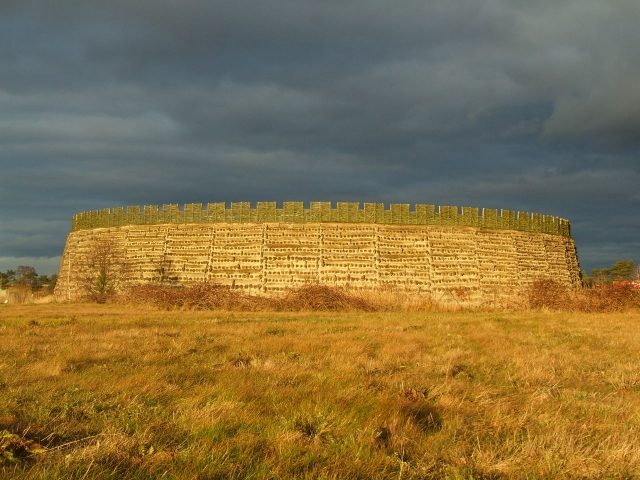
The Slawenburg Raddusch is an outwardly largely faithful reconstruction of a Slavic refuge castle near the village of Raddusch, which today belongs to the town of Vetschau/Spreewald.
The castle is one of approximately 40 ring-shaped rampart systems originally existing in Lower Lusatia. These castles were built in the 9th and 10th centuries by the Slavic tribe of the Lusitzi. They served as refuge castles for the population living in the immediate vicinity. The concentration of these castle complexes in the Lower Lusatia region is attributed to the strong pressure of conquest emanating from the Germanic side. The complex was built of wood stacked in log cabin style and surrounded by a moat. The interior of the wooden construction was filled with sand, earth, and clay to ensure stability. Around 880, construction of the castle rampart began on a slight elevation. It was oval, had a rampart about 10 m wide, and enclosed an inner area of 35 to 36 meters. The castle had two tunnel gates, which were almost exactly opposite each other, as well as a water-filled moat. Around 925, the castle was renovated. The rampart was widened, so the inner area shrank to 31 m. Before 950, the castle rampart was expanded again. The castle area was now only about 28 m large. In 963, the German Margrave Gero conquered the territories of the Lusizi. This also marked the end of Raddusch Castle. The complex was abandoned and decayed over time. The castle rampart was cultivated agriculturally until 1984 and was therefore heavily eroded. In the end, only a hill 3 m high and 85 m in diameter remained. From 1984 to 1989, the castle, known by the field name "Schanze", was archaeologically investigated. It was found that settlements from the Younger Bronze Age and the Migration Period had already existed at the same location.
Not far from Raddusch Castle stood other similar complexes, such as the Slawenburg Tornow, which was probably built as early as the 7th century. The diameter of the walled area was about 25 m.
After Raddusch Castle lost its original function, it decayed and in the 20th century was still recognizable as a tree-covered ring-shaped elevation.
During the GDR era, the excavation of the area for the Seese-Ost lignite opencast mine was decided. In preparation for the loss of this archaeological monument, archaeological excavations took place in the castle in 1984 and 1989/1990. An 1100-year-old wooden statue of a deity was also found here.
Source: Wikipedia · Licence: CC BY-SA 4.0 · Image: https://commons.wikimedia.org/wiki/File:Slawenburg_Raddusch_%28Radu%C5%A1%29_01.JPG
This description draws on the facts documented in the linked Wikipedia article; Wikipedia content is licensed under CC BY-SA 4.0. Wording and editing: Mobile History.
Location: 51.8047, 14.0305