CastleButzbach

Solmser Castle (Butzbach)
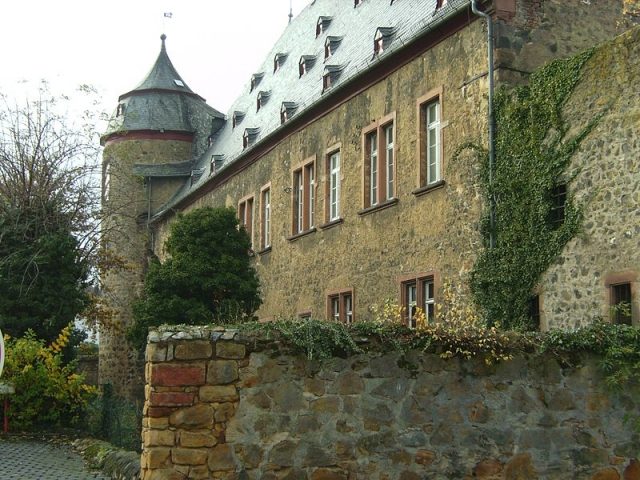
Solmser Castle (Butzbach)

To be privately owned

Solms Castle (also Solmssches Schloss) is a castle complex of the Counts of Solms-Lich in Butzbach, Wetteraukreis in Hesse.

Both castles in Butzbach, both the Landgrave's and Solms Castle, were built on the site of a former castle complex on the southeastern edge of Butzbach's old town. The place was first mentioned in a document in 773 and was built near the remains of a Roman fort at a crossroads of several ancient roads, including the Wine Route and the Lange Hessen. It is not certain whether this moated castle in a town location (town castle) dates back to the lower nobility of Buetsbach, vassals of the Lords of Hagen-Münzenberg, mentioned in 1243, or was only later built by the Falkensteiners, who inherited the Münzenbergers.

In 1321, Philipp IV of Falkenstein received town rights for the place and had a fortification built. With the extinction of the Falkensteiners in 1418, Butzbach fell to the Lords of Eppstein, half each to "von Eppstein-Münzenberg" and "von Eppstein-Königstein". Subsequently, the property was further divided. Still in the 15th century, the Münzenberg line sold a quarter to the County of Katzenelnbogen, which fell to Hesse in 1479, and another quarter to Count Otto of Solms-Braunfels. The Königstein line sold a quarter to Solms-Lich in 1479, and its last quarter only in 1595 to Hesse-Marburg.

The parts of the medieval castle formerly incorporated into the city wall were probably largely dilapidated by this time. Around 1462, Werner von Eppstein-Münzenberg had a large granary built next to the southern gate of the city wall, which came into the possession of the Counts of Solms in 1479. They had it representatively rebuilt and supplemented with a fortified round tower in the style of the time. The resulting Solms Castle subsequently served as an official and widow's residence, the latter demonstrably in 1524 and 1555.

During the Thirty Years' War, the Counts of Solms-Lich and Solms-Braunfels temporarily lost their share of Butzbach, as they had fallen out of favor with the emperor. The castle initially fell to Philipp III of Hesse-Butzbach, and after his death to the Landgraviate of Hesse-Darmstadt. From 1648 until its final sale to Hesse-Darmstadt in 1741, it was used by the Solms-Braunfels line as an administrative seat and again as a granary. After a renovation in 1876-79, the Butzbach district court moved in here.

Layout+

The castle is a two-story rectangular building, the back of which leans against the city wall. A four-story round tower of the city wall is integrated into the castle. The outwardly rather simple Renaissance building has an elaborate interior. According to older considerations, the building had only two large halls on each floor, which is supported by the arrangement of the windows on the outside. In fact, however, a different room layout probably existed in the 16th century. A precise examination of the building fabric will only be possible with a necessary renovation of the building.

Particularly noteworthy in the interior design is the Renaissance-era staircase, which is located in the entrance risalit. It contains inscriptions by a humanist that have not yet been fully deciphered.

Take Mobile History with you

You are reading this text for free. Premium adds what matters on the road: descriptions read aloud, sites found through your camera, whole regions taken offline.

  • Every description, including the ~17,700 Premium sites
  • Audio guide: have descriptions read to you on location
  • AR finder: see sites through your camera, with distance and bearing
  • Unlimited saved sites

14 days free, then from €2.99 a month. Cancel anytime.

Source: Wikipedia · Licence: CC BY-SA 4.0

This description draws on the facts documented in the linked Wikipedia article; Wikipedia content is licensed under CC BY-SA 4.0. Wording and editing: Mobile History.

Location: 50.4323, 8.6734