The church can be visited
ChurchRiede
St. Andreas Church Riede
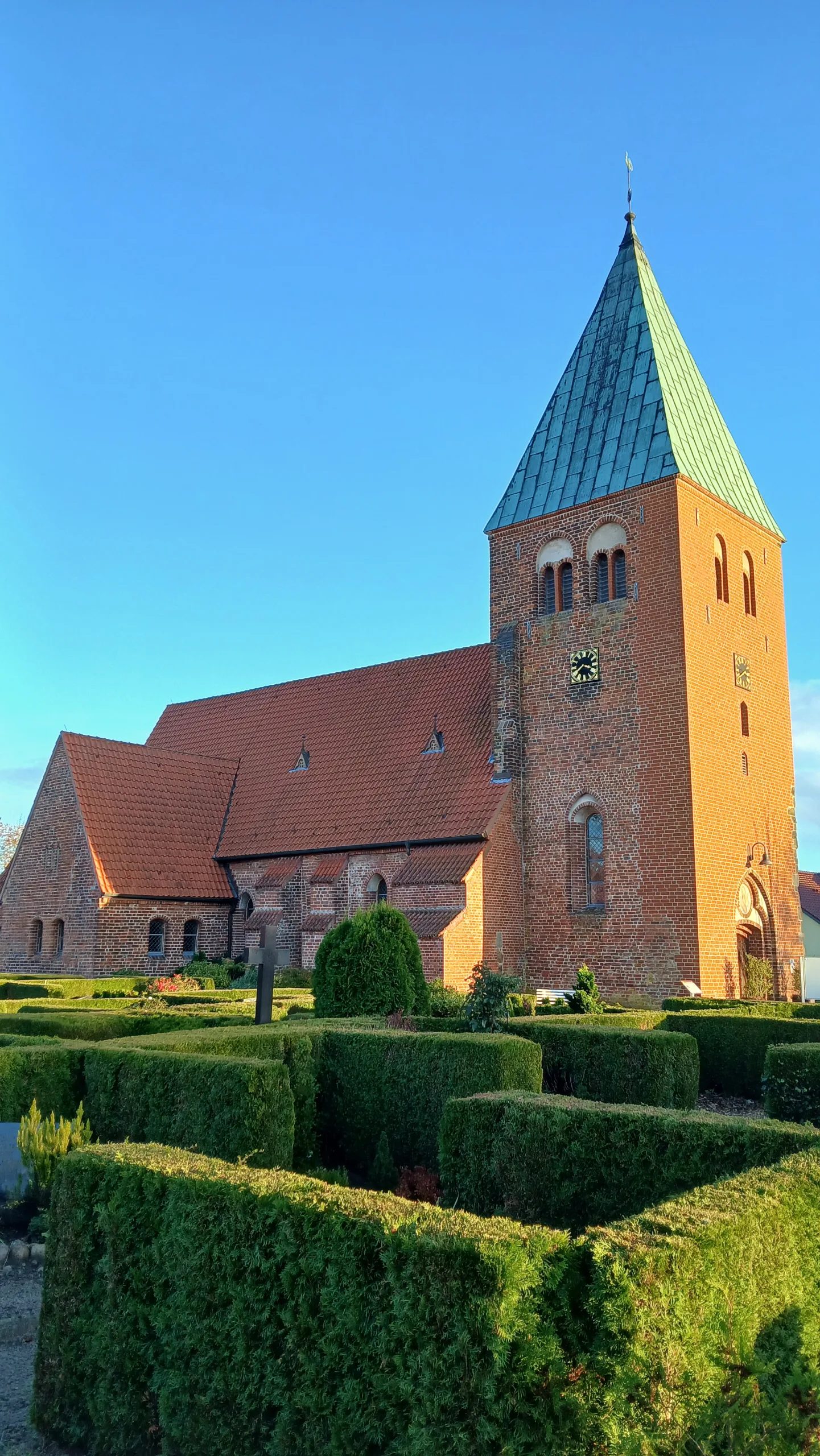
The St. Andreas Church in Riede, Verden district, is an early Gothic church. The congregation belongs to the Verden church district of the Evangelical-Lutheran State Church of Hanover.
History+
Riede was first documented in 1058. Presumably there was a first, possibly wooden church. Around 1200, connections to the Archdiocese of Bremen are attested. The present, continuously vaulted, early Gothic brick hall church dates in its core from the 13th century. The sandstone ashlar blocks from the predecessor church from around 1150 are said to have been reused later in the lower section and at the corners of the present church. Around 1280, the brick church was extended to the north by the "olle Bichtkammer" (Old Sacristy) and around 1320 received a massive, square tower with a high pyramidal roof. The building was extended in 1521 by the New Church, which was built opposite the "ollen Bichtkammer" (Confessional Chamber). This gave the church its cruciform ground plan. In the 19th century, the old sacristy was opened to the interior of the nave, and a new sacristy was built in the angle between it and the choir.
Furnishings+
Altar+
The altar dates from the renovation of 1900. It replaced the baroque altar and was given a late Gothic branch cross from around 1400 as an altarpiece. Presumably two figures from the baroque altar are located behind the baptismal font. These are Moses and Aaron from the first half of the 17th century. Moses, recognizable by his horns, holds the tablets of the Ten Commandments in his hands, and Aaron wears the breastplate of the high priest, on which 12 different gemstones symbolize the Twelve Tribes of Israel. In his left hand, he presumably originally held an censer.
Pulpit+
The pulpit without a soundboard dates from 1646/47. The Drost Johann von Langen donated it on the occasion of his 25th anniversary of service and the marriage of his son Friedrich to a von Prachow. Both coats of arms adorn the pulpit basket between the elaborate reliefs of the four Evangelists. The coat of arms of the von Langen family, once residing at Gut Heiligenbruch, contains a sheep shear, also found in the coat of arms of the municipality of Riede.
Baptismal Font+
The Romanesque baptismal font dates from the first half of the 13th century. Before 1700, it was misused as a chicken trough in the pastor's yard, by breaking off part of its rim so that the chickens could better reach the water. During the restoration in 1958, its chalice shape was restored, and it was brought into the "olle Bichtkammer," which has served as a baptismal chapel ever since.
Vault Painting+
The most significant adornment of the church are the vault paintings from the end of the 15th century; the depictions in the choir, according to Fritz Garvens, date from the period after the plague wave around 1350. During the Reformation, they were painted over and only rediscovered in 1899/1900, uncovered, and (again?) heavily overpainted during the church's restoration in 1957/59. In the choir vault, embedded in a cap-filling tendril work, a narrative Last Judgment is depicted. Angels blow trumpets for the Last Judgment. Christ the Judge of the World, surrounded by the mandorla, seated on the rainbow, his feet on the globe, raises his hands in blessing. According to the Revelation of John, a sword comes out of his mouth, symbolizing worldly power or justice and judgment. In the depictions of the Last Judgment, it is directed only to the left, to the damned, while the lily, the symbol of spiritual power, purity, and grace, is directed from his mouth to the blessed. To the right and left, people rise from their graves. To the right of the Judge of the World kneels Mary, and to the left, John the Baptist. Both have raised their hands in intercession to Christ.
To the right of Jesus, the heavenly Jerusalem can be seen. In its two gates sit Peter with the key to heaven and Abraham with the souls of his countless descendants. Angels lead the blessed into heaven. Two must be carried in by angels. Above them hovers the interceding Mary. In the depiction of hell, there is a special feature in Riede. For here, to the left of Jesus, the damned are first driven into purgatory, and then individually or in a group, tied together with a rope, driven into the wide-open maw of hell. Among them are crowned and mitred heads, young and old, men and women. The woman with the butter churn is also not missing. She sold herself to the devil during her lifetime, thus representing a witch. Opposite the Last Judgment with the end of the world, the biblical beginning of the world is depicted: a youthful God brings Adam and Eve together. However, the two transgressed God's commandment and sinned by eating from the forbidden tree. The Riede serpent does not have a snake's head, but a woman's head. The wings are meant to indicate that it is the devil. She holds a second apple in her hand. This either indicates the movement of handing over the apple, or she had a second apple ready for Adam. With her index finger, she probably appeased Eve's scruples about transgressing God's commandment. "You will be like God," she whispered to her, followed by the expulsion from Paradise. The frescoes above the altar vividly made it clear to the faithful that it is worthwhile to live according to God's commandments. In the second vault, they are shown the life of Jesus in four scenes: The Annunciation by the Angel Gabriel, the Birth of Jesus, the Adoration by the Three Kings, and the Presentation of Jesus in the Temple. And what did the angels proclaim to the shepherds in the field? "Today in the town of David a Savior has been born to you" (Luke 2:11). And in his hymn of praise, the aged Simeon sang: "For my eyes have seen your salvation, which you have prepared in the sight of all nations" (Luke 2:30). In the choir, on the north wall, St. Christopher and the patron of the church, the Apostle Andrew, are depicted. Christopher was one of the saints whom Martin Luther did not abhor. Well aware that his legend was not historical, he regarded him as a role model for a seeker of God. Opposite St. Andrew on the south wall, one sees the Apostle Philip. To the right of the altar, the tabernacle is framed with Gothic decorations. Above it, two angels carry a monstrance. On the vault above the organ, a shortened Dance of Death can be seen. It consists of an elegant woman with a dove in her hands and Death as a reaper with a scythe. Interestingly, the Riede Death is not a skeleton, but a human whose decaying body is feasted upon by snakes. In antiquity, the dove was a symbol of gentleness, simplicity, and innocence. It was believed that it had no gall and was therefore free from all evil. In the Bible, the serpent is considered an adversary of the Divine, destroying a harmonious, paradisiacal state.
Organ+
In 1900, a gallery was built in the first vault of the church, where the new organ was placed. The current one with 13 stops is a work by the Hanoverian organ builder Emil Hammer from 1981.
Bells+
The church has four bells. The farmer's bell is the second largest bell; it was acquired by the farmers in 1320. A legend tells that the Archbishop of Bremen was unsuccessful in buying it, despite very high sums he offered. Finally, the inverted bell, with a diameter of 111 centimeters, was to be filled with the silver pieces of the Bremen Grote as the purchase price; but the people of Riede did not sell.
Take Mobile History with you
You are reading this text for free. Premium adds what matters on the road: descriptions read aloud, sites found through your camera, whole regions taken offline.
- Every description, including the ~17,700 Premium sites
- Audio guide: have descriptions read to you on location
- AR finder: see sites through your camera, with distance and bearing
- Unlimited saved sites
14 days free, then from €2.99 a month. Cancel anytime.
Source: Wikipedia · Licence: CC BY-SA 4.0 · Image: Foto: Jörg Heldt (Community)
This description is a machine translation of an excerpt from the linked Wikipedia article. The source text was written by its authors, the translation is by Mobile History; like the original it is licensed under CC BY-SA 4.0.
Location: 52.9691, 8.9419