The church can be visited
ChurchStendal
St. Petri Church Stendal
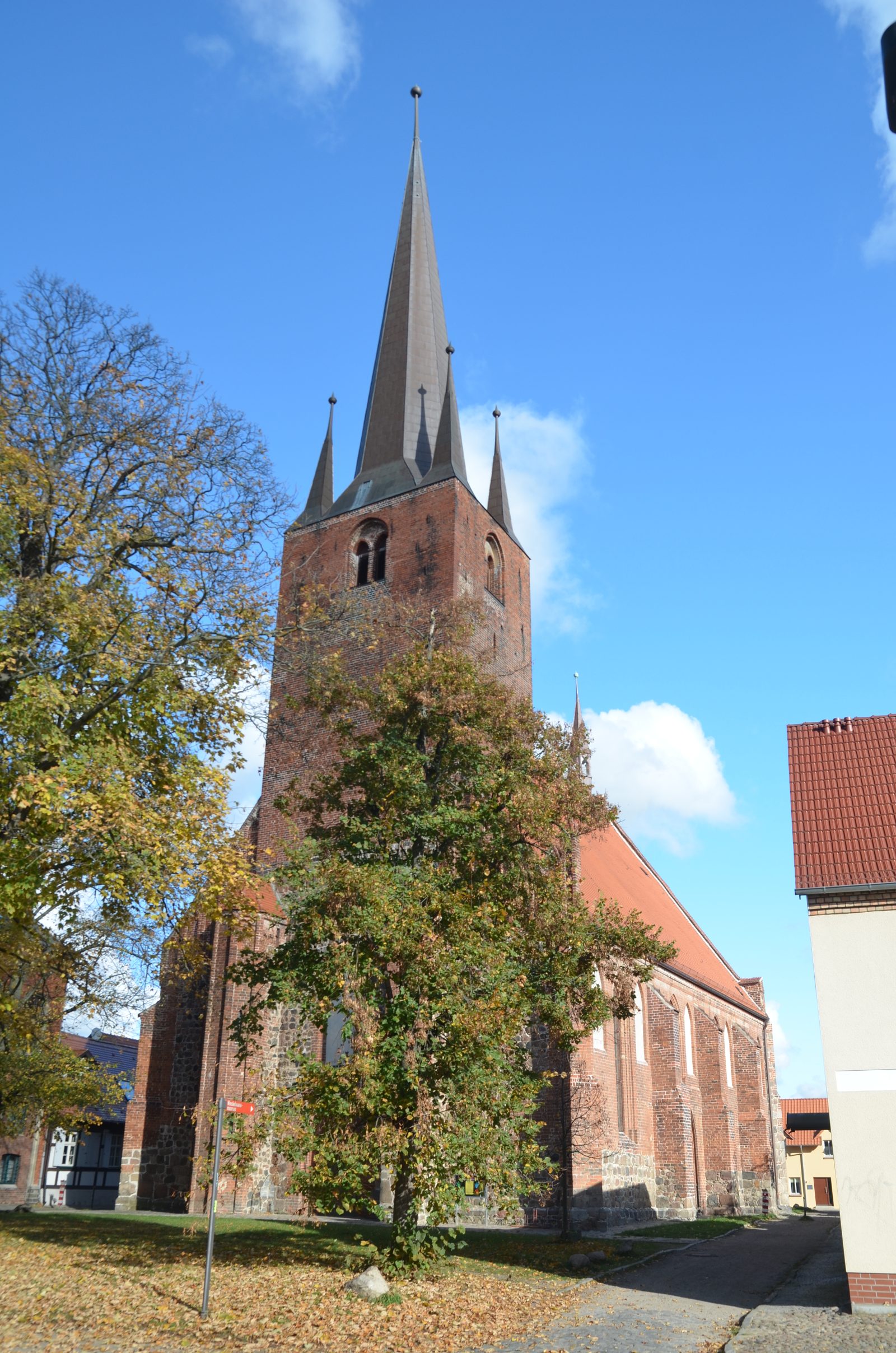
The Church of St. Petri in Stendal is an Evangelical town church in the Brick Gothic style. It belongs to the Stendal church district of the Evangelical Church in Central Germany and is located in the northwest corner of Stendal's old town.
History and Architecture+
The Church of St. Petri is a three-aisled, four-bay hall church with a tower in place of the westernmost central aisle bay and a two-bay choir with a four-sided, decagonal apse the width of the central aisle. The church was probably built in sections after 1285, with the choir in fieldstone masonry completed in 1306. Afterwards, the nave and then the lower part of the tower were also built in fieldstone masonry in the first half of the 14th century. After the completion of the tower, according to dendrochronological dating (d), the choir was raised and vaulted by 1371, the rood screen was installed, and the nave was vaulted. The later parts were executed in brick masonry. The tower was raised to the height of the bell storey in 1415 (d). This was followed by the vaulting of the nave in the first half of the 15th century. The spire was completed in 1583. As in the larger Jakobikirche in Stendal, octagonal pillars support the arcade arches with stepped soffits and the cross vaults. On the exterior of the choir, there is a sandstone relief of the Annunciation to Mary, created around 1430. Restorations were carried out in 1933/34 and 1979/80.
Furnishings+
The rood screen is designed as a half-height brick wall with two passages, with quatrefoil patterns made of molded bricks arranged in the spandrels of the arches. It is topped by a niche gallery with wooden sculptures of the blessing Christ with twelve apostles from the mid-14th century. Above it, a triumphal cross from the mid-15th century completes the rood screen. The altar consists of two carved altars placed one above the other on a two-tiered predella. In the center of the lower shrine, a Coronation of Mary is depicted, with apostles and saints in two rows one above the other on either side and in the wings. The figures are of different origins and quality and date partly from the late 14th and partly from the late 15th century. A painted depiction of Calvary can be found on the wings. In the upper altar, a Madonna with six saints from around 1500 can be seen. The pulpit from around 1600 shows paintings on the balustrade of the stairs and basket from a restoration in 1696, depicting the Salvator, Peter, the four Evangelists, and seven scenes from the New Testament, as well as Luther, as oil paintings on canvas in shallow niches. Other furnishings include a brass chandelier from 1633, a Gothic cabinet with original fittings, and a Gothic sacrament niche with an iron-clad wooden door. The sacristy door with fittings also dates from the Gothic period. The organ is a work by the Voigt company from the beginning of the 20th century. On the north wall is a simple tombstone of Heinrich Christian von Hasfort († 1732). Further tombstones for Catharina Elisabeith Werckenthin († 1736), for Johannes Werckenthin († 1752) and Regina Sophia Döllen († 1759) with her husband Johann Friedrich Döllen († 1785) are attached to the tower pillars. Of the two bronze bells from 1490 and 1497, one cast in tone h0 by Geert van Wou and the other in tone d′ by Herman Vogel, the former deserves special mention, as it comes from the caster of the most famous medieval bell, Gloriosa.
Parish Register 1591–1719+
The historical parish register from the 16th century is one of the oldest of its kind in Saxony-Anhalt. In December 1998, it was stolen along with cash, 19th-century art objects, and three packets of coffee from the community center, where it was stored in the archive room. Police investigations were unsuccessful. In November 2024, a private person from the Wolfsburg district came forward, stating that they had inherited the book and returned it to the community in January 2025 without payment. The book is now kept in a central archive. It is to be digitized and made accessible via Archion. The approximately 15 cm thick, handwritten book contains several thousand entries on over a thousand pages for all baptisms, weddings, and burials of the St. Petri parish from 1581 into the 18th century. It is partly written in Latin and partly in German and was rebound in the first half of the 20th century. The first entry in the book is from "Diaconus Steph. Bülow". From 1583, there is an entry "This year the plague somewhat raged". On December 12, 1717, the baptism of Johann Joachim Winckelmann, the founder of scientific archaeology, was documented. An illustration of this baptismal entry was available as a postcard during the GDR era.
Take Mobile History with you
You are reading this text for free. Premium adds what matters on the road: descriptions read aloud, sites found through your camera, whole regions taken offline.
- Every description, including the ~17,700 Premium sites
- Audio guide: have descriptions read to you on location
- AR finder: see sites through your camera, with distance and bearing
- Unlimited saved sites
14 days free, then from €2.99 a month. Cancel anytime.
Source: Wikipedia · Licence: CC BY-SA 4.0 · Image: Torsten Maue · Wikimedia Commons · CC BY 2.0
This description is a machine translation of an excerpt from the linked Wikipedia article. The source text was written by its authors, the translation is by Mobile History; like the original it is licensed under CC BY-SA 4.0.
Location: 52.6063, 11.8536