The church can be visited
ChurchStendal
St. Anna Church Stendal
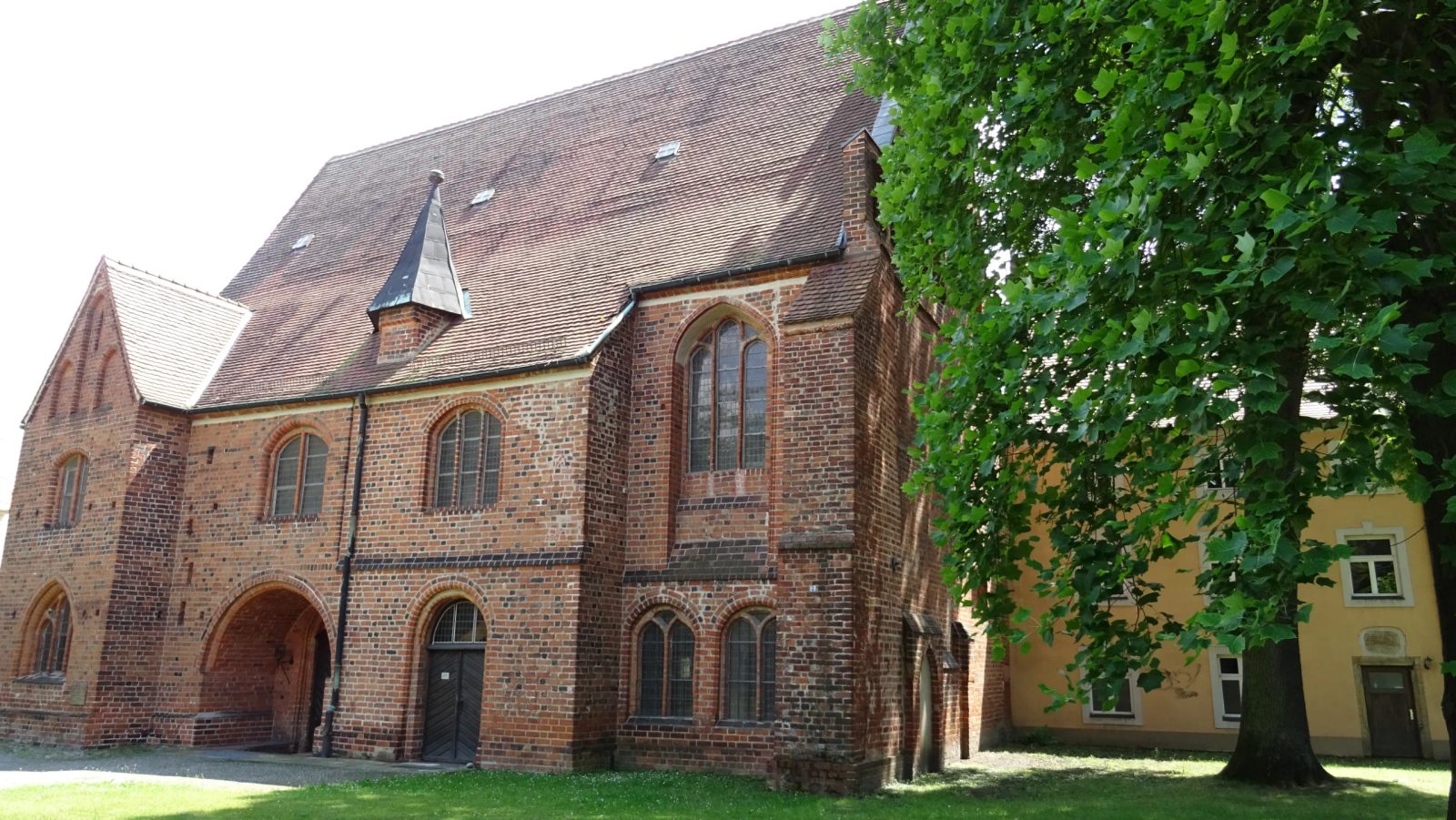
The Church of Saint Anna is the Catholic church in Stendal, the district town of the district of the same name in the north of Saxony-Anhalt. Named after Saint Anna, the mother of Mary, the church is located on Mönchskirchhof. It is the seat of the St. Anna parish in the Altmark pastoral region of the Diocese of Magdeburg.
History+
Construction of the church and Franciscan convent presumably began in 1460, and the church was consecrated in 1461. In 1539, the city of Stendal adopted the Confessio Augustana under Joachim II, Margrave of Brandenburg. In the course of the Reformation, the convent was dissolved around 1540 and converted into an evangelical women's convent in 1541. Catholic life in Stendal ceased. Around 1700, Catholics returned to Stendal. These were soldiers, for whom Catholic services were held from 1739 in various secular rooms in Stendal by clerics of the Benedictine monastery of Ammensleben. From 1784, the Church of St. Anna was used for this purpose. After the secularization of Ammensleben monastery in 1804, Benediktus Greb, one of the Benedictine fathers from Ammensleben, settled in Stendal as a pastor in 1808, and the Stendal parish was founded in 1810. In 1821, the bull De salute animarum brought about a reorganization of ecclesiastical affairs in the Prussian territories. The Prince-Episcopal Commissariat for the Elbe-Saale Department was removed from the Apostolic Vicariate of the North and connected by a real and personal union with the Prussian Diocese of Paderborn, to which the Stendal parish belonged from then until the founding of the Diocese of Magdeburg. From the mid-19th century onwards, the number of Catholics in the Magdeburg Börde increased due to migrant workers from Eichsfeld, Silesia and Poland, who found employment in agriculture and the newly emerging sugar beet industry. Consequently, Bishop Konrad Martin introduced a deanery structure for the Province of Saxony in 1867, whereby Stendal initially became part of the Magdeburg deanery, but due to the great distances of the Altmark parishes to Magdeburg, Stendal became the seat of its own deanery as early as 1868, to which, in addition to the Stendal parish, the mission parishes of St. Michael (Gardelegen) and St. Lorenz (Salzwedel) were also assigned. At that time, the Stendal parish also included Giesenslage, Goldbeck, Osterburg, Seehausen, Tangermünde and Vaethen, where independent church communities were founded and churches built in the following decades. In 1907, the Church of St. Anna in Stendal was purchased by the Catholic parish of Stendal. After the Second World War, the number of Catholics in the Stendal area increased so sharply due to the flight and expulsion of Germans from Central and Eastern Europe that churches and chapels were established in Arneburg, Bismark, Kläden and Lüderitz, and in some cases independent church communities were founded. In 1960, the Burg deanery was established with the parishes of Burg, Genthin, Gommern and Loburg, whose parishes came to the Stendal deanery after its dissolution. From 1967 to 1975, Leo Nowak, the later bishop of the Diocese of Magdeburg, worked as a vicar at St. Anna. In 1973, the church was hit by a fire that destroyed the roof with the then still existing roof turret, the organ and the choir stalls. During the Wende period, contacts were established with the St. Bernward community in Wolfsburg, Lower Saxony. On July 8, 1994, the Diocese of Magdeburg was founded, to which Stendal has belonged ever since. On February 1, 2007, the parish cluster "Stendal – Bismark – Giesenslage – Goldbeck – Meßdorf – Osterburg" was established, which, in addition to the Stendal Church of St. Anna, also included the churches of Heilig Kreuz in Bismark, Unbefleckte Empfängnis in Giesenslage, St. Bernhard in Goldbeck, Hl. Maria von der Verkündigung in Meßdorf, St. Joseph in Osterburg, St. Johannes Baptist in Seehausen and St. Elisabeth in Tangerhütte. At that time, the Stendal parish comprised around 1280 Catholics. On May 2, 2010, the current St. Anna parish emerged from the parish cluster. The churches in Bismark, Giesenslage, Goldbeck, Meßdorf, Seehausen and Tangerhütte have since been deconsecrated. The 2011 European Union census showed that of the 119,204 inhabitants of the Stendal district, 3,110, or about 2.6%, belonged to the Roman Catholic Church. Until the dissolution of the deanery structures in the Diocese of Magdeburg on September 1, 2023, Stendal was the seat of a deanery of the same name; it was the northernmost deanery in the Diocese of Magdeburg and the largest deanery in Germany by area. Since then, Stendal has belonged to the Altmark pastoral region. Since the number of active parishioners in the neighboring St. Elisabeth parish, which had its seat in Tangermünde, had become too small, the parish was dissolved and its churches, the Dreifaltigkeitskirche in Tangermünde and the Schlosskapelle in Sandau, were attached to the St. Anna (Stendal) parish on January 1, 2025.
Architecture and Furnishings+
The single-nave, east-facing and now towerless brick church was built in the late Gothic architectural style. The church has four bays and a three-sided choir apse. Rib vaults span the east bay and the choir.
The current organ was installed in the summer of 2014. The instrument has 21 stops and 1068 pipes. It was built in 1870 by Thomas Joseph Frederick Robson for St. Andrew's Church in Hastings, England. Following the demolition of this church in 1970, it came to a church in Prestbury, after which it was acquired in 2010 by the Dutch organ restorer Fokke-Rinke Feenstra (Grootegast) and restored and rebuilt for the Stendal church in 2014. In Stendal, it was consecrated by Bishop Gerhard Feige on October 12, 2014.
Take Mobile History with you
You are reading this text for free. Premium adds what matters on the road: descriptions read aloud, sites found through your camera, whole regions taken offline.
- Every description, including the ~17,700 Premium sites
- Audio guide: have descriptions read to you on location
- AR finder: see sites through your camera, with distance and bearing
- Unlimited saved sites
14 days free, then from €2.99 a month. Cancel anytime.
Source: Wikipedia · Licence: CC BY-SA 4.0 · Image: Foto: Jörg Heldt (Community)
This description is a machine translation of an excerpt from the linked Wikipedia article. The source text was written by its authors, the translation is by Mobile History; like the original it is licensed under CC BY-SA 4.0.
Location: 52.6029, 11.8556