The church can be visited
ChurchHalle
St. Briccius Church
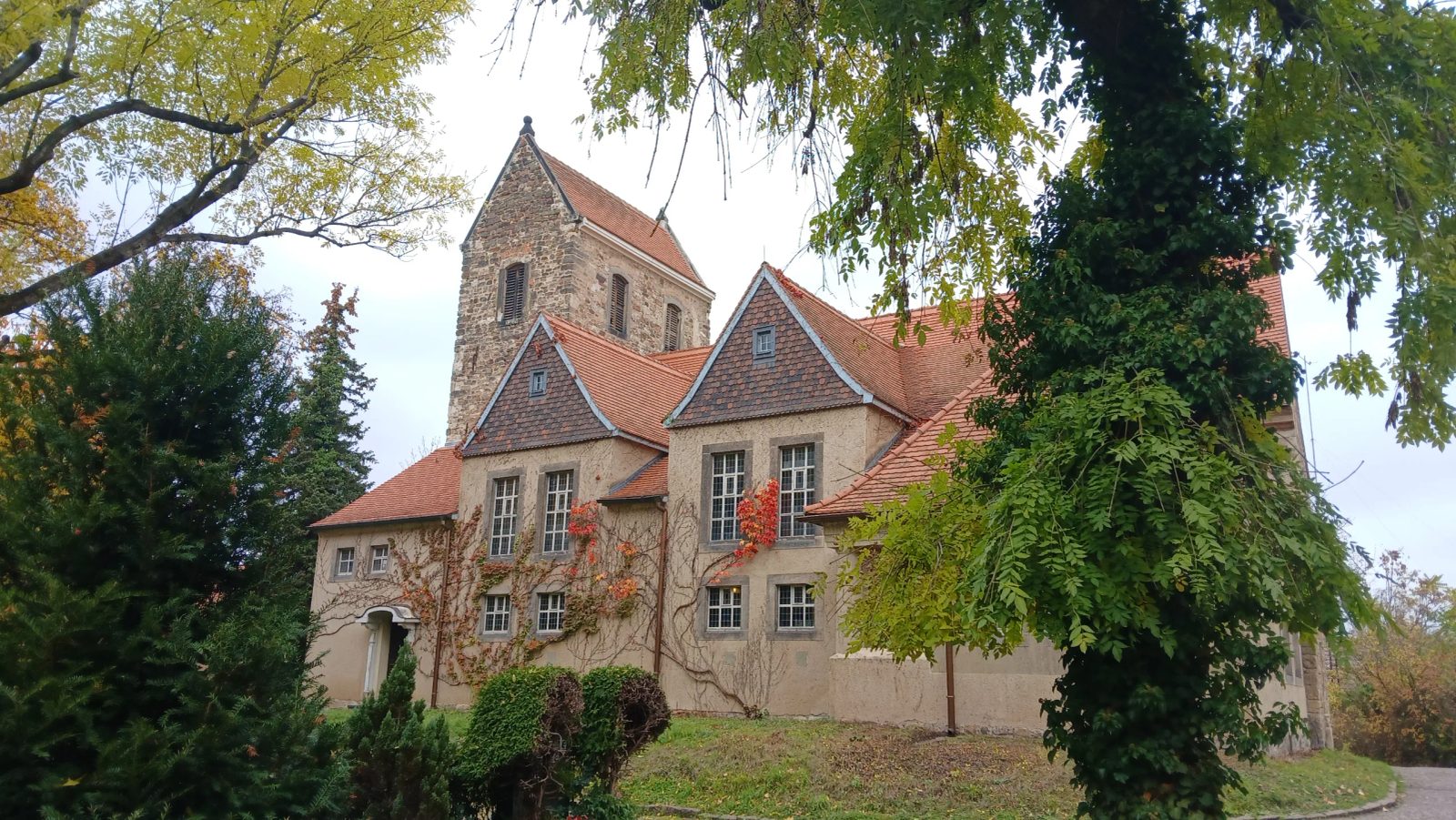
St. Briccius, one of the oldest churches in Halle (Saale), is an Evangelical church in the former farming and fishing village of Trotha, which is now a district in the north of Halle. The Halle-Trotha parish belongs to the Trotha-Seeben parish in the Mitte-Nord parish cooperation in the Halle-Saalkreis church district of the Evangelical Church in Central Germany. In the monument directory of the city of Halle, the church is listed as a monument under the registration number 094 05079.
History+
At the site of the present church, there was initially a West Slavic cult site, which was later built over by a wooden baptismal and prayer chapel after the (East) Frankish conquest. This wooden structure could have been erected at the earliest during the time of Charlemagne (King of the Frankish Empire from 768 to 814) from the year 806. However, it is more likely that it was built from the late 920s or even later, for example from 966, after the Sorbian village had become the property of the Moritzkloster Magdeburg. In 1116, the church was first mentioned in the records of the Neuwerk Monastery. In 1121, Archbishop Rüdiger of Magdeburg donated the village of Trotha to the Neuwerk Monastery. Around 1150, the late Romanesque rubble stone church was built. It is dedicated to St. Briccius, a student of St. Martin of Tours. Trotha remained with the Neuwerk Monastery until its dissolution in 1520. Since 1525, with the community's conversion to the Protestant faith, the church had an Evangelical pastor. During the Thirty Years' War, the church was repeatedly devastated, for example in 1636 by Saxon troops. In 1730, the church was sparingly rebuilt in Baroque style and the nave was extended by about one meter to the south. The entrance was moved to the east side and large rectangular windows were installed. The altar was moved to the tower side in the west, where the pulpit and the crucifix were also located. In 1896, the interior of the church, damaged by a lightning strike, had to be renewed. With industrialization in the 19th century, the number of parishioners grew sharply, so the church had to be expanded. Therefore, a southern extension was built in 1910/1911. The eastern entrance door was closed again using a Romanesque column, and a new entrance was created in the west. Two bay windows, each with two windows, were placed on the church roof, and a sacristy was added to the east of them. Inside, the eastern orientation of the altar was restored. In the First and Second World Wars, two of the three bells had to be handed over for armament purposes. The current bells are a donation from 1957.
Structure and Furnishings+
The late Romanesque rubble stone church, at its core, dates from the middle of the 12th century. The west transept with a gable roof, as well as the north and east walls, are still preserved from the construction period. The wooden barrel vault ceiling inside dates from the renovation in 1730. The crucifix from 1520, the oldest piece of equipment in the church, is attributed to Georg Ihener from Orlamünde, who is also said to have worked on the altar paintings of the Moritzkirche. When the altar area was redesigned in 1954, the crucifix was placed above the altar. The L-shaped galleries in the southern extension were installed during the renovation in 1910. Other furnishings in simple Art Nouveau forms from this period include the wooden pulpit on the north side, a lectern, a baptismal font, and pews. Two stained glass windows were donated in 1911 by the von Trotha family for the windows of the north wall in memory of their old ancestral seat. The furnishings originally also included a late Romanesque baptismal font from the 12th or 13th century. After the community had given it away in 1830 due to cracks, it is now in the Gothic Vault of the Moritzburg Museum (Halle). St. Briccius is surrounded by the Evangelical cemetery of the community. There is also a tombstone designed by Gerhard Marcks for Erich Consemüller, which is depicted in Marcks' catalog raisonné.
Organ+
The Trotha church received its first organ in 1716. After a lightning strike in 1896, the instrument (possibly already a successor?) was severely damaged, whereupon the couple Otto and Alma Nagel, large landowners in Trotha, left the community a sum of 5000 Mark in 1897 for the construction of a new organ. The order was given to the organ building company of Wilhelm Rühlmann from Zörbig. On May 27, 1899, the instrument, as their op. 211, was consecrated during the Pentecost service. In the course of extensive renovation work in the church, the organ was moved in 1910 and 1911 from its location on the then east gallery to the newly built west gallery, where it remains to this day. In 1927, it received an electric motor; foot operation of the bellows remained possible. After the Second World War, organ builder Jandeck from Halle tuned the organ three-quarters of a tone higher and also made changes to the disposition. As was customary in the so-called organ movement, some fundamental registers were replaced by overtone registers. For example, a Quinte 2 2⁄3′ replaced the Doppelflöte 8' in the main work, and a Sifflöte 1' replaced the Lieblich Gedackt 8' in the swell work. The exact changes can be seen in the disposition overview. A fundamental cleaning, an overhaul of the console and bellows system, and a re-intonation of the pipework were carried out by the organ building workshop Hüfken from Halberstadt in 1987. Christoph Schulz, organ expert of the then church province of Saxony, advised in an expert opinion from 2000 to restore the disposition to its romantic original state; this has not happened yet. The 100th and 125th organ anniversaries were celebrated with festive events in 1999 and 2024 respectively.
Disposition
In 1899, the Rühlmann organ was accepted in the following condition:
Couplers: I/P, II/P, I/II In 1916, a Posaune 16' was added to the pedal. Since the renovation after the Second World War, the organ has the following disposition (changes in italics):
Couplers: I/P, II/P, I/II
The War Memorial in front of the Church+
In honorable memory of the soldiers from Trotha who fell in the First World War, the Evangelical Church community had an obelisk made of shell limestone, crowned with the Iron Cross, erected in front of the church. The solemn inauguration took place on July 4, 1926; the monument was not damaged during the Second World War. Against the request of the municipal building administration not to disturb the demolition work of the war memorial, the St. Briccius church community lodged an objection with the Soviet city commandant's office on June 3, 1947, referring to the "Control Council Decision" and the change in Article 4 on July 12, 1946. According to this, monuments dedicated to the memory of fallen regular troops, which did not express Nazi ideology or show corresponding symbols, should not be removed. The church community also pointed out that the monument was on church property. Although the decision of the city commandant's office was still pending, the building administration had the war memorial blown up on June 9, 1947, and the rubble removed. Only on June 11 did the city administration inform the church community of the decision of the military commandant, Colonel Tschaikin: "The obelisk at the church in Trotha will not be blown up!" – The church community lodged an objection against the demolition on July 18, 1947, and demanded compensation. On August 9, 1947, a letter was sent from the building administration to the Evangelical Church community of St. Briccius. In it, the hasty demolition was regretted, but at the same time, a claim for compensation was rejected.
Take Mobile History with you
You are reading this text for free. Premium adds what matters on the road: descriptions read aloud, sites found through your camera, whole regions taken offline.
- Every description, including the ~17,700 Premium sites
- Audio guide: have descriptions read to you on location
- AR finder: see sites through your camera, with distance and bearing
- Unlimited saved sites
14 days free, then from €2.99 a month. Cancel anytime.
Source: Wikipedia · Licence: CC BY-SA 4.0 · Image: Foto: Jörg Heldt (Community)
This description is a machine translation of an excerpt from the linked Wikipedia article. The source text was written by its authors, the translation is by Mobile History; like the original it is licensed under CC BY-SA 4.0.
Location: 51.5121, 11.9581