The remains of the Church can be visited
ChurchMainz
St. Christoph Church
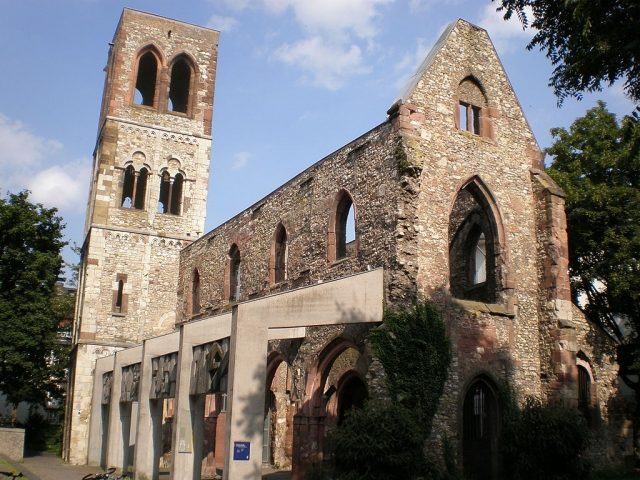
St. Christoph Church in Mainz is an example of early Gothic architecture and a memorial to the consequences of war. Known as the baptismal church of Johannes Gutenberg, it stands today as a ruin, commemorating the destruction of World War II.
History+
The first documented mention of St. Christoph Parish Church dates to 893. In 1140, Pope Innocent II confirmed the patronage of the Imperial Abbey of St. Maximin in Trier. The current structure, apart from the Romanesque tower from around 1240, was built between 1280 and 1330. In the 17th and 18th centuries, the church underwent Baroque alterations and renovations. Petrus Canisius, the first German member of the Jesuit Order, took a vow in 1543 at the rectory of St. Christoph. During World War II, the church was damaged and burned out in bombing raids in 1942 and 1945, causing the vaults to collapse. The surviving outer walls were later secured and fitted with buttresses adorned with a relief by sculptor Heinz Hemrich.
Source: Wikipedia · Licence: CC BY-SA 4.0 · Image: http://en.wikipedia.org/wiki/File:St._Christoph_Mainz.jpg
This description draws on the facts documented in the linked Wikipedia article; Wikipedia content is licensed under CC BY-SA 4.0. Wording and editing: Mobile History.
Location: 50.0019, 8.2721