Church
ChurchSt Davids
St David's Cathedral
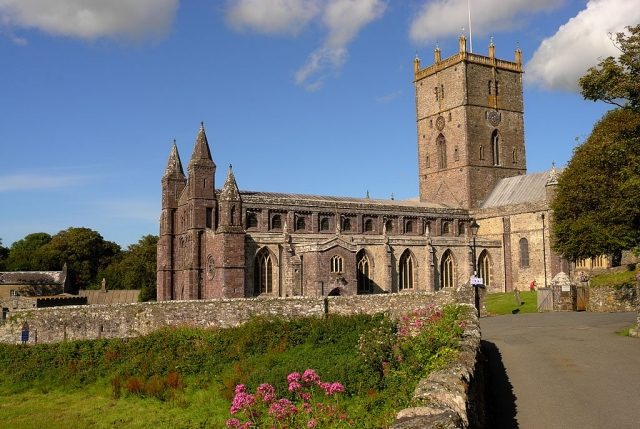
St Davids Cathedral in Pembrokeshire, Wales, is an ecclesiastical building and one of the oldest complexes in Great Britain. Its origins date back to the 6th century when St David founded a monastery here. Today, it is an active church of Norman architecture.
History+
The cathedral's history begins in the 6th century with the founding of a monastery by St David. The monastic settlement suffered from Viking raids. In 1081, William the Conqueror visited St David's shrine, likely for political reasons. After the death of the last Celtic bishop Wilfrid in 1115, St Davids was subordinated to the Archbishop of Canterbury. In the 12th and 13th centuries, the bishops focused on building the cathedral in the Norman style, making it the last major Norman church in Great Britain, even though Gothic architecture was already flourishing in England. Under Bishop Thomas Bek (from 1280), further buildings such as the Bishop's Palace and the gatehouse were erected. Bishop Henry de Gower (1328–1347) Gothicized the exterior and the ensemble, which was once surrounded by a wall. After his death, the plague, the Reformation, and the English Civil War led to its decline. In the 16th century, structural reinforcements were necessary; the Bishop's Palace fell into disrepair. Only in the late 18th century did restoration efforts begin, led by architects such as John Nash and George Gilbert Scott.
Location+
St Davids Cathedral is located in the city of St Davids in the district of Pembrokeshire (Sir Benfro) in Wales, United Kingdom, at an elevation of approximately 18 m above sea level.
On site+
St Davids Cathedral currently serves as an active church. Access is at the western end of the south side. Inside, the outward-leaning columns of the south aisle are striking, caused by the tower's weight, inadequate foundations, marshy ground, and an earthquake in 1248. Despite later Gothic windows, the nave is unmistakably Norman with six massive arcades and a carved wooden ceiling from the 16th century. The choir houses intricately carved choir stalls with misericords depicting scenes of rural life. In the presbytery, built under Bishop Vaughn, are St David's shrine and Edmund Tudor's sarcophagus. Numerous tombs and effigies of medieval figures can be found in the aisles.
Take Mobile History with you
You are reading this text for free. Premium adds what matters on the road: descriptions read aloud, sites found through your camera, whole regions taken offline.
- Every description, including the ~17,700 Premium sites
- Audio guide: have descriptions read to you on location
- AR finder: see sites through your camera, with distance and bearing
- Unlimited saved sites
14 days free, then from €2.99 a month. Cancel anytime.
Source: Wikipedia · Licence: CC BY-SA 4.0
This description draws on the facts documented in the linked Wikipedia article; Wikipedia content is licensed under CC BY-SA 4.0. Wording and editing: Mobile History.
Location: 51.8820, -5.2684