The church can be visited
ChurchWürzburg
St. Gertraud Church
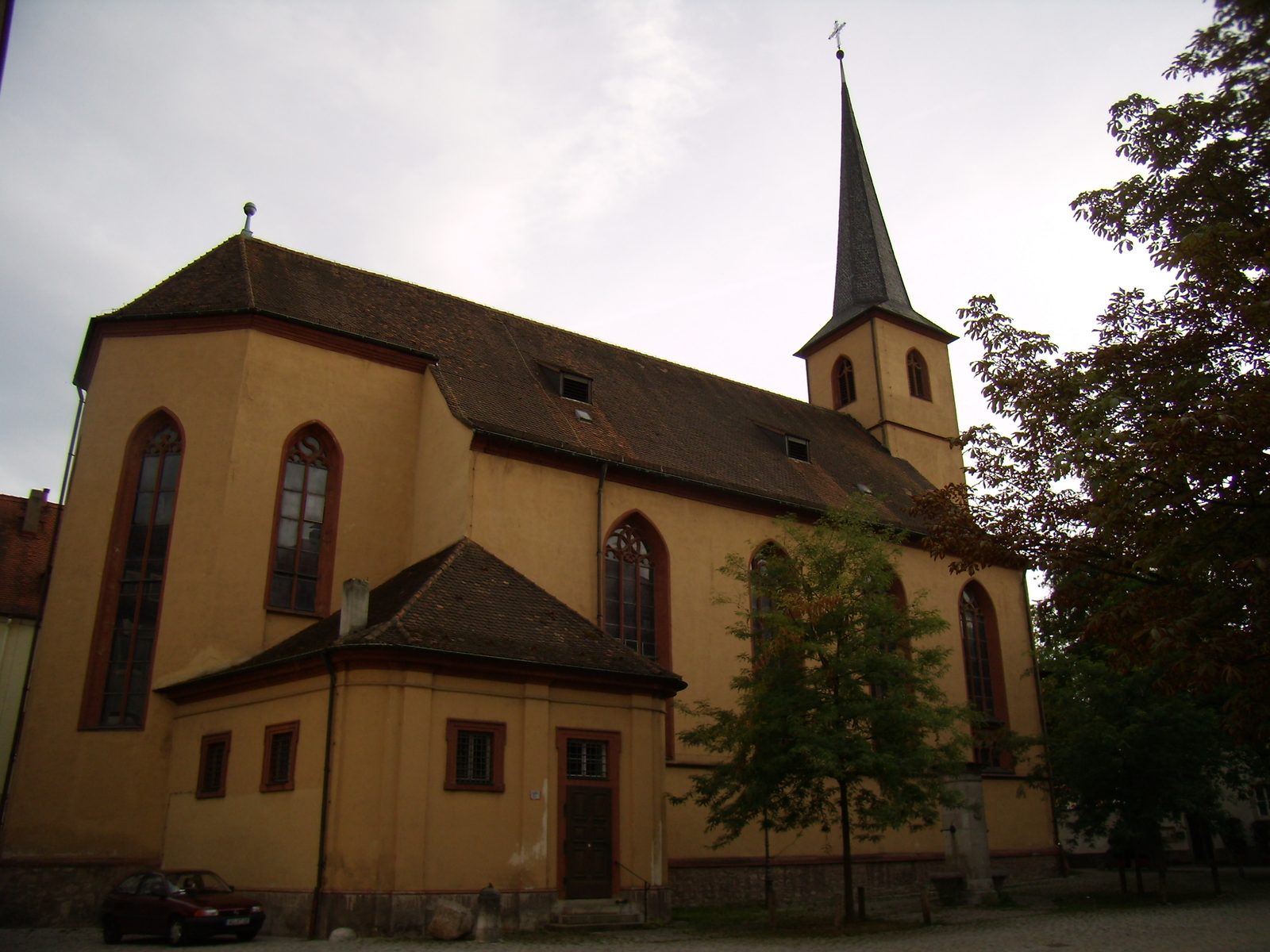
The parish church of St. Gertraud in the old town of Würzburg is located on Pleicherkirchplatz, the central square in the Pleich district (inner) north of Juliuspromenade and west of Juliusspital. It was built in the 12th century.
St. Gertraud was built around 1130 by the bridge, cathedral, and city master builder Enzelin as a proprietary church in the northern suburb of Pleich and elevated to a parish church in 1133 by Bishop Embricho. In 1248, the patronage passed to the St. Markus women's monastery (cf. Adrian of Nicomedia#Memorials), also known as St. Marx monastery, which was assigned to the Dominican Order in 1246. In 1250, the Gothic choir was consecrated. From 1611 to 1613, the church was rebuilt into its present form under Prince-Bishop Julius Echter. Saint Gertrude, abbess of Nivelles Abbey, is the patron saint of the church. Gertrude's extraordinary zeal in caring for the sick, widows, pilgrims, and prisoners made her a special patroness of hospitals, which often bore her name in the Middle Ages. The patronal feast day is March 17.
Description of the Monument+
Building+
St. Gertraud is a hall church with a gabled roof and a recessed 5/8 choir, it has a projecting square west tower with a spire. The height of the tower is around 35 meters. The plastered masonry has sandstone frames and window tracery in the style of so-called Post-Gothic (so-called Echter Gothic or Julius style). The nave has a flat ceiling and four window axes with pointed arch windows. The sacristy is located north of the choir. The church was built in 1612, and after war damage in 1945, it was rebuilt by 1950. The church's furnishings are also listed as a monument.
Mount of Olives+
Outside the church building, on the south-west side, there is a Mount of Olives; it is a single-story lean-to with a basket-arch opening and sandstone figures. They date from the Renaissance and were created by Jörg Riemenschneider in the mid-16th century.
Interior+
Notable artworks include the crucifix by Julius Bausenwein and various tombstones (including the tomb slab for councilor Hans Schiler, also known as Johann Schiller, who died in 1492, and his wife Elisabeth, who died in 1487, around 1485/90, and the epitaph for Kilian Baiß († 1531) presumably by Jörg Riemenschneider). In a small reliquary, remains of the shrine with the "Holy Body" of the martyr Adrianus, which had fallen victim to fire in 1945, were kept from 1978 onwards. The saint's bones – after a turbulent history – were re-enshrined by citizens of Pleich in 1806 and placed in St. Gertraud.
Organ+
The current organ with electric playing and register action was built in 1954 by the company Gustav Weiß & Söhne from Zellingen. It has 32 sounding stops on 3 manuals and pedal. The disposition is:
Couplers: III/II, II/I, III/I, I/P, II/P, III/P Notes:
Bells+
The church has a four-part D major peal with the notes e′, f♯′, g♯′ and h′. It was cast in 1956 by the Schilling company in Heidelberg.
Parish Community+
The church of St. Gertraud belongs to the Würzburg Innenstadt parish community. The community has existed since January 10, 2010. Member parishes, in addition to the parish of St. Gertraud, are the Cathedral Parish (Churches: Cathedral and Neumünster), the Parish of St. Johannes in Stift Haug (Church: St. Johannes in Stift Haug) and the Parish of St. Peter and Paul (Churches: St. Peter and Paul and Hofkirche).
Take Mobile History with you
You are reading this text for free. Premium adds what matters on the road: descriptions read aloud, sites found through your camera, whole regions taken offline.
- Every description, including the ~17,700 Premium sites
- Audio guide: have descriptions read to you on location
- AR finder: see sites through your camera, with distance and bearing
- Unlimited saved sites
14 days free, then from €2.99 a month. Cancel anytime.
Source: Wikipedia · Licence: CC BY-SA 4.0 · Image: Parklife · Wikimedia Commons · CC BY-SA 3.0
This description is a machine translation of an excerpt from the linked Wikipedia article. The source text was written by its authors, the translation is by Mobile History; like the original it is licensed under CC BY-SA 4.0.
Location: 49.7977, 9.9276