Parish Church
ChurchKühbach
St. Magnus Church
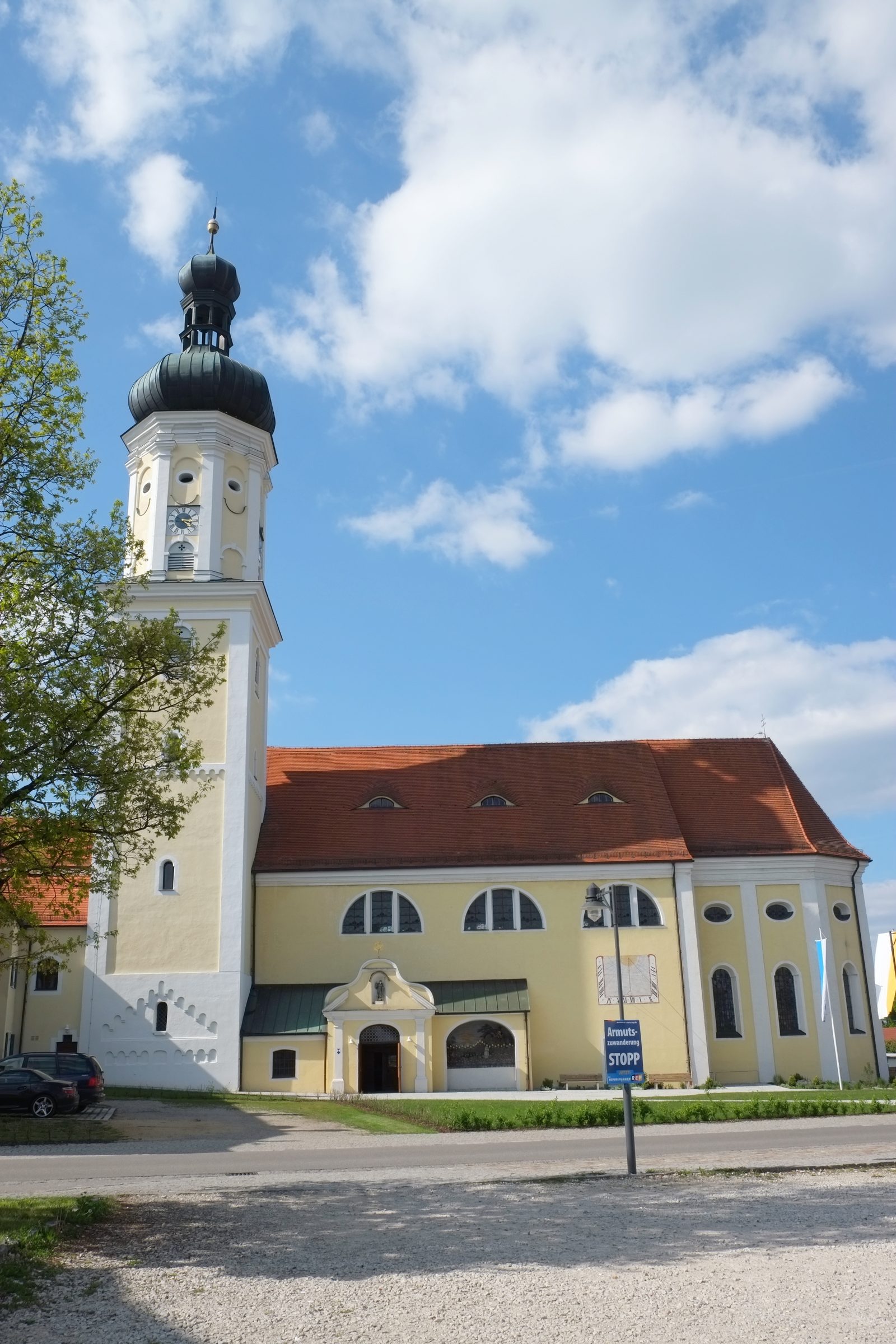
The Catholic parish church and former monastery church of St. Magnus is a listed building in Kühbach.
History+
The former church of Kühbach Monastery was founded and built around 1000. The patronage of Saint Magnus of Füssen is unusual in the area and probably goes back to the founding family. The current lower floors of the tower date from around 1160. After a fire in 1577, the church was rebuilt in Gothic style. The current Baroque building was erected in 1687/88 by Giovanni Androi. Parts of the previous building were used. The church was consecrated in 1689; the tower was raised the following year. The Mount of Olives on the south side was fundamentally restored in 2013.
Architectural Description+
The church is structurally integrated into the east wing of the monastery. The Romanesque substructure of the southwestern tower is decorated with blind arch arcades and a round arch frieze. The octagon is structured by pilasters and provided with an onion dome with a lantern. Next to it is the porch with a Mount of Olives. St. Magnus is a wall-pillar church with three and a half bays under a barrel vault with lunettes and a retracted, three-sided closed choir. The high-set thermal windows in the nave are tripartite. Above the round arch windows in the choir are transversely oval oculi. The nuns' gallery behind the west gallery dates from the 15th/16th century. Below it, to the west, is the so-called founders' crypt from the 15th/16th century, the eastern part with a cross-ribbed vault, the western part was the original cloister. To the northeast, the sacristy with a barrel vault with lunettes from 1613 adjoins the nave, which was extended by one bay to the north in 1687/88.
Furnishings+
The stucco of the church from around 1687/88 comes from the circle of Matthias Schmutzer the Younger. Above the choir arch is the coat of arms of the monastery and of Abbess Maria Helena von Lerchenfeld. The high altar from 1690/93 is by Matthias Bosch, the sculptural works are attributed to Franz Stainhard the Elder. The altarpiece from 1708 by Johann Andreas Wolff shows the glory of Saint Magnus with Saint Teresa of Avila and Saint Scholastica. The Immaculata in the altarpiece from 1690/93 is attributed to Johann Georg Melchior Schmittner. The altars in the eastern chapel from 1693 are by Michael Pusch. On the altarpieces, the Deposition from the Cross is depicted on the left and Saint Francis Xavier in the altarpiece (1708 by Johann Baptist Untersteiner), and the Archangel Raphael on the right; in the altarpiece, Saint Michael (1709 by Heinrich Matthäus Mayer). The figural groups on the altars are from the middle of the 16th century; on the left a Pietà and on the right Anna selbdritt. The altars of the middle chapels from 1690/93 are by Matthias Klinger. The painting on the left (1757 by Ignaz Baldauf) shows the seven refuges. Saint Benno is depicted in the altarpiece. On the right, the death of Saint Benedict and in the altarpiece Saint Anthony of Padua (1712 by Johann Andreas Wolff) can be seen. The figures on the left, by Matthias Klinger, depict Saint Nicholas and Saint Ulrich, those on the right, by Franz Stainhard the Elder, Saint Agnes and Saint Apollonia. In the northwestern chapel is the former high altar from around 1610/20, which was altered in 1713. It contains the miraculous image of the Scapular Confraternity, founded in 1667, which was created around 1713.
The pulpit, around 1690, is by Matthias Klinger. Figures of the Evangelists are found on the basket, and a Salvator mundi on the soundboard.
The painting in the central chapels of Mary with the Annunciation Angel around 1690 is attributed to Johann Heiss. The panel paintings under the west gallery with saints, monastery founders and representatives of the House of Wittelsbach are from the first half of the 16th century. The paintings in the eastern chapels show the Crowning with Thorns and the Flagellation of Christ. They were donated in 1691 and restored in 1709. The depictions of the holy nuns around 1705/10 are by Johann Baptist Untersteiner. In the choir there is a depiction of the Mother of God around 1710. The figure of Saint Sebastian around 1620 on the choir arch comes from the circle of Christoph Murmann the Younger. That of Saint Rochus was created around 1700. The crucifix with Saint Mary Magdalene around 1705/10 is probably by Franz Stainhard the Elder. The frame stucco and the frescoes in the sacristy are from 1613. A cupboard from 1598 has painted doors, which show Saint Benedict and Saint Scholastica on the inside, as well as Otto von Wittelsbach and the abbesses Willibirgis and Barbara Stern, among others. Scenes from the life of Mary are depicted on the outside. On the north wall of the founders' crypt there is a tomb inscription for a Countess Alberat from the 11th century. The red marble baptismal font dates from the end of the 17th century. The Christ on the donkey was created around 1690.
Organ+
In 1854, the church received a new organ from Balthasar Pröbstl from Füssen. This was rebuilt in 1929 by Max Josef Offner from Augsburg and replaced in 1968 by a new building by Max Anton Offner from Kissing. This instrument was last expanded in 2003 by Andreas Offner from Kissing to 29 stops on two manuals and pedal with mechanical playing and stop action. The disposition of the Offner organ from 1968/2003 is as follows:
Couplers: Normal couplers II/I, I/P, II/P Playing aids: Setter system with sequencer
Take Mobile History with you
You are reading this text for free. Premium adds what matters on the road: descriptions read aloud, sites found through your camera, whole regions taken offline.
- Every description, including the ~17,700 Premium sites
- Audio guide: have descriptions read to you on location
- AR finder: see sites through your camera, with distance and bearing
- Unlimited saved sites
14 days free, then from €2.99 a month. Cancel anytime.
Source: Wikipedia · Licence: CC BY-SA 4.0 · Image: Reinhardhauke · Wikimedia Commons · CC BY-SA 3.0
This description is a machine translation of an excerpt from the linked Wikipedia article. The source text was written by its authors, the translation is by Mobile History; like the original it is licensed under CC BY-SA 4.0.
Location: 48.4912, 11.1850