The church can be visited
ChurchStendal
St. Marien Church Stendal
More pictures
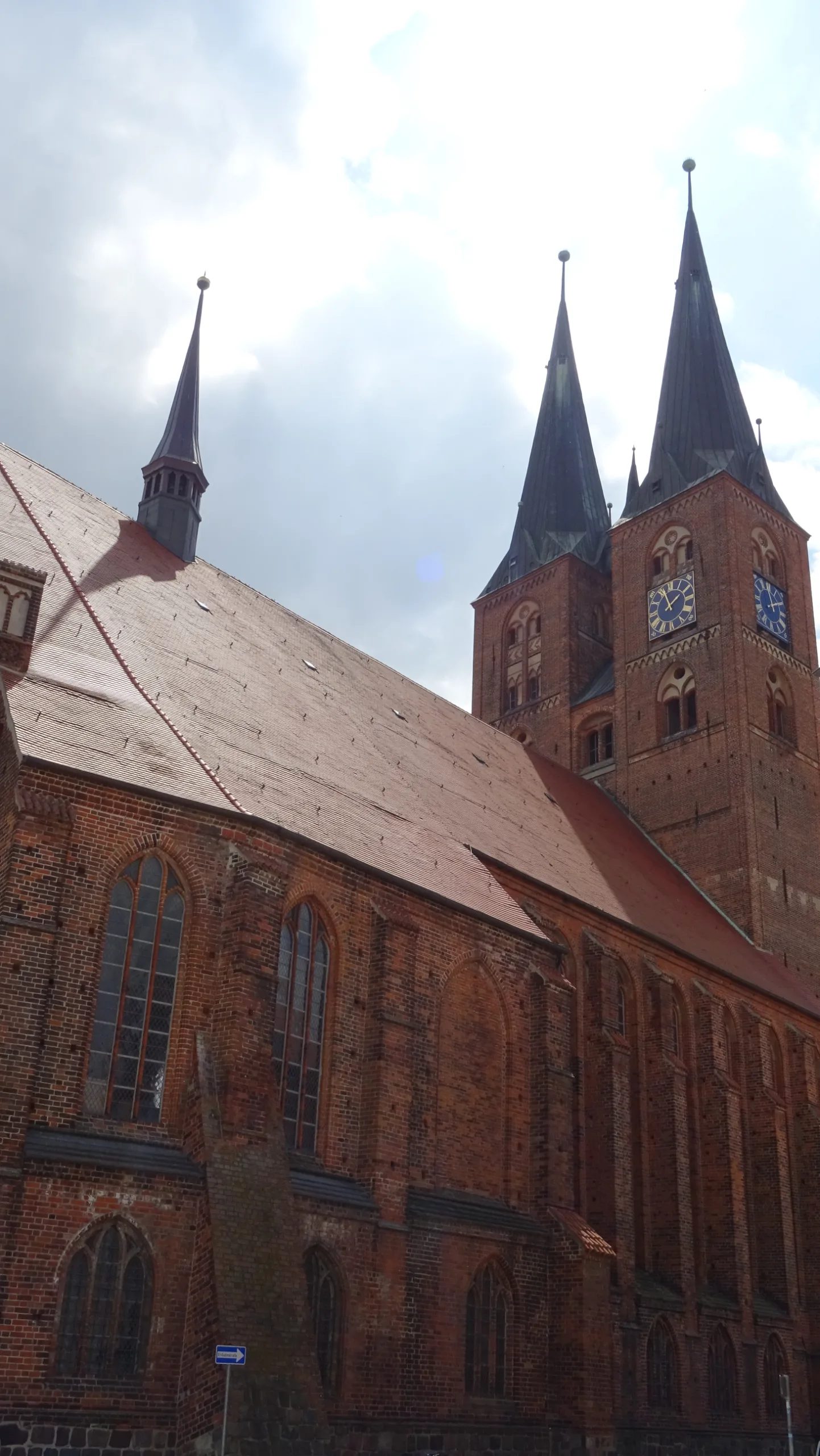
St. Mary's Church is a parish church in the center of Stendal from the Brick Gothic period.
History+
In the 12th century, a Romanesque basilica was built on the site of today's St. Mary's Church, a part of whose furnishings is still preserved today. In the late 14th century, the west building with the double tower facade was extended; the towers were lengthened. In 1420, the new construction of St. Mary's Church as a late Gothic hall church began. A portal porch, called Paradise, was built on the south side. The Romanesque predecessor building was demolished a few years later. By 1447, the church was vaulted. The church consecration took place on August 24, 1447. From 1470 to 1473, the St. Mary's Chapel was built. In 1471, the high altar was installed. After the Reformation, in 1538, it was Justus Jonas the Elder who held the first Protestant sermon in the Mark Brandenburg in St. Mary's Church. In the 16th century, the towers were completed. In 1580, an astronomical clock was installed. St. Mary's Church was the main parish church of the Hanseatic merchants. During the Thirty Years' War, the Hieronymus Altar was abducted, as it was suspected to have been created by Albrecht Dürer. It actually comes from the Dutch painter Jacob Cornelisz van Oostsanen and is now in the Kunsthistorisches Museum Vienna. Around 1725, the Schönebeck'sche Library, which belongs to the Schönebeck'sche Foundation, was housed in St. Mary's Church, in the vault, above the sacristy, in the westwork of St. Mary's Church, where it still exists today. In 1794, the Paradise was demolished and a sandstone relief from 1420 was placed above the portal. From 1834–1844 and 1965–1971, major repair works took place. From 1995, the roof was re-covered with copper, several bells were restored, and the windows were re-glazed.
Location, Architecture and Furnishings+
St. Mary's Church is located in the center of Stendal directly east of the town hall, which in turn borders the market. On the east side is the northern end of Stendal's main shopping street. South of the church is Marienkirchstraße. St. Nicholas Cathedral, which also has two towers, is about one kilometer away. St. Mary's Church is built in the Brick Gothic style. It has two 82-meter-high towers, making them, after St. Stephan in Tangermünde, the second-highest church towers in the Altmark. The two towers are connected by a bridge with a roof turret. There is a second roof turret on the roof. The church is a three-aisled hall church. The side aisles are led around the inner choir as an ambulatory and form the structurally elaborate hall ambulatory choir. The choir is separated from the nave by a rood screen. In front of the rood screen is the lay altar. Numerous chapels adjoin the side aisles. The furnishings include the high altar, the pulpit, the baptismal font, the astronomical clock, the organ, and the bells. From the former basilica, apostle figures in the choir screen from the 13th century and a triumphal cross from the 14th century are preserved.
Altar+
The eight-meter-high high altar, a winged altar, was made in 1470 in the Flemish-Dutch style and installed in St. Mary's Church the following year. On the inside, scenes from the life of Mary and the childhood of Jesus are depicted as carved reliefs in the main shrine and the wings. In the finial, Mary stands in a halo between the holy virgins Catherine of Alexandria and Barbara. When the wings are closed, paintings on the everyday side show the Passion story. On the predella, the legend of Saint Catherine is painted. In 1581, the altar was supplemented by four paintings on canvas that frame the finial.
Pulpit+
The richly decorated pulpit was moved to its current location on the southern first pillar in 1844. The basket from 1566 stands on balusters. Below the parapet is the Bible verse Ps 68:12 in Latin. Below it are paintings created by Andreas Blome in 1571, which show from left to right Moses, John the Baptist, Jesus Christ, the apostles Peter and Paul, and the evangelists Matthew and Mark, some of whom stand in front of Stendal cityscapes. Christ as the Judge of the World holds the globe in his hand, in which the city silhouette of Stendal with the towers of St. Mary's Church in the middle can be seen. The five-sided soundboard bears a temple-like structure.
Baptismal Font+
The baptismal font is one of the Gothic bronze fonts. It was made in Lübeck, installed in the nave in front of the lay altar in 1474, and moved to the St. Mary's Chapel in 1844, which still serves as a baptistery today. It is richly decorated with figures. The eight large figures show Mary and seven other female saints, between them stand eight significantly smaller male saints. The anthropomorphic supporting figures symbolize the four evangelists. The Latin inscription translates to: "In the year of the Lord 1474. Go and baptize in the name of the Father and of the Son and of the Holy Spirit. Amen". Remains of the original and later colored paintings have been preserved.
Astronomical Clock+
The clock belongs to the type of Hanseatic astronomical clocks. It is located below the organ gallery. Its dial is three by three meters and displays a 24-hour day. The large hand makes one revolution in two hours. The positions of the sun and the moon are displayed by models. A star disk, in which an opening indicates the lunar cycle, serves as a counterweight to the models. The inner ring of numbers displays the date. The clock weighs 100 kilograms, the pendulum is 3.25 meters long. The clock must be wound every five days. It is driven by a 65-kilogram weight and a rope pulley. In 1856, the clockwork was rebuilt by the then sub-sacristan and then deliberately destroyed again. In the 1970s, the Stendal master goldsmith Oskar Roever began to restore the clock. On May 14, 1977, it was handed over to the public in working order.
Scherer Organ+
The organ is located on a gallery decorated with a cycle of paintings at the west end of the church. The Rückpositiv with the inscription "1580" was originally on a small organ gallery on the south wall of the nave. It was built by Hans Scherer the Elder in 1580 and at that time had 29 stops on two manuals and pedal. Today it has about 2600 pipes and 38 speaking stops on three manuals, a mechanical action and an electric registration. A fundamental restoration has been sought for several years (as of 2011).
Couplers: I/II, II/III
Bells+
St. Mary's Church in Stendal has twelve bells. The four larger bells form the main peal; the Marienglocke and the Faule Anna were cast by one of the most important bell founders of the Middle Ages, Gerdt van Wou. The Faule Anna gets its name from the fact that it is never heard solo; it only rings in conjunction with the other bells. Bells 5–9 form the choir peal, with the smallest bell, Cantate, to be hung in the future in the roof turret above the crossing, which is yet to be restored. On feast days (Christmas, Easter, Pentecost, church consecration on August 24), the choir peal of five minutes with a short break of one minute is separately preceded by the main peal of bells 1–4. Three bells serve for the clock strike, with the former quarter bell being integrated as a second signal bell into the choir peal, and two bells functioning for the quarter-hour strike in its place. These hang with the medieval hour bell in the roof turret on the bridge between the two west towers. With the help of the specially founded bell association, the peal could be comprehensively renovated and expanded.
(Table:) In the newly built roof turret, a carillon with 24 bells in the tone range c3 to d5 was installed in 2020.
Usage+
St. Mary's Church is the parish church of the Protestant city congregation of Stendal, which was formed in 2000 from a merger of the former Stendal congregations of St. Nicholas Cathedral, St. Mary, St. Peter, Paul, and Borstel. It also formerly served as a council church. Services, as well as organ concerts and other concerts, and occasionally theater performances, take place in the church.
Take Mobile History with you
You are reading this text for free. Premium adds what matters on the road: descriptions read aloud, sites found through your camera, whole regions taken offline.
- Every description, including the ~17,700 Premium sites
- Audio guide: have descriptions read to you on location
- AR finder: see sites through your camera, with distance and bearing
- Unlimited saved sites
14 days free, then from €2.99 a month. Cancel anytime.
Source: Wikipedia · Licence: CC BY-SA 4.0 · Image: Foto: Jörg Heldt (Community)
This description is a machine translation of an excerpt from the linked Wikipedia article. The source text was written by its authors, the translation is by Mobile History; like the original it is licensed under CC BY-SA 4.0.
Location: 52.6056, 11.8606